

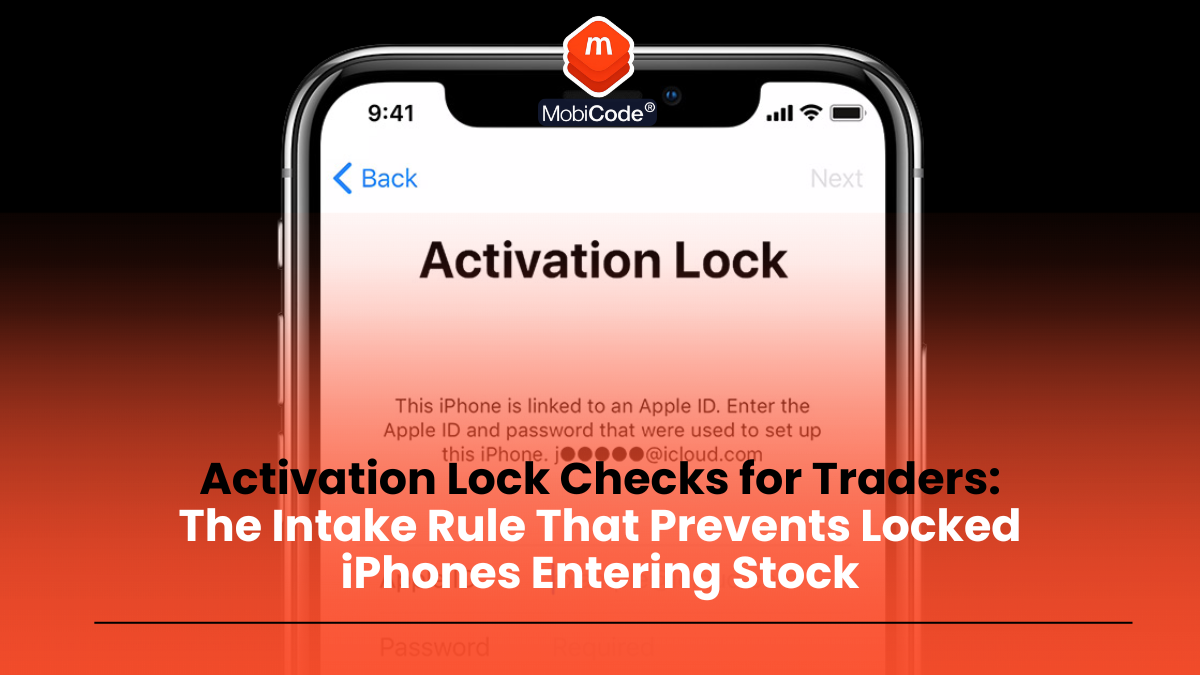
Activation Lock checks are one of the simplest ways to prevent expensive iPhone intake mistakes. When a locked device gets into normal stock, the loss is not just the handset value. It is the wasted labour spent testing, handling, listing and dispute management before someone realises the device is still tied to the previous owner.
This guide gives a practical intake rule for trade and refurb teams: check early, route clearly, and record enough evidence to resolve issues quickly. It also reflects current Apple guidance on how Activation Lock works and what to check before taking ownership of a used device.
Why Activation Lock checks matter operationally
Activation Lock problems are expensive because they are easy to miss if the process is informal. Common failure patterns include:
- Checking too late: the device has already gone through testing or prep
- No clear hold rule: staff are unsure whether to proceed or quarantine
- Poor records: teams cannot show what was checked or when seller follow-up happened
- Confusion with factory reset: a reset is wrongly treated as proof that the device is ready
Apple’s guidance remains clear: devices can still be protected by Activation Lock even after erase/reset scenarios, and used buyers should confirm the device is no longer linked to the previous owner’s account before taking ownership.
What Activation Lock is (in practical terms)
Activation Lock is linked to Apple’s Find My feature. It is designed to prevent someone else from using an iPhone or iPad if it is lost or stolen. In trade workflows, the practical issue is simple: if the device is still linked to the previous owner’s account, it may not be usable or resellable through your normal route.
Apple’s support guidance also advises buyers of used devices to check for Activation Lock before taking ownership, which is exactly why this should be an intake gate for traders too.
The Activation Lock intake workflow (simple and repeatable)
Step 1: Capture identifiers at intake
- Record IMEI and serial as soon as the device arrives.
- Tie the identifiers to one device record immediately.
- Label the device so it cannot be mixed into the wrong batch.
This makes later follow-up and evidence retrieval much easier.
Step 2: Check Activation Lock before testing, wiping or listing
- Do the check at intake, not after bench work starts.
- Record the result and the operator/system that performed the check.
- Use the same rule for all Apple devices and all suppliers.
Apple’s published guidance for used buyers is useful here: if a device is still linked to the previous owner, do not take ownership until it is removed from their account.
Step 3: Apply a strict route rule
- Clear: proceed to the normal workflow
- Locked/flagged: quarantine and request proper removal from the previous owner
- Uncertain: hold and re-check under your policy before any more labour is spent
Step 4: Confirm removal properly before release
If a device is locked, the clean route is for the previous owner to remove it from their Apple Account. Record the follow-up and only release the device into the workflow once the re-check confirms it is clear.
- Record who was contacted and when
- Record when removal was confirmed
- Record the re-check result and timestamp
This prevents the same device from circulating in and out of hold status without a clear outcome.
How MobiCode helps stop locked devices entering normal stock flow
In activation-lock handling, the operational win is speed at the point of contact. MobiCode supports that by making it easier to surface lock issues early and tie the result to the device record straight away.
- Device check workflows at intake: support earlier risk checks and fewer surprises.
See: MobiCode CHECK - Connected intake-to-processing workflow: prevent flagged devices drifting into normal test/wipe queues.
See: MobiONE

The practical gain is consistency: the same rule, the same route outcomes, and the same record quality across the team.
Current factual note (Apple guidance and used devices)
Apple’s current support guidance continues to emphasise checking Activation Lock before buying or taking ownership of used devices, and warns against taking ownership of a device still linked to the previous owner’s Apple Account. That aligns exactly with the intake-control approach in this article.
Common mistakes that cause avoidable losses
- Checking after bench work: labour is wasted before the lock issue is found
- Assuming reset = clear: factory reset does not prove Activation Lock is removed
- No evidence trail: seller follow-up becomes slow and hard to manage
- No quarantine rule: flagged devices drift back into the main workflow
Intake-Control Takeaway
Treat Activation Lock as an intake gate, not a later troubleshooting task. Check early, quarantine consistently, and record the result and follow-up. That is how traders avoid locked iPhones entering stock and wasting time across the workflow.
The lowest-friction Activation Lock workflow
The cheapest time to resolve an iPhone lock issue is when the seller or customer is still in front of you. A strong intake routine is simple: power the device, confirm whether Find My is still active, and if it is, ask the owner to remove the device from their account before the transaction is completed. If they cannot do that there and then, the device should go into a hold queue rather than standard stock.
That single step avoids the classic bad workflow where a locked iPhone gets booked in, tested, labelled and shelved, only for someone else to discover days later that it cannot be resold. The operational win is not just security; it is avoiding labour on stock that should never have entered normal flow.
FAQ: Activation Lock checks for traders
When should we check Activation Lock?
At intake, before testing, wiping or listing. The earlier the check happens, the less wasted labour you risk.
Does a factory reset prove the device is clear?
No. A reset does not necessarily mean Activation Lock has been removed from the previous owner’s account.
What should we record for an audit trail?
IMEI/serial, check result, timestamp, route outcome, and any seller follow-up/re-check notes.