

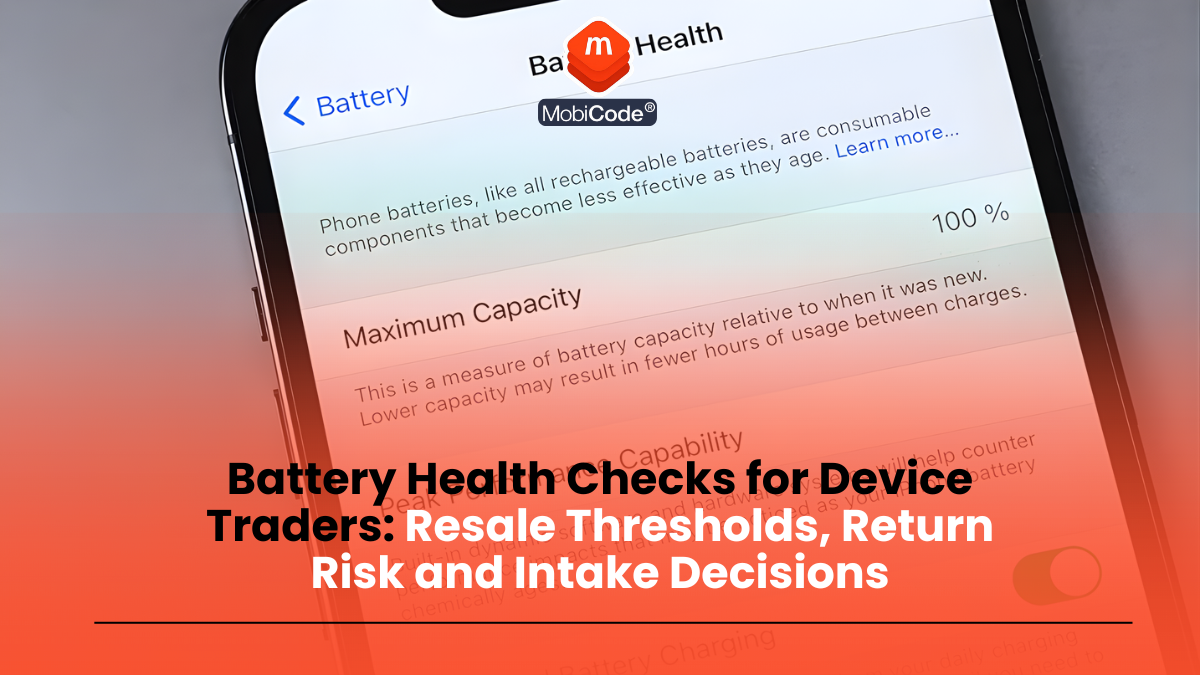
Battery health checks are one of the most commercially important parts of device processing. They affect resale value, return rates, buyer confidence and how much bench time your team should spend on a device. Most battery-related losses do not come from one bad battery. They come from inconsistent thresholds, weak process control and poor disclosure.
This guide sets out a practical battery-health workflow for device traders and refurb teams: check early, apply a written threshold rule, and record the result in a way your team can retrieve later. It also uses current Apple guidance where relevant for iPhone battery health context.
Why battery health is a profit issue (not just a technical detail)
Battery complaints are one of the most common causes of dissatisfaction in device resale. They create returns, support time and pricing disputes, especially when teams check the battery informally or fail to disclose the result clearly.
In real trade workflows, battery condition is one of the fastest ways a device moves from profitable to problematic when the standard is unclear.
- Pricing risk: similar devices get priced inconsistently because thresholds vary by operator
- Return risk: buyer expectations are not set properly
- Bench-time waste: teams process devices further before making the battery decision
- Dispute friction: the team has no record of what it measured and when
Current factual context (Apple battery health guidance)
Apple’s current support guidance states that:
- batteries in iPhone 14 models and earlier are designed to retain 80% capacity at 500 charge cycles under ideal conditions
- batteries in iPhone 15 models are designed to retain 80% capacity at 1000 charge cycles under ideal conditions
That does not mean every device below 80% creates the same commercial case. It does, however, explain why the 80% threshold remains a widely used benchmark in resale and service conversations.
In practice, many traders see elevated return risk well before that threshold if they do not manage expectations carefully. Devices under 90% battery health often need clearer disclosure on marketplaces, even if they are still technically saleable, because buyer sensitivity often rises before the battery formally drops into replacement territory.
Capacity percentage is not the whole story. An aftermarket battery can sometimes outperform an ageing original one, even if the brand name carries less buyer confidence. The operational decision, then, is not “OEM good, third-party bad”. The real question is whether the device now meets your resale standard, how you disclose the repair, and whether the economics justify replacement rather than routing the unit into parts or recycling.
From a commercial perspective, teams should decide early. If a unit is heading towards battery replacement, make that decision before grading and listing. If replacement is uneconomic, stop adding labour and move the unit into the right secondary route quickly.
What a good battery-health process should do
A strong process is not about perfect prediction. It is about consistent decisions and clear communication.
- Check battery health early enough to influence routing and pricing
- Combine reading + behaviour rather than relying on percentage alone
- Apply a written threshold rule across all staff
- Record the result and decision against the device record
- Disclose appropriately so buyers are not surprised later
The practical battery-health workflow (trade-team version)
Step 1: Capture identifiers and check battery status early
- Record IMEI/serial first and tie it to the device record.
- Check battery health/status before your team spends too much time on cosmetics or listing prep.
- For iPhone, record the battery health reading and any service messages shown.
- For Android and other devices, use a consistent testing or diagnostic method and record the outcome in the format your team uses.
An early battery check prevents wasted labour on devices that need a battery decision before anything else.
Step 2: Test behaviour, not just the number
Battery disputes often stem from behaviour such as drop-offs, shutdowns or overheating rather than from a single percentage. Use a short, repeatable behaviour check.
- Charging behaviour looks normal
- No obvious rapid drain or shutdown behaviour during a short standard test
- No obvious overheating under normal use or charge conditions
A percentage alone can mislead your team if behaviour is poor.
Step 3: Apply a written threshold decision rule
Keep the rule simple and consistent. For example:
- Pass: the device meets your acceptable threshold and behaves normally
- Replace: the device falls below threshold or shows behaviour/service messages that point to a replacement route
- Sell with disclosure: the device is borderline but stable, with clear wording and price alignment

Step 4: Record the result so it is defensible later
- IMEI/serial
- test date/time
- battery reading or diagnostic outcome
- behaviour notes (if relevant)
- decision taken (pass / replace / disclose)
That record saves time when a buyer later says the battery was not as expected.
Step 5: Make disclosure and pricing follow the same rule
Even a good technical process fails commercially if listings and invoices do not reflect the decision.
- Use consistent wording for disclosed battery conditions
- Align the pricing decision to the battery route taken
- Keep the battery disclosure linked to the device record or evidence set
How MobiCode helps teams make battery decisions earlier and more consistently
Battery decisions become easier when teams treat the result as a routing input rather than as an afterthought. MobiCode helps teams attach that battery evidence to the same record they use for testing, pricing and listing.
- Device testing workflows: support repeatable battery-related checks and recording.
See: MobiCode TEST - Connected processing records: keep battery outcomes tied to the device workflow.
See: MobiONE
The commercial benefit is simple: fewer battery-related surprises and faster dispute handling when questions arise.
Common mistakes that hurt profit
- No threshold rule: each operator makes different decisions
- Percentage-only decisions: teams miss behaviour issues
- Checking too late: staff waste time on devices that should be rerouted
- No record: disputes become opinion versus opinion
- Poor disclosure: buyer expectations are not set clearly
Battery Takeaway
Battery health checks protect margin when teams treat them as a routing and disclosure decision, not just a diagnostic reading. Check early, use a written threshold rule, record the outcome, and keep listing and disclosure aligned to the decision.
A battery routing rule that traders can actually use
A practical commercial rule is often simpler than teams think. Devices at 90%+ battery health are usually the easiest to list on buyer-sensitive channels. Units at 80% to 89% often need a clearer pricing decision: either disclose the battery honestly and route them to the right channel, or replace the battery if the margin supports it. Devices below 80% usually fit better in a battery-fault category than in normal resale-ready inventory.
This also lines up with with Apple’s published context for iPhone batteries: iPhone 14 models and earlier are designed to retain around 80% capacity after 500 full charge cycles under ideal conditions, while iPhone 15 models are rated to reach 80% at 1,000 cycles. That does not make every phone at 84% unsellable, but it does mean operators should stop treating battery health as an afterthought. It changes price, route and return probability.
FAQ: battery health checks for device traders
Is 80% always the right threshold?
80% is an important benchmark and widely recognised, but your commercial threshold and disclosure rules should reflect your market, buyer expectations and device route.
Should we rely only on the battery percentage?
No. Use the reading alongside basic behaviour checks. Many returns come from behaviour issues, not just the headline number.
Why record the battery result if we disclose it in the listing?
Because the record helps defend the decision later and keeps your team’s process consistent across staff and sites.