

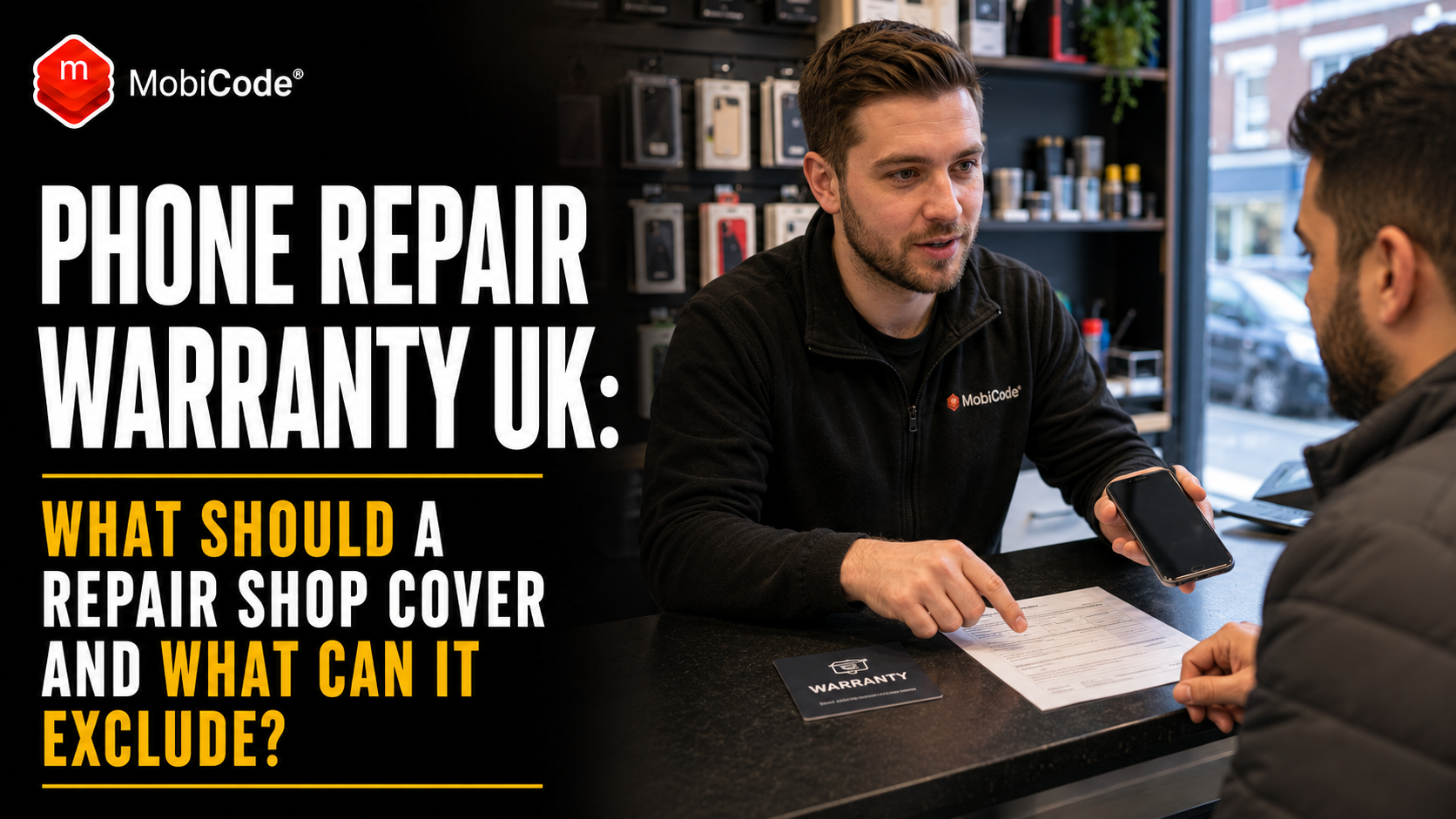
A phone repair warranty should clearly explain what happens if the repaired part or workmanship fails after the customer collects the device. However, a 90-day, six-month or 12-month warranty is not a substitute for the customer’s legal rights under UK consumer law.
For repair shops, that distinction matters. A warranty is an additional commercial promise. Separately, the Consumer Rights Act 2015 requires services supplied to consumers to be carried out with reasonable care and skill.
Therefore, simply writing “30-day warranty only” on a receipt does not automatically remove every responsibility after day 30.
A good warranty policy also protects the repair business. It makes clear that replacing a cracked screen does not create an unlimited guarantee against future drops, liquid damage, battery failure or unrelated faults elsewhere in the phone.
The strongest approach combines clear terms with good evidence. Record the handset’s condition before repair, document the work completed and test the relevant functions afterwards.
This guide explains how UK phone shops can do that.
What is a phone repair warranty?
A phone repair warranty is a promise from the repair business about what it will do if a covered problem develops after the repair.
For example, a screen-replacement warranty might cover a defect in the fitted display or the workmanship used to install it for a stated period.
What could the warranty promise?
Depending on the shop’s policy, a valid claim might result in:
- inspection of the device;
- repeat repair;
- replacement of the defective part;
- another agreed remedy where appropriate.
Importantly, the shop should state the scope clearly. A warranty on a replacement screen is not necessarily a warranty for every component inside the handset.
Does UK law require a 12-month phone repair warranty?
There is no simple rule in the Consumer Rights Act saying that every mobile-phone repair shop must provide a particular commercial warranty period such as 90 days or 12 months.
Instead, UK law sets standards for the service itself.
The service must be performed properly
Under the Consumer Rights Act 2015, consumer services must be carried out with reasonable care and skill.
Where no specific time has been agreed, the service should also be completed within a reasonable time. Likewise, where no price has been agreed, the consumer should pay a reasonable price.
Consequently, a shop should not confuse its own voluntary warranty duration with the full extent of its legal responsibilities.
What happens if a repair was not carried out with reasonable care and skill?
The Consumer Rights Act provides remedies when a consumer service does not meet the required standard.
Repeat performance may come first
Where appropriate, the customer can require the trader to perform the service again so that it conforms to the contract.
The Act says repeat performance must take place within a reasonable time, without significant inconvenience to the consumer, and at the trader’s cost.
A price reduction may sometimes follow
If repeat performance is impossible, or it cannot be completed within a reasonable time and without significant inconvenience, a price reduction may be available.
Depending on the circumstances, that reduction can potentially be up to the full price of the service.
Therefore, a shop should have a clear complaints process rather than automatically rejecting anything that arrives after the printed warranty period.
A warranty does not replace statutory rights
This distinction should be reflected in the shop’s terms and staff training.
A commercial warranty can give customers useful additional protection. However, warranty wording should not suggest that the customer loses rights they have under consumer law.
A risky approach
That type of blanket statement may create problems because it attempts to make a voluntary warranty period look like the complete extent of the customer’s rights.
A clearer approach
Instead, separate:
- the commercial warranty you voluntarily offer;
- the faults covered by that warranty;
- reasonable warranty exclusions;
- the customer’s statutory rights.
Where necessary, businesses should obtain professional legal advice on their actual consumer terms.
How long should a phone repair warranty be?
That is a commercial decision rather than a single universal industry rule.
Repair businesses use different periods depending on the component, quality of parts, supplier warranty and business model.
Look at the wider repair market
Apple, for example, currently guarantees its UK service and replacement parts for 90 days or for the remaining period of the applicable Apple warranty or AppleCare plan, whichever is longer.
That does not mean every independent repair business must copy Apple’s 90-day period.
Nevertheless, large repair providers influence what customers consider a normal professional service.
Choose a period you can genuinely support
Before advertising a warranty, consider:
- supplier warranty on the replacement part;
- expected component reliability;
- repair type;
- average warranty return rate;
- labour cost of repeat repairs;
- how claims are assessed;
- what competitors offer.
A generous headline warranty is not useful if the business routinely argues with customers when they try to use it.
Should different repairs have different warranty terms?
Possibly.
A screen assembly, battery, charging port and microsoldering repair do not necessarily present the same risks.
For example
A shop might decide that its commercial policy treats:
- replacement-screen defects;
- battery defects;
- charging-port workmanship;
- board-level repairs;
- water-damaged devices
differently.
However, any differences should be explained before the customer agrees to the work rather than introduced only after a problem develops.
What should a screen repair warranty cover?
Screen repairs are one of the most common sources of warranty questions.
A reasonable commercial warranty can focus on defects connected with the supplied part or workmanship.
Potential covered problems
Depending on the policy, these could include:
- touch failure caused by the replacement display;
- display lines appearing without new physical damage;
- abnormal screen flickering caused by a defective component;
- a panel separating because of installation workmanship;
- another confirmed defect in the fitted display.
What normally needs separate assessment?
By contrast, a customer returning with a newly smashed screen presents a different situation.
Similarly, impact damage, crushed OLED panels or new liquid ingress are not automatically evidence that the original repair was defective.
That is why documenting the returned device matters.
Does a screen warranty cover another cracked screen?
Normally, a commercial workmanship or parts warranty would not be expected to function as accidental-damage insurance unless the shop specifically promises that cover.
For example, a replacement display could work perfectly for three months before the phone is dropped on concrete.
The new crack does not prove that the first screen replacement was defective.
Do not rely on assumptions
Instead, tell the customer clearly whether accidental damage is excluded.
If you sell additional accidental-damage cover, describe that separately rather than blurring it with the repair warranty.
What about liquid damage after repair?
Liquid damage is another common source of disagreement.
Modern phones may originally be manufactured with a water-resistance rating. However, age, impact damage, previous repairs and opening the device can affect sealing.
Be careful with water-resistance promises
Unless the business has a reliable process for restoring and verifying a particular water-resistance standard, avoid making absolute promises that a repaired phone remains waterproof.
Instead, explain the position before the repair.
For example, customers should understand whether:
- new adhesive will be installed;
- water resistance is tested;
- a particular rating is guaranteed;
- subsequent liquid damage falls within the voluntary warranty.
Battery repair warranties need clear definitions too
A battery warranty is not the same as a promise that battery health will remain at 100% for the entire warranty period.
Batteries are consumable components and naturally degrade as they are charged and used.
Separate defects from normal degradation
A shop should define how it handles issues such as:
- battery not charging;
- unexpected shutdowns;
- swelling;
- incorrect installation;
- abnormally rapid degradation;
- ordinary capacity loss through normal use.
Again, accurate wording matters more than promising a large number of months without explaining what those months actually cover.
What if the customer returns with a completely different fault?
This is where many repair disputes become difficult.
Imagine that a shop replaces an iPhone battery. Eight weeks later, the customer returns because a rear camera has failed.
The phone is still inside the shop’s six-month warranty period.
Does that automatically make the camera repair free?
No. The key question is whether the new problem relates to the original repair or another issue for which the shop is responsible.
The warranty should identify its scope
A battery-replacement warranty could cover the fitted battery and related workmanship rather than every future failure anywhere inside the device.
However, the shop should still investigate a credible allegation that its work caused another component to fail.
Pre-existing faults should be recorded before repair
A cracked screen can make other faults difficult for the customer to notice.
For example, the handset might already have:
- a weak microphone;
- faulty proximity sensor;
- camera focus problem;
- charging issue;
- speaker distortion;
- Bluetooth fault.
If nobody records those problems at intake, the discussion becomes much harder afterwards.
“It worked before” is difficult to resolve without evidence
The customer may genuinely believe the technician caused the problem.
Meanwhile, the technician may genuinely believe it was already present.
Without a pre-repair test, neither side has much objective information.
Therefore, good diagnostics can become part of the warranty process rather than simply part of fault finding.
Test the phone before the repair
Where the condition of the handset allows it, perform relevant checks before opening the device.
A pre-repair test might include
- physical buttons;
- display;
- touchscreen;
- speakers;
- microphones;
- cameras;
- proximity sensor;
- accelerometer;
- Wi-Fi;
- Bluetooth;
- USB connectivity.
Of course, some faults make particular tests impossible. A completely dead phone cannot complete the same intake workflow as a device with a cracked but functioning screen.
In that case, record what could and could not be tested.
Then test the handset again afterwards
A completed repair should normally be followed by relevant functional testing.
For example, replacing a display should involve more than checking whether an image appears.
Post-screen-repair checks
Useful tests can include:
- touch across the entire screen;
- multi-touch;
- pixel quality;
- brightness;
- colour;
- front camera;
- proximity sensor;
- speakers and microphones where disturbed during repair.
Consequently, the shop can catch a defective part before the customer discovers it at home.
How MobiTEST can support repair warranty evidence
MobiTEST provides guided mobile-device diagnostics for professional businesses.
MobiCode’s current platform covers areas including hardware buttons, display and touchscreen, sound, sensors, USB, Wi-Fi and Bluetooth.
Why guided testing helps
A highly experienced technician may already know every check to perform.
However, consistency becomes harder when:
- several technicians work in the shop;
- new staff are being trained;
- multiple branches follow the same policy;
- the handset returns weeks later;
- a manager needs to review the original job.
Therefore, a repeatable diagnostic process can support both repair quality and later warranty decisions.
A warranty claim should start with inspection, not an argument
When a customer returns, staff should avoid deciding immediately that the claim is either valid or invalid.
Instead, inspect the phone.
Step 1: identify the original job
Confirm:
- device;
- repair date;
- part fitted;
- technician;
- original test results;
- warranty terms supplied.
Step 2: record the customer’s complaint
Use the customer’s actual description rather than rewriting it immediately as your diagnosis.
For example:
“Touch stops responding intermittently near the bottom of the screen.”
That is more useful than entering simply:
“Faulty screen.”
Step 3: inspect the current condition
Look for new:
- impact damage;
- cracks;
- bent housing;
- liquid signs;
- tampering;
- missing parts;
- damage unrelated to the original job.
Step 4: reproduce the fault
Where practical, run the relevant test and compare it with the original record.
Only then should staff decide whether the issue appears to be a warranty claim, unrelated new damage or something requiring further investigation.
What warranty exclusions can make sense?
Commercial warranty terms often contain exclusions. However, exclusions should be specific, clear and reasonable rather than attempts to remove legal responsibility altogether.
Examples that may need separate treatment
Depending on the repair and policy, a shop may distinguish:
- new accidental damage;
- new liquid damage;
- normal battery degradation;
- unrelated component failure;
- subsequent third-party repair;
- deliberate misuse;
- damage arising after the completed repair.
Nevertheless, a label such as “accidental damage” should not be used to dismiss a genuine workmanship defect without investigation.
Be careful with “warranty void if opened” language
Repair businesses naturally need protection against later interference.
If another technician has dismantled the phone and altered the same repair, establishing responsibility may become much harder.
However, the wording should focus on how subsequent work affects the claim rather than pretending every possible statutory right automatically disappears.
Record what changed
When a returned handset has clearly been opened elsewhere, document:
- missing screws;
- different adhesive;
- replacement components;
- damaged connectors;
- signs of further repair.
Evidence produces a stronger decision than simply pointing at a sticker.
Should you warranty customer-supplied parts?
This is another common issue.
A customer may arrive with a screen purchased online and ask the shop to fit it.
The business should decide in advance whether it accepts such work.
Parts and workmanship are different questions
If the shop did not supply the component, it may be unreasonable to promise the same commercial parts warranty it offers on its own stock.
However, the installation service still needs to be carried out with reasonable care and skill.
Therefore, the receipt should clearly distinguish between:
- the customer-supplied component;
- the installation service;
- what the shop can test;
- what commercial warranty, if any, applies.
What if the replacement part itself is defective?
Repair shops need a supplier process as well as a customer warranty process.
If a high percentage of one screen model returns with touch problems, treating each incident as an isolated customer issue hides the real problem.
Track part failure rates
Record:
- part supplier;
- component type;
- model;
- installation date;
- fault;
- warranty outcome.
Over time, this can identify poor batches or suppliers creating unnecessary rework.
Warranty returns are an operating metric
A warranty claim is not merely a customer-service issue. It also contains useful information about repair quality.
Track warranty return rate
For example:
Warranty returns ÷ completed repairs × 100
Then split the result by repair type.
A business might discover that:
- battery repairs return at 1%;
- charging ports return at 2%;
- one particular screen SKU returns at 8%.
That immediately gives management something useful to investigate.
Measure first-time fix rate as well
A good warranty policy deals with problems after repair. A better operational system reduces how often those problems occur.
First-time fix rate measures how many repair jobs are completed successfully without the customer returning for the same underlying issue.
A low first-time fix rate can indicate
- weak diagnostics;
- poor-quality parts;
- incorrect fault identification;
- technician training gaps;
- insufficient post-repair testing.
Therefore, improving diagnostics may reduce warranty cost before the claims process even begins.
Keep photographs for physical-condition disputes
Diagnostic software can show whether functions passed or failed. However, it does not replace photographs of physical damage.
At intake, photographs may help document:
- existing cracks;
- frame damage;
- missing glass;
- camera-lens damage;
- housing dents;
- significant scratches.
Likewise, photograph the returned device if a warranty claim involves new physical damage.
Combined with functional tests, these records create a much clearer device history.
Record the IMEI or serial number against the job
Device identity should also be clear.
A receipt that says only “iPhone screen repair” is weak evidence six months later.
A stronger job record includes
- make;
- model;
- IMEI or serial number where appropriate;
- colour;
- repair performed;
- date;
- part type;
- warranty period;
- test result.
Consequently, the business can confirm that the returning handset is the same device it repaired.
Repair warranty terms should be given before the dispute
Customers should not discover important exclusions only after something goes wrong.
Make the policy accessible through:
- website terms;
- booking confirmation;
- repair authorisation;
- receipt;
- email or digital job record.
Most importantly, explain unusual restrictions before the customer agrees to the repair.
Use plain English
A warranty does not become stronger because it contains more legal language.
For example, customers should be able to understand:
- how long the commercial warranty lasts;
- which repair it applies to;
- what problems are covered;
- what is excluded;
- how to make a claim;
- what happens next.
Clear wording also helps staff apply the policy consistently.
An illustrative repair-warranty structure
The exact wording should be reviewed for the individual business, but a practical policy normally needs several components.
1. Warranty duration
State the commercial warranty period and when it begins.
2. Covered repair
Identify the part and workmanship covered.
3. Remedy
Explain what the business normally does when a valid warranty defect is confirmed.
4. Exclusions
Explain relevant issues such as new accidental damage, liquid ingress or unrelated faults.
5. Inspection process
State that the handset may need to be inspected before a claim is accepted.
6. Statutory rights
Make clear that the commercial warranty does not remove the customer’s applicable legal rights.
Do not promise more than you can prove
Marketing claims can form part of the customer’s expectations.
Therefore, be careful with phrases such as:
- “100% waterproof afterwards”;
- “will work like new”;
- “lifetime warranty on everything”;
- “genuine part” where the part is not genuine;
- “all faults repaired” when only one fault was authorised.
A clear, accurate promise is usually more valuable than a dramatic one that creates disputes later.
What should happen when a valid warranty claim is confirmed?
Once staff establish that the issue falls within the shop’s commercial warranty, the process should be straightforward.
Keep the customer informed
Explain:
- what has failed;
- whether the claim has been accepted;
- what work will be performed;
- the expected timescale;
- whether any customer cost applies.
A valid warranty claim should not feel like the customer has started a second sales negotiation.
What if the warranty claim is rejected?
A rejection should also be evidence-based.
For example, suppose a handset returns with a cracked OLED panel after a screen repair.
Rather than stating simply “physical damage — warranty void”, show the customer what has changed.
Document the decision
The record could include:
- photographs;
- current diagnostic result;
- original condition;
- original repair;
- reason the new issue falls outside the commercial warranty.
That does not guarantee the customer will agree. However, it makes the decision easier to explain and defend.
How MobiONE can help larger repair and refurbishment operations
For businesses that repair phones as part of a wider trade-in or refurbishment process, warranty evidence can sit inside a broader device record.
MobiONE combines device lookup, diagnostics, grading and secure erasure within a centralised processing workflow.
Why that matters at volume
A single shop may be able to search old repair tickets manually.
However, businesses processing hundreds or thousands of devices need consistent information across staff and locations.
A connected workflow can make it easier to review:
- device identity;
- initial checks;
- diagnostic results;
- repair decisions;
- grading;
- later processing history.
The best warranty claim is often the one that never happens
Warranty terms are important. Nevertheless, preventing repeat faults is more profitable than managing them well.
Reduce claims through process
Focus on:
- accurate initial diagnosis;
- reliable part suppliers;
- technician training;
- consistent repair procedures;
- post-repair testing;
- clear customer communication.
Ultimately, a strong warranty should reinforce confidence in the repair rather than compensate for weak quality control.
A practical warranty workflow for UK phone shops
At intake
- Identify the handset.
- Record existing physical damage.
- Record the customer’s reported fault.
- Run available functional tests.
Before repair
- Confirm the diagnosis.
- Agree the price.
- Explain the part being fitted.
- Provide the relevant warranty terms.
After repair
- Retest the affected functions.
- Check nearby functions where appropriate.
- Record the repair result.
- Give the customer their warranty information.
If the phone returns
- Locate the original job.
- Record the new complaint.
- Inspect current physical condition.
- Reproduce the fault.
- Compare against previous test results.
- Make and document the warranty decision.
Commercial takeaway
A good phone repair warranty is not simply a number of months printed on a receipt.
UK repair businesses need to distinguish between their voluntary commercial warranty and the consumer’s statutory rights.
At the same time, shops should protect themselves from being treated as insurers for every fault or accident that happens after a repair.
The solution is clarity.
Define what the repair warranty covers. Explain sensible exclusions. Record the device before work begins. Test the handset afterwards and retain enough evidence to investigate a later claim properly.
Most importantly, use the data generated by warranty returns to improve the business. A recurring screen failure may reveal a supplier problem. Repeat microphone complaints might expose a process issue. A poor first-time fix rate could indicate that diagnosis needs attention.
In that sense, warranty management should not sit separately from quality control.
For professional repair centres, structured tools such as MobiTEST can help turn pre-repair and post-repair testing into a repeatable process rather than relying solely on technician memory.
A practical example: the customer who returns after a screen repair
A customer brings an iPhone into a repair shop with a smashed display.
At intake, staff photograph the damage and run the functions that remain testable. The microphones, cameras, buttons, speakers, Wi-Fi and Bluetooth all pass.
The shop replaces the screen.
Post-repair testing
Afterwards, staff run the relevant tests again.
Touch response, display quality, front camera and proximity sensing all pass. The successful result is recorded against the job.
The customer collects the phone along with the shop’s written repair warranty.
Six weeks later
The customer returns because the bottom of the touchscreen has stopped responding.
No new cracks, impact marks or liquid damage are visible.
Staff reproduce the touch failure and compare the result with the original post-repair test.
The screen passed when fitted but is now failing without obvious new external damage.
Under the shop’s warranty process, the case is therefore treated as a potential defective replacement part. The business replaces the display and claims against its own parts supplier where appropriate.
A different outcome
Imagine instead that the same phone returns with a large impact point and fresh crack across the OLED panel.
The functional failure may be identical, but the evidence is different.
Staff photograph the new damage and explain why a subsequent impact does not fall within the shop’s ordinary parts-and-workmanship warranty.
In both cases, the shop reaches a decision from the device evidence rather than from an argument across the counter.
That is the real value of combining clear warranty terms with proper diagnostics.
Frequently asked questions
How long should a phone repair warranty be in the UK?
There is no single commercial warranty period that every UK phone repair shop must use. A business may choose its own additional warranty terms, but those terms do not remove applicable statutory consumer rights. The service itself must still meet the standards required by consumer law.
Does a repair warranty replace my Consumer Rights Act rights?
No. A voluntary warranty provides additional contractual protection. Services supplied to consumers must still be performed with reasonable care and skill, and relevant statutory remedies may apply when that standard is not met.
Does a phone screen repair warranty cover another cracked screen?
A normal parts-and-workmanship warranty would not usually be intended to insure against new accidental damage unless the business specifically promises that cover. However, shops should inspect the device rather than automatically assuming every screen failure was caused by the customer.
What happens if a phone repair is faulty?
Where a consumer service does not meet the required standard, the Consumer Rights Act can provide a right to repeat performance. Where repeat performance is impossible or cannot be completed within a reasonable time without significant inconvenience, a price reduction may be available.
Can a repair shop exclude liquid damage from its warranty?
A commercial warranty can define the additional cover it provides and may distinguish later liquid or accidental damage from defects in the repaired part or workmanship. However, warranty wording cannot simply remove statutory rights where the original service itself failed to meet the legally required standard.
Should phone shops test devices before repair?
Yes, where the device condition allows it. Pre-repair testing can identify existing faults, while post-repair testing helps confirm that the completed work functions correctly. Together, those records are particularly useful if the handset returns later.
Should a repair warranty cover customer-supplied parts?
That depends on the repair shop’s policy. If the customer supplied the component, the shop may offer different commercial cover for the part itself. However, the installation service must still be carried out to the applicable legal standard.
How can MobiTEST help with repair warranty claims?
MobiTEST provides guided professional diagnostics across functions including hardware, displays, touchscreens, sound, sensors and connectivity. Consistent pre-repair and post-repair test records can help shops investigate whether a later complaint relates to an original fault, the completed repair or a new problem.
References and further reading
- GOV.UK: Consumer Rights Act 2015
- Legislation.gov.uk: Consumer Rights Act 2015
- Business Companion: Supplying services and Consumer Rights Act remedies
- GOV.UK: Implied and statutory rights for goods and services
- Citizens Advice: Complaining about a service
- Citizens Advice: Warranties and guarantees
- Apple UK: Repair Terms and Conditions
- MobiTEST: Professional mobile phone diagnostics
- MobiONE: Mobile device testing and processing workflow