

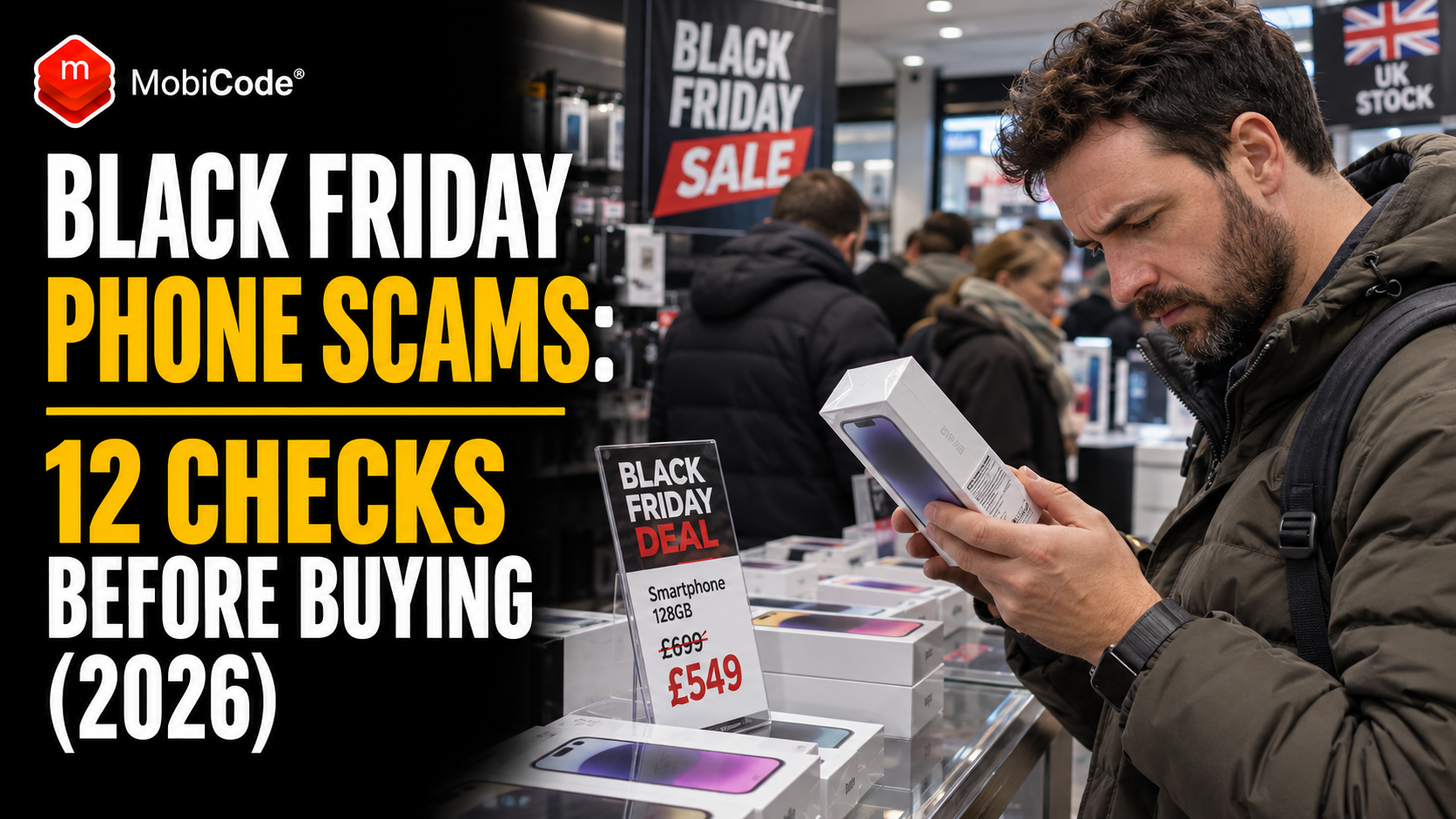
Black Friday phone scams can turn what looks like an incredible iPhone or Samsung deal into an expensive mistake. A refurbished phone might look perfect in photographs, but how do you know whether it is genuine, blacklisted, account-locked or still linked to an insurance or finance agreement?
With Black Friday falling on Friday 27 November 2026 and Cyber Monday following on Monday 30 November, shoppers across the UK are searching for cheaper smartphones.
Many genuine discounts are available. However, the shopping season also brings misleading offers, fraudulent websites, suspicious second-hand listings and devices that are not suitable for resale.
For consumers, the risk may involve losing money or purchasing a phone that cannot be used normally.
For mobile phone retailers, recyclers and trade-in businesses, similar problems can create costly stock losses and customer disputes.
In research published on 4 November 2026, TSB reported that 33% of surveyed UK adults had experienced purchase fraud on social media or second-hand selling platforms. The bank’s customer data also showed an average loss of £354 for reported phone purchase scams during the period examined.
These figures are not specific to Black Friday, but they demonstrate why checking smartphone deals carefully matters.
This guide explains how to avoid Black Friday phone scams, including 12 checks to make before purchasing a used or refurbished smartphone, how to investigate an IMEI and what to do if a deal turns out to be fraudulent.
We’ll also explain how MyMobiCheck helps individual buyers investigate device-status records, while MobiCHECK provides professional IMEI due diligence for retailers and businesses buying phones in larger volumes.
Quick answer: How can you avoid Black Friday phone scams?
Before paying for a discounted smartphone, verify that the seller is legitimate and check the actual device rather than relying on photographs or promotional claims.
Essential checks include:
- Compare the price with genuine recent selling prices.
- Check the seller’s identity, reviews and contact details.
- Confirm whether the handset is new, used or refurbished.
- Ask for the correct IMEI before buying a second-hand device.
- Investigate available blacklist, loss, theft and finance records.
- Check for Apple Activation Lock or Android account restrictions.
- Verify battery condition, repair history and important functions.
- Pay using a method that offers appropriate buyer protection.
- Understand the seller’s return policy and your statutory rights.
Buying a second-hand phone? MyMobiCheck currently advertises an individual IMEI report for £1.50. It can identify relevant recorded device-status risks, but it cannot guarantee that a seller or transaction is genuine.
When are Black Friday and Cyber Monday in 2026?
Black Friday takes place on Friday 27 November 2026.
Cyber Monday falls on Monday 30 November 2026.
However, many UK retailers begin promoting Black Friday discounts earlier in November.
Some also extend promotional campaigns into December, with additional deals appearing during Christmas and Boxing Day.
Consequently, shoppers may encounter phone deals over several weeks rather than on one particular Friday.
Are Black Friday smartphone deals always cheaper?
No.
Some offers represent genuine savings, while others may be less impressive than the advertised discount suggests.
For example, a retailer might promote a smartphone as reduced from £699 to £499.
However, if the phone has regularly sold for around £520 during the previous few months, the real saving is considerably smaller than the headline implies.
Consumer organisation Which? recommends examining price history instead of assuming the advertised original price reflects the usual selling price.
Read Which?’s guide to checking Black Friday discounts.
Why refurbished phones attract attention during Black Friday
Refurbished smartphones can offer a cheaper alternative to the latest flagship models.
For example, a professionally refurbished phone from a previous generation may provide many of the features a buyer needs at a lower price.
However, the term refurbished does not guarantee that every handset has undergone identical testing, received a new battery or had all previous issues resolved.
Buyers need to understand the seller’s actual refurbishment process and the condition of the individual device.
Why Black Friday phone scams are a serious problem
Smartphones are attractive targets for purchase fraud because they can have substantial resale value and are easy to advertise online.
A convincing listing can display professional photographs, detailed specifications and an apparently excellent price.
However, none of those details proves that a genuine handset will arrive.
What does the latest UK fraud research show?
On 4 November 2026, TSB published research into purchase fraud and shopping behaviour ahead of the festive season.
Its polling of 2,000 UK adults found that:
- 33% reported having fallen victim to a purchase scam through social media or second-hand platforms.
- 42% expected to rely more heavily on discounts because of the cost of living.
- 41% were not confident in their ability to distinguish AI-generated product images from genuine photographs.
Separately, the bank’s own 2026 customer fraud records showed an average reported loss of £354 for phone-related purchase scams.
These findings do not mean that one in three Black Friday phone purchases is fraudulent. The survey covers purchase fraud more broadly, while the average phone loss comes from TSB’s reported cases.
Source: TSB’s November 2026 purchase-fraud research.
Why fake smartphone listings can look convincing
Fraudulent advertisements may reuse photographs from legitimate retailers, invent positive reviews or present exaggerated discounts.
Some sellers also apply pressure by claiming the price is available only for a few minutes.
For example, a supposed new iPhone offered at an exceptionally low price may attract attention even when the seller provides little information about ownership or delivery.
Therefore, buyers should investigate the seller and the handset independently.
Black Friday phone scams: 12 checks before buying
The following checklist applies particularly to second-hand and refurbished smartphones, although many steps are also useful when purchasing a new handset.
1. Verify the seller is genuine
Start with the business or individual offering the phone.
For a professional retailer, inspect its website, published contact details, delivery terms and independent customer reviews.
For an individual seller, review the available account history and whether the listing information is consistent.
However, remember that reviews and account profiles can sometimes be manipulated.
Be particularly cautious when a seller asks you to continue the transaction away from a recognised payment process.
2. Check whether the discount is real
Compare the offer against the price of the exact handset elsewhere.
For example, a 128GB device may have a different normal selling price from the 256GB version.
Similarly, a Grade B refurbished phone cannot automatically be compared with a brand-new handset.
Use price-history tools and comparable listings where available.
Don’t assume that a large percentage discount proves a good deal.
3. Confirm whether the phone is new, used or refurbished
These descriptions matter.
A new phone should be described accurately as new.
A used phone may have ordinary wear and previous ownership.
A refurbished phone has typically undergone some degree of checking, restoration or preparation, but the process varies between sellers.
Before buying, ask whether the battery, screen or other components have been replaced.
Also check the stated cosmetic grade and whether the retailer provides a meaningful condition description.
4. Ask for the handset’s IMEI
An IMEI is the identifier used to identify a cellular device.
For a second-hand smartphone, it is one of the most useful pieces of information for investigating device-status records.
On many phones, the current IMEI can be displayed by entering *#06# in the Phone app.
It may also be available in the handset’s settings.
Some dual-SIM or eSIM-capable devices have more than one IMEI, so the relevant identifiers should be checked appropriately.
Where practical, compare the identifier against the actual handset before completing the purchase.
Never rely solely on an IMEI typed into a listing without establishing that it belongs to the phone being sold.
5. Check whether the phone is reported lost, stolen or blacklisted
A smartphone can appear fully functional while carrying an adverse network-status record.
For example, a handset reported lost or stolen may be subject to a mobile-network block.
That could affect its ability to connect to relevant cellular networks.
An IMEI check can help identify records that require investigation before purchase.
MyMobiCheck provides an individual IMEI checking service that searches available blacklist, loss, theft and related device-history records.
However, no IMEI check guarantees that a device’s status will remain unchanged in the future.
6. Investigate outstanding finance or insurance concerns
A phone may be associated with a finance, rental, lease or insurance arrangement.
That does not automatically establish that a sale is unlawful.
However, an unresolved financial or ownership interest can create potential complications for a buyer.
For example, a handset might be offered for sale while another business claims a legitimate interest in it.
Professional device-status services may identify relevant finance or insurance indicators.
Where a warning appears, investigate the actual circumstances rather than assuming the phone is suitable for resale.
7. Check for Apple Activation Lock or Android account restrictions
Network blacklisting and account locking are different problems.
For example, an iPhone may have no recorded network block but still remain linked to another person’s Apple Account.
Apple advises buyers not to purchase an iPhone if Activation Lock remains enabled.
Before accepting a second-hand iPhone, verify that the previous owner has completed the appropriate account-removal process.
For Android devices, relevant Google Account and Factory Reset Protection restrictions may also require attention.
See Apple’s official pre-owned iPhone buying guidance.
8. Examine battery health and previous repairs
Battery condition can influence how long a used smartphone remains practical to use.
For example, a handset may look excellent but contain a heavily worn battery.
On supported iPhones, Battery Health provides information about maximum battery capacity and other relevant indicators.
Additionally, Parts and Service History can display information about recorded component replacements.
However, an indication that a part has been replaced is not automatically proof of poor workmanship.
Use the available information to ask relevant questions about repair history and current functionality.
9. Check the screen, cameras, microphone and charging
Some faults are not visible in sales photographs.
For example, a phone may have a perfect screen while its microphone or charging connection is unreliable.
Before purchasing in person, test the functions you can safely access with the seller’s permission.
For a delivered handset, inspect it promptly and document unexpected problems.
A practical inspection should cover the screen, touchscreen, buttons, cameras, speakers, microphones, charging and relevant wireless connectivity.
Professional refurbishers can use MobiTEST to provide more consistent diagnostic checks before putting phones on sale.
10. Check network compatibility and software support
Not every phone will work equally well with every UK mobile network.
Imported handsets may have different network capabilities or restrictions.
Additionally, older phones may be approaching the end of their manufacturer security-update support.
For example, a low purchase price may be less attractive if the handset has very little remaining supported life.
Check the exact model, network compatibility and security-support information before buying.
Which? highlighted the importance of remaining software support in its November 2026 smartphone-buying guidance.
11. Use an appropriate payment method
Be cautious when a seller insists on bank transfer to an unfamiliar account or asks you to leave an established payment system.
Depending on the transaction, credit-card protections or other payment-provider arrangements may offer additional recourse if something goes wrong.
However, payment protection depends on the circumstances and relevant provider terms.
Never assume that every card or payment service guarantees a refund.
The UK’s Report Fraud service recommends using safer payment methods and taking care with online sellers.
12. Understand your return rights before paying
Black Friday discounts do not remove ordinary UK consumer protections.
When buying from a business, goods must meet the applicable legal standards for satisfactory quality, fitness for purpose and accurate description.
Consumers generally have a 30-day short-term right to reject goods that fail to conform to the contract, subject to the statutory conditions.
For many eligible online purchases, a separate 14-day cancellation period also applies even when the product is not faulty.
However, private sales and other transactions can involve different rights.
See GOV.UK’s returns and refunds guidance.
How to check a second-hand phone’s IMEI before Black Friday
If you’re considering a used smartphone, an IMEI check provides a useful additional layer of due diligence.
It is especially relevant when the handset has a higher price or its ownership history is uncertain.
Step 1: Get the correct IMEI
Ask the seller for the identifier associated with the handset.
Where possible, verify it directly on the device.
For supported handsets, you can usually find the IMEI in Settings or by dialling *#06#.
Step 2: Run a device-status check
Use an appropriate IMEI checking service.
MyMobiCheck currently advertises a £1.50 individual report that examines available device-history records.
It includes relevant blacklist, loss, theft, finance and insurance checks.
The report is sent to the email address associated with the payment process.
Step 3: Investigate any warnings
Review the actual information returned.
A warning does not automatically prove that a particular seller has committed fraud.
However, it may indicate that further investigation is needed before purchasing.
Do not ignore an unresolved block or ownership-related concern simply because the handset is attractively priced.
Step 4: Complete the remaining checks
An IMEI report does not assess every possible risk.
For example, it cannot establish that a website is genuine, that the phone’s battery is healthy or that a private seller will deliver the promised device.
Therefore, combine the report with account-lock checks, appropriate hardware inspection, price research and payment precautions.
Buying a used iPhone or Samsung this Black Friday?
Before committing hundreds of pounds to a second-hand phone, investigate its recorded IMEI history.
MyMobiCheck currently offers a £1.50 individual IMEI report covering available network-block, loss, theft, finance and insurance information.
An IMEI check cannot guarantee a risk-free transaction, but it can help identify recorded concerns that ordinary photographs will not reveal.
Price shown is the advertised individual-check price at the time of writing. Confirm the current charge and service terms before purchasing.
How to spot fake Black Friday phone deals online
Not every scam involves a stolen or blocked handset.
Some fraudsters advertise devices that do not exist.
Others impersonate legitimate retailers or use misleading offers to obtain payment details.
Fake shopping websites
A fraudulent website may copy a familiar retailer’s branding and product images.
For example, it could advertise an unusually cheap smartphone and request immediate payment.
Check the full website address, independent business information and available customer-service details.
Be cautious when a site provides no credible information about the seller or its returns procedure.
Fake social media advertisements
Fraudulent social media advertisements can direct buyers to suspicious shopping pages.
Some use convincing product photography, manufactured reviews or claims about limited stock.
Do not assume an advertisement is legitimate simply because it appears within a familiar social media service.
Counterfeit or misrepresented phones
Some listings may describe a handset as a genuine model when its identity or specifications are questionable.
For example, a phone could display misleading model information or carry an invalid device identifier.
Professional buyers should compare available device details with the physical handset and appropriate IMEI validation data.
Fake delivery messages after placing an order
Criminals also use delivery-themed messages during busy shopping periods.
For example, an SMS may claim that a parcel cannot be delivered until a small additional fee is paid.
Instead of following an unexpected link, check the order through the retailer or courier’s genuine website.
The National Cyber Security Centre provides guidance on recognising and reporting suspicious shopping communications.
Black Friday phone deals: new vs refurbished vs private sale
One of the most important decisions is where to buy the handset.
Each option has different potential advantages and risks.
| Buying option | Potential advantage | What to check |
|---|---|---|
| New phone from a retailer | New device with applicable statutory rights and manufacturer support | True price saving, seller legitimacy, specification and support period |
| Refurbished phone from a retailer | Potentially lower price with professional inspection | Battery, grade, testing, IMEI status, warranty and returns |
| Used phone from a private seller | Potentially attractive individual pricing | Seller identity, device ownership, account locks, IMEI and payment safety |
| Imported phone | Access to additional models or offers | UK compatibility, support, warranty arrangements, network restrictions and taxes |
A refurbished phone is not automatically safer than a privately sold one simply because it is labelled refurbished.
However, an established retailer with documented testing and clearly stated returns procedures may offer greater transparency and practical remedies.
What should phone retailers do before Black Friday 2026?
The same festive shopping period that creates demand for discounted phones can also place additional pressure on trade-in and refurbishment businesses.
For example, a retailer may receive more used handsets from customers upgrading their devices.
Meanwhile, its warehouse may be preparing large quantities of refurbished stock for Christmas delivery.
That makes consistent device checks particularly important.
1. Check IMEIs before paying for trade-ins
A business should investigate the relevant device-status records before accepting a handset.
For example, the phone may carry an existing block or another indicator requiring review.
MobiCHECK provides professional live IMEI due diligence against multiple datasets, including relevant GSMA blacklist information.
2. Validate device identity
Compare the handset’s IMEI, model and specifications with the details supplied by the customer or wholesaler.
For example, a mismatch between the expected and actual model may affect the valuation.
Businesses should document and investigate discrepancies rather than automatically treating them as fraud.
3. Use bulk IMEI checking for seasonal stock
Checking handsets one at a time can become inefficient when volumes rise.
MobiCHECK supports bulk IMEI uploads, helping professional businesses incorporate status checking into larger stock-intake procedures.
For example, a refurbishment centre receiving several hundred handsets may want batch results before releasing devices into its ordinary processing workflow.
4. Consider monitoring devices after purchase
Some device-status records can change after a handset has been acquired.
For example, a phone initially showing no recorded block might later receive an adverse report.
MobiCHECK offers a 30-day device-monitoring option and relevant watchlist capabilities.
However, monitoring cannot guarantee that every subsequent problem will be prevented.
5. Run consistent functional diagnostics
IMEI checks are not hardware tests.
A phone may have no recorded blacklist concern while still having a faulty touchscreen, worn battery or charging problem.
MobiTEST provides guided hardware diagnostics and reporting for professional phone businesses.
For a retailer preparing seasonal stock, consistent testing can help identify devices that need repair or further inspection before sale.
6. Check account-lock and management restrictions
Handsets should not enter ordinary resale stock while unresolved previous-owner account restrictions remain.
For example, an iPhone may require the authorised account holder to remove Activation Lock.
Similar considerations apply to Android account restrictions and organisational management systems.
Network unlocking, factory resetting and IMEI due diligence are not interchangeable processes.
7. Complete appropriate data erasure
Before a previously owned phone is resold, the business should follow appropriate data-protection and sanitisation procedures.
MobiCode’s MobiWIPE supports professional data erasure for compatible devices, with associated certification and reporting.
However, the business remains responsible for selecting a suitable method and investigating failed erasures.
8. Reconcile sold and returned IMEIs
High seasonal sales volumes can produce additional returns and delivery enquiries.
Keep a record of the individual IMEI associated with each transaction.
If a handset is returned, verify that it matches the original device sold.
This helps distinguish the legitimate original unit from a different device that may have been supplied in error or substituted.
How MobiCHECK helps retailers manage Black Friday phone fraud risks
MobiCHECK is MobiCode’s professional IMEI checking and device-status service for businesses handling pre-owned mobile phones.
It is designed to help retailers, wholesalers, recyclers and refurbishment businesses make better-informed purchasing decisions.
Live IMEI checks
MobiCHECK checks device IMEIs against multiple available sources, including GSMA blacklist records.
Results can identify relevant reported loss, theft, network-block, finance or insurance indicators.
This provides a useful extra layer of due diligence when purchasing trade-in stock.
Bulk processing
Professional businesses can submit multiple IMEIs for processing.
For example, a warehouse handling a delivery of used iPhones and Samsung phones may want to check the batch before committing additional refurbishment resources.
30-day monitoring
MobiCode advertises an option to monitor eligible IMEIs for 30 days after an initial check.
This can help identify relevant later status changes.
However, no historical or ongoing check provides a permanent guarantee that the device will remain free from adverse records.
API integration
Businesses operating their own trade-in or buyback platforms may need to integrate checking into existing systems.
MobiCHECK provides API access and integration support for volume traders.
For example, an eligible retailer may want an automated device-status check as part of its trade-in acceptance process.
Device verification and reporting
MobiCHECK provides device-model information and reports linked to the submitted identifiers.
These records can support purchasing decisions and later investigations.
However, the business should still compare those results against the actual handset and its transaction documentation.
Buying used phones for Black Friday and Christmas resale?
Every handset represents money committed to inventory.
MobiCHECK helps retailers and refurbishment businesses investigate available IMEI status information before buying devices and offers relevant monitoring options after purchase.
Professional capabilities include:
- Live IMEI and blacklist due diligence.
- Available loss, theft, finance and insurance indicators.
- Device-model and identifier validation.
- Bulk IMEI processing.
- 30-day monitoring and watchlist capabilities.
- API access and integration support for volume traders.
Talk to MobiCode about your monthly processing volumes, current checks and seasonal stock requirements.
How much could bad phone stock cost a retailer?
During busy shopping periods, a business may focus heavily on purchasing enough inventory to meet demand.
However, buying unsuitable phones can reduce the value of that stock.
An illustrative refurbishment business
Suppose a business acquires 500 used smartphones for an average of £240 each.
Its total inventory acquisition cost would be:
500 × £240 = £120,000
Hypothetical business example.
Now suppose four handsets are ultimately confirmed unsuitable for normal resale and the business cannot recover any value from them.
At the assumed purchase cost, the direct stock loss would be £960.
If the business normally makes £40 contribution per successfully sold device, it would need 24 additional successful sales to offset that direct loss.
This example assumes no recovery, supplier compensation or residual value.
It also does not mean an IMEI checker would necessarily have identified all four devices, because problems may arise from hardware faults or later status changes.
Nevertheless, it illustrates why professional buyers should invest in appropriate due diligence and quality-control procedures.
What should you do if you have already bought a scam phone?
Act promptly if you suspect that a smartphone purchase was fraudulent.
Contact the seller or retailer
If the phone was purchased from a legitimate business, explain the problem and request an appropriate remedy.
For example, a phone that arrives significantly different from its description may breach relevant consumer-law requirements.
Keep the original listing, order confirmation and communications.
Contact your bank or payment provider
If you believe you have paid a fraudulent seller, contact your payment provider promptly.
Explain the transaction and ask about any available fraud, chargeback or other recovery procedures.
The available options depend on how the payment was made and the circumstances.
Report suspected fraud
In England, Wales and Northern Ireland, suspected fraud can be reported through the UK’s Report Fraud service.
For incidents in Scotland, follow Police Scotland’s reporting guidance.
If your payment account or personal information may have been compromised, take appropriate steps to secure your accounts.
Do not attempt to bypass another person’s account lock
If a purchased phone is linked to a previous owner, follow the legitimate manufacturer and ownership-resolution process.
For example, Apple provides official guidance for removing Activation Lock.
Do not assume that paying for an unrelated unlock service will make an improperly transferred handset usable.
Black Friday and Christmas phone-buying checklist
Use this checklist before paying for a second-hand or refurbished smartphone.
The seller and the deal
- ☐ I have checked that the seller appears legitimate.
- ☐ I have compared prices for the exact model and condition.
- ☐ I know whether the device is new, used or refurbished.
- ☐ I understand the relevant delivery and returns terms.
The handset
- ☐ I have obtained and, where practical, verified the IMEI.
- ☐ I have investigated relevant blacklist or device-status records.
- ☐ There are no unresolved previous-owner account restrictions.
- ☐ I have checked the stated battery condition and repair history.
- ☐ I have considered important hardware functions.
- ☐ I have checked network compatibility and software support.
Payment and protection
- ☐ I understand the payment method and applicable protections.
- ☐ I have saved the listing and purchase confirmation.
- ☐ I know how to contact the seller if a problem appears.
Final verdict: a genuine bargain should survive a few checks
Black Friday can be an excellent opportunity to buy a discounted smartphone.
However, a low price alone does not establish that a phone is genuine, usable or suitable for resale.
For consumers, the safest approach combines seller verification, sensible payment methods, an understanding of consumer rights and appropriate device checks.
When buying a used or refurbished handset, an IMEI report can help identify recorded network-block, theft, finance and insurance concerns.
MyMobiCheck offers an individual-check option, while MobiCHECK provides more extensive professional workflows for retailers and device-processing businesses.
For traders, the same principles apply at a larger scale: check stock before purchase, investigate exceptions, complete functional testing and maintain accurate records.
No service can eliminate every shopping scam or guarantee that a phone will never develop a problem.
However, consistent due diligence can help buyers and businesses make better-informed decisions during the Black Friday, Christmas and January sales periods.
Check before you buy with MobiCode
Whether you’re buying one refurbished phone or purchasing hundreds of devices for Christmas resale, device-status information can help you make a better-informed decision.
Buying one phone?
MyMobiCheck offers an individual IMEI report, currently advertised at £1.50, covering relevant recorded device-history information.
Buying or refurbishing phones professionally?
MobiCHECK provides live due diligence, bulk checking, relevant monitoring and API capabilities for trade businesses.
MobiTEST and MobiONE can also support professional device diagnostics and wider refurbishment workflows.
Check device status. Investigate warnings. Buy and trade with better information.
Frequently asked questions about Black Friday phone scams
When is Black Friday 2026 in the UK?
Black Friday falls on Friday 27 November 2026. Cyber Monday is Monday 30 November 2026. Some retailers begin their offers earlier in November and extend them into December.
Are Black Friday iPhone deals safe?
Many Black Friday iPhone offers are genuine. However, buyers should verify the seller, compare actual prices and check the handset’s condition. For second-hand devices, also investigate the IMEI, relevant account restrictions and any available repair information.
How can I tell whether a cheap iPhone is stolen?
You cannot reliably determine that from price or appearance alone. Check the device’s IMEI using an appropriate service, review any reported loss or theft information and verify that the phone is not linked to a previous owner’s account. Even a clear check does not guarantee that no future report will appear.
How much does an IMEI check cost?
MyMobiCheck currently advertises a £1.50 individual IMEI report. Professional MobiCHECK pricing depends on the commercial service and business arrangement. Always confirm the current price before purchasing.
Can an IMEI check detect a fake shopping website?
No. An IMEI check examines available information associated with a device identifier. It cannot establish whether a shopping website is legitimate, confirm that a seller will deliver the phone or protect against every type of payment fraud.
Can a phone become blacklisted after I buy it?
Yes, device-status records can change after purchase. An initial check provides information available at the time of checking, not a permanent guarantee. MobiCHECK offers a 30-day monitoring option for eligible devices to help professional businesses identify relevant changes.
Do I have the right to return a Black Friday phone?
Black Friday purchases from traders remain subject to normal UK consumer law. Faulty or misdescribed goods may qualify for statutory remedies. Many eligible online purchases also have a 14-day cancellation period. Rights differ depending on the circumstances and whether the seller is a business or private individual.
Is buying a refurbished phone a good idea during Black Friday?
It can offer good value, particularly when the phone has useful remaining software support and has been appropriately tested. Compare the actual price, battery condition, repair history, seller reputation and returns arrangements before purchasing.
How can phone retailers reduce Black Friday trade-in risks?
Retailers can check individual IMEIs before purchase, validate device identity, investigate blocklist and ownership warnings, run functional diagnostics and maintain accurate transaction records. MobiCHECK provides bulk due diligence and monitoring options for professional traders.
What is the difference between MobiCHECK and MobiTEST?
MobiCHECK investigates available IMEI and device-status records, including relevant blacklist, loss, theft, finance and insurance information. MobiTEST focuses on guided hardware and functional testing. Professional refurbishers may need both types of checks before resale.
Sources and further reading
Black Friday 2026 and shopping fraud
UK Black Friday and Cyber Monday dates and seasonal shopping guidance.
TSB — Purchase Fraud Research, 4 November 2026
Research into UK shopping scams, social media purchase fraud and reported phone-related losses.
Which? — Five Mistakes to Avoid Buying a Phone This Black Friday
19 November 2026 smartphone-buying guidance, including value, trade-ins and software support.
Which? — How to Check Whether a Black Friday Deal Is Genuine
Consumer advice on discount claims, price history and comparison shopping.
Fraud prevention and consumer rights
National Cyber Security Centre — Shopping and Paying Safely Online
Official guidance on online shopping scams, account protection and suspicious messages.
Official UK police advice about online purchase fraud and safer payment methods.
GOV.UK — Accepting Returns and Giving Refunds
Official guidance on consumer rights for faulty products and applicable cancellation rights.
Apple — Buying a Pre-Owned iPhone
Official guidance covering Activation Lock, hardware condition and repair information.
MobiCode device checking and professional solutions
MyMobiCheck — Individual IMEI Checks
£1.50 individual IMEI reports for available network-block, loss, theft, finance and insurance information.
Professional device due diligence, bulk IMEI checks, monitoring, reports and API support.
Guided smartphone hardware diagnostics, testing workflows and reports.
Wider device checking, testing, grading and data-erasure workflows.
Professional data-erasure software for supported Apple and Android devices.
Commercial enquiries about device checks, diagnostics and refurbishment software.