

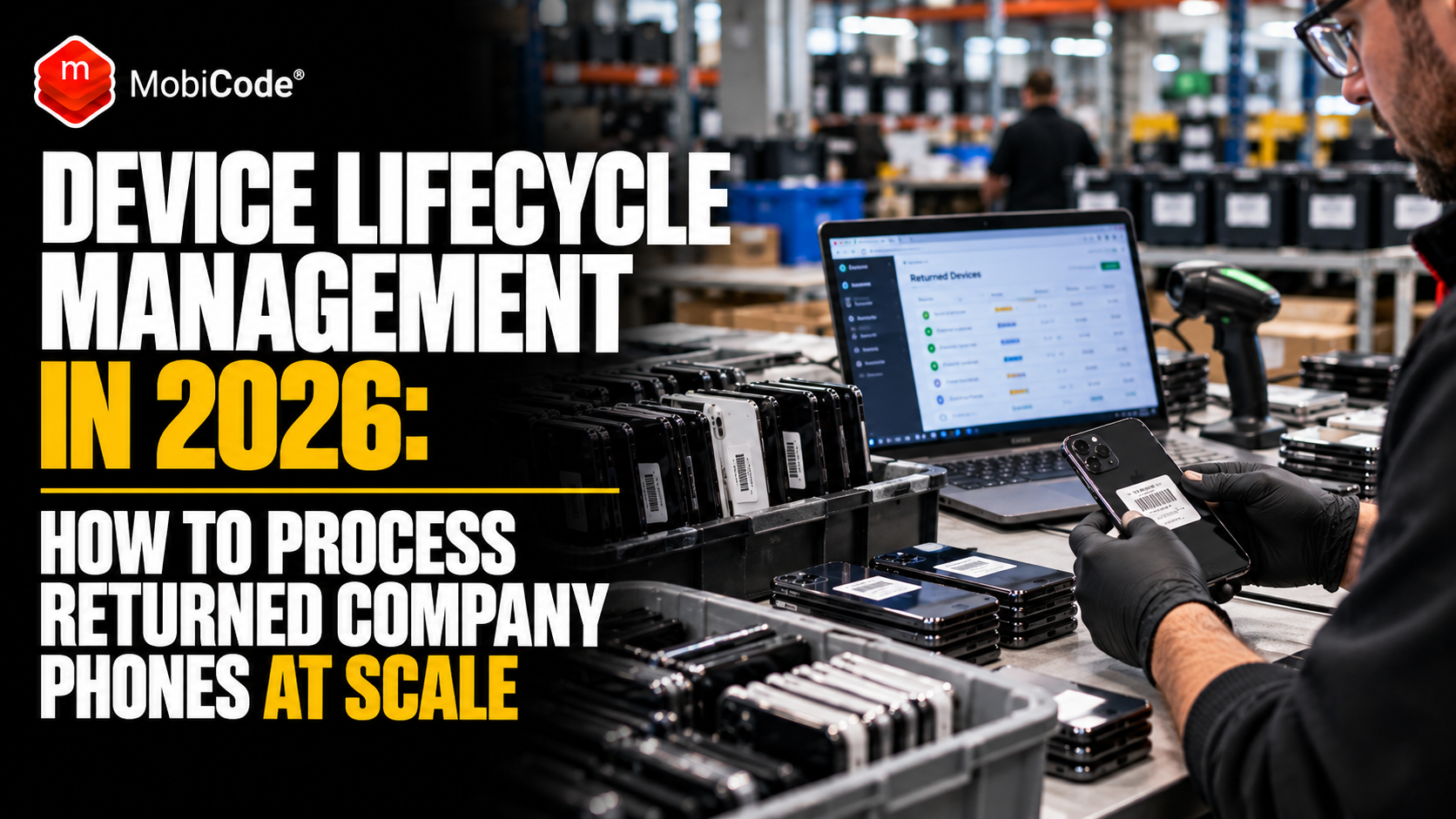
Device lifecycle management is becoming a bigger operational challenge as businesses move from buying employee smartphones outright to leasing, Device-as-a-Service and structured technology refresh programmes. The difficult part is no longer simply getting phones into employees’ hands. It is knowing what to do when hundreds of devices come back.
A returned company phone may need its identity checked, commercial status reviewed, hardware tested, condition graded, data erased and final destination recorded before it can be redeployed, refurbished, resold or recycled.
This guide explains why device lifecycle management is becoming more important in 2026, what an effective return workflow should look like and how MobiONE can help operators, recyclers, refurbishers and enterprise-device businesses process returned smartphones consistently at scale.
The commercial problem
Supplying 1,000 phones is a procurement problem. Getting 1,000 different phones back, understanding their condition and deciding what happens to each one is a device-processing problem.

Why device lifecycle management is a 2026 business issue
Business smartphone ownership is changing.
In June 2026, Vodafone Business launched a new UK Device-as-a-Service offering aimed at mid-sized organisations with 250 to 1,000 employees.
According to Vodafone Business, the service covers smartphones and tablets and combines device provision with lifecycle management through a predictable monthly payment model.
Crucially, the proposition does not end when the employee finishes using the handset.
Vodafone says its service can also cover retrieval, secure data wiping, refurbishment and responsible recycling at the end of the lease.
Therefore, the commercial model increasingly depends on what happens during the second half of the device lifecycle, not just the first.
Device-as-a-Service changes what happens to the phone
Under a traditional purchase model, a company buys a smartphone and may leave replacement decisions to its internal IT team.
Device-as-a-Service creates a more structured lifecycle.
Typically, the device moves through several stages:
- procurement;
- configuration;
- employee deployment;
- support and management;
- collection or return;
- data erasure;
- condition assessment;
- reuse, refurbishment, resale or recycling.
As a result, returned hardware becomes an operational asset rather than simply an old phone in a cupboard.
The better a business processes those returns, the more value it can potentially recover.
The mobile industry is also pushing harder towards circularity
This trend goes beyond corporate leasing.
In August 2026, GSMA Industry Services launched new Circularity Services aimed at helping mobile operators and ecosystem businesses extend device lifecycles, reduce electronic waste and recover greater value from existing assets.
In other words, keeping devices in circulation for longer is becoming both an environmental objective and a commercial opportunity.
However, that opportunity depends on one thing: businesses need to understand the condition and status of the phones they recover.
A returned phone is not automatically resale-ready
Imagine 500 smartphones arriving back from employees at the end of a two-year leasing programme.
They may all be the same original model, but they will not all be the same asset anymore.
One might be almost pristine.
Another may have a damaged camera.
A third may still have an account restriction.
Another could have a weak microphone or damaged display.
Some may be ready for immediate redeployment. Others may justify repair. A smaller number may need parts recovery or recycling.
Therefore, the business cannot simply label the entire batch “returned phones” and treat them identically.
Device lifecycle management starts with identity
Before making any commercial decision, the business needs to know exactly which physical device it is processing.
That generally means linking identifiers such as the IMEI and serial number to the correct asset record.
This sounds basic, yet high-volume operations can quickly create errors when handsets, spreadsheets and labels become separated.
A strong device lifecycle management workflow should therefore establish one reliable record at intake.
From that point onwards, every test result, grade, exception and wipe outcome should stay associated with the correct device.
Why spreadsheets become dangerous at scale
A spreadsheet can work perfectly well for 20 phones.
The problem appears when the organisation is handling thousands.
Staff begin copying identifiers between systems.
One employee changes a status manually. Another forgets.
A phone moves to the repair bench while its digital record remains in the original queue.
Meanwhile, managers struggle to tell which devices have completed testing and which are still waiting for erasure.
Consequently, the issue is not that spreadsheets are inherently bad. It is that they are rarely designed to control a physical device-processing line.
Where MobiONE fits into device lifecycle management
MobiONE is MobiCode’s all-in-one PC-based device-processing application.
MobiCode currently positions MobiONE around four core stages:
- device checking;
- device testing;
- data wiping;
- grading.
Importantly, it also adds configurable Workflow Block Rules.
That means the business can do more than display information to an operator. It can define situations where the workflow should alert the employee or stop the process from continuing.
MobiONE Workflow Blocks turn policy into process
This is where MobiONE becomes particularly relevant to larger operations.
A written policy might say:
However, a policy still relies on the employee noticing the problem and remembering the rule.
MobiONE’s Workflow Block functionality can alert the operator or stop the defined process when relevant conditions appear.
MobiCode lists examples including MobiCHECK results, Find My iPhone status and Samsung Knox-related conditions.
Therefore, the workflow itself can reinforce the business rule.
The goal is fewer expensive decisions made from memory
Human judgement remains important.
However, staff should not need to remember every possible commercial exception while processing devices quickly.
Instead, the system should identify routine problems and draw attention to them.
This leaves experienced operators to make decisions about genuine exceptions rather than spending their time remembering checklists.
Returned smartphones need commercial due diligence too
Device lifecycle management is not only about hardware condition.
Businesses may also need to understand whether a handset has a relevant status issue before it moves into reuse or resale.
MobiCHECK provides MobiCode’s device-status due-diligence layer.
Meanwhile, MobiONE incorporates checking into the wider workflow.
This distinction matters because a smartphone can function perfectly while still requiring investigation for a commercial-status reason.
Two different questions
Device checking: is there a status issue that affects whether we should process or release this handset?
Device diagnostics: does the hardware actually work correctly?
Testing tells you what the returned phone is worth
Once a handset passes the relevant status checks, its functional condition becomes central to the commercial decision.
MobiONE supports guided tests across several areas, including:
- physical buttons;
- LCD and touchscreen;
- pixels and colour;
- speakers;
- microphones;
- supported sensors;
- USB;
- Wi-Fi;
- Bluetooth.
MobiCode says the guided handset-testing workflow can complete in under two minutes.
Moreover, multiple devices can connect simultaneously or independently.
That makes the system particularly relevant when a leasing provider, recycler or refurbishment centre receives large batches at once.
Why processing time matters commercially
Consider an operation receiving 1,000 smartphones from a corporate refresh.
If unnecessary handling adds only two minutes to every handset, the batch absorbs more than 33 additional staff hours.
If that happens repeatedly, small inefficiencies become substantial operating costs.
Therefore, faster device lifecycle management is not simply about convenience.
It influences labour cost, inventory velocity and the speed at which assets can return to productive use.
Grading decides the next commercial route
A working smartphone still needs a condition assessment.
Cosmetic grading can influence:
- resale value;
- refurbishment priority;
- trade buyer demand;
- redeployment decisions;
- whether repair is worthwhile.
However, grading can become inconsistent when each employee interprets terms such as “Excellent”, “Good” or “Grade B” differently.
MobiONE allows businesses to capture custom grading information as part of the device-processing workflow.
Therefore, the organisation can define its own standards and guide operators towards a more consistent result.
Why grading consistency matters more than the grade name
The exact terminology is less important than repeatability.
A business can call its highest condition Grade A, Excellent or Premium.
The important point is that two different employees should reach broadly the same conclusion when assessing the same handset.
Otherwise, inconsistent grading can lead to overvaluation, customer disappointment or unnecessary write-downs.
Secure wiping is part of device lifecycle management
A returned corporate phone may still contain business or personal information.
Consequently, a device should not move into resale or external reuse simply because it passes diagnostics.
MobiWIPE provides MobiCode’s certificated data-erasure capability.
MobiONE incorporates wiping into the wider device-processing workflow so data removal does not need to sit in a disconnected process.
This is particularly relevant to Device-as-a-Service providers, ITAD businesses and corporate refresh programmes where proof of processing may matter to the client.
Vodafone’s new DaaS model shows why this matters
Vodafone’s 2026 Device-as-a-Service announcement is a useful example of how enterprise-device management is evolving.
Its service explicitly covers the lifecycle from procurement through to end-of-lease collection.
Vodafone also highlights secure wiping, refurbishment and responsible recycling at the end of the term.
That reflects a wider shift.
The commercial service is no longer:
It is increasingly:
Consequently, downstream processing becomes part of the customer proposition.
Returned devices should not all follow the same path
Once checking, testing and grading are complete, the business can make a more informed routing decision.
A handset might:
- return directly to service;
- go to another employee;
- receive a minor repair;
- enter refurbishment;
- move into resale inventory;
- be sold to a trade buyer;
- be harvested for parts;
- be recycled responsibly.
The objective is to choose the highest-value appropriate route rather than treating all returned phones as waste.
Circularity only works when businesses know what they have
The GSMA’s 2026 circularity work focuses heavily on extending device life and recovering value from existing assets.
However, a circular strategy cannot rely only on collecting more devices.
Businesses also need to know whether those devices are:
- usable;
- repairable;
- commercially clear;
- securely erased;
- appropriately graded;
- economically worth returning to market.
Therefore, device processing is the operational bridge between collection and reuse.
GSMA says refurbished phones still face a trust gap
This is also important from the customer’s perspective.
In August 2026, the GSMA published research on trust in refurbished smartphones.
It reported that almost half of surveyed consumers would consider a refurbished phone for their next device, yet actual refurbished purchasing remains much lower in most markets.
The GSMA described this as a trust gap.
Better testing and consistent processing do not solve that entire problem, but they provide the operational foundation behind credible quality claims.
Device lifecycle management can reduce avoidable write-offs
Poor workflows can destroy value unnecessarily.
For example, a device may be written off because staff assume it has several faults when only one repairable component has failed.
Alternatively, a phone may receive costly refurbishment work before somebody discovers an activation-lock or status issue.
A better sequence identifies expensive exceptions earlier.
Therefore, the order of operations matters.
A better returned-device workflow
Create the device record
Capture the handset identity and connect it to the correct asset, customer, lease or batch record.
Run due diligence
Identify relevant blocklist, activation-lock or other status exceptions before investing unnecessary processing effort.
Assess functionality
Run the defined hardware, display, sound, sensor and connectivity diagnostics.
Assess condition
Apply the organisation’s agreed cosmetic standard and record the result against the same device.
Choose the highest-value appropriate path
Redeploy, repair, refurbish, resell, harvest for parts or recycle according to the device’s condition and commercial value.
Remove previous-user data
Complete the appropriate data-erasure process before the handset moves into external reuse or resale.
Keep the processing evidence
Retain the relevant checking, testing, grading, erasure and final-route information for later reporting.
Why Workflow Blocks matter in high-volume device lifecycle management
As throughput increases, the business needs to focus employee attention on exceptions.
Routine devices should move efficiently.
Problem devices should stop.
This is where MobiONE’s Workflow Block Rules become commercially useful.
According to MobiCode, the software can alert during a process or prevent the workflow from continuing when defined conditions appear.
Consequently, the organisation can build safeguards into the process rather than relying entirely on staff memory.
Managers also need to see what is happening
Device lifecycle management is not only an operator problem.
Managers need visibility across:
- processing volumes;
- failed devices;
- workflow exceptions;
- staff consistency;
- location performance;
- grading behaviour;
- device status;
- processing progress.
MobiCode says MobiONE’s reporting environment provides visibility across users and locations.
Therefore, management can identify training or consistency problems without needing to stand beside every processing bench.
MobiONE makes device progress visible
The MobiONE PC application uses device tiles to represent connected handsets and their current processing status.
According to MobiCode, those tiles can reflect progress across CHECK, TEST and WIPE stages and highlight issues through visual status changes.
For a busy processing centre, that provides a simple answer to an important question:
Device lifecycle management is ultimately about margin
Sustainability is important, but commercial performance matters too.
Every returned device represents capital.
Poor processing can reduce that value through:
- unnecessary handling;
- incorrect grading;
- missed hardware faults;
- late discovery of status issues;
- avoidable repairs;
- failed or undocumented data erasure;
- devices sitting in processing queues;
- unnecessary recycling of reusable stock.
Therefore, better workflow control can affect both cost and asset recovery.
The most expensive phone may be the one sitting in a queue
Inventory velocity matters.
A returned smartphone cannot generate resale value while it sits waiting to be checked.
Likewise, a corporate redeployment programme gains little from having hundreds of devices waiting weeks for manual processing.
Reducing unnecessary handling can therefore release value sooner.
MobiCode positions MobiONE around faster processing, reduced handling time and increased productivity.
Who should consider MobiONE?
MobiONE is most compelling when a business processes enough devices that consistency becomes an operational problem.
Relevant organisations include:
- mobile recyclers;
- large refurbishment businesses;
- trade-in operators;
- mobile networks;
- Device-as-a-Service providers;
- leasing businesses;
- ITAD providers;
- large retailers;
- corporate device-processing centres;
- organisations managing high-volume handset returns.
When does device lifecycle management software become worth it?
There is no universal device count.
However, the need becomes clearer when several of these problems appear:
- different employees follow different processes;
- devices regularly need rechecking;
- staff copy information between several systems;
- grading varies between employees or sites;
- important status issues are discovered late;
- large batches create processing queues;
- management lacks visibility across locations;
- data-erasure evidence is difficult to retrieve;
- training new operators takes too long;
- the organisation cannot easily explain why a device followed a particular route.
At that point, the business does not simply need another test.
It needs a controlled workflow.
MobiTEST or MobiONE?
The distinction is useful.
MobiTEST is designed around guided diagnostics.
MobiONE goes further by combining checking, testing, grading, wiping and configurable Workflow Blocks within one broader process.
Therefore, a small repair business primarily needing faster diagnostics may start with MobiTEST.
By contrast, an organisation processing large batches of returned devices may gain more from MobiONE’s wider workflow control.
MobiONE versus separate device-processing tools
Separate systems can work.
However, every handoff between systems creates another point where information can be lost or entered incorrectly.
For example:
MobiONE’s proposition is to connect more of those decisions inside one processing environment.
Consequently, the value is not merely having several features on one screen.
It is reducing the number of disconnected decisions surrounding each handset.
Device lifecycle management will matter more as leasing grows
Vodafone’s 2026 DaaS launch is unlikely to be the last move towards managed enterprise-device models.
Businesses increasingly want predictable costs, less internal administration and clearer control over their technology estates.
However, every leased device eventually creates a return event.
That means growth in managed-device models also creates growth in:
- device collection;
- intake;
- testing;
- grading;
- data erasure;
- refurbishment;
- resale;
- recycling.
In other words, the end of one lease is the beginning of another operational workflow.
Commercial takeaway
The value of a returned smartphone depends on how quickly you can decide what it is worth
Device-as-a-Service, corporate refresh programmes and circularity initiatives are putting more used phones back into professional processing channels.
However, collecting a device is only the beginning. Businesses still need to identify it, check it, test it, grade it, erase it and route it correctly.
MobiONE turns those separate tasks into a more consistent device lifecycle management workflow, helping businesses process returned phones with greater speed, control and visibility.
Use MobiONE to control returned-device processing
MobiONE is designed for organisations that have outgrown informal device-processing methods and need a repeatable workflow.
Current MobiONE capabilities include:
- device checking and due diligence;
- guided handset testing;
- screen, sound, sensor, hardware and connectivity diagnostics;
- custom grading;
- secure data-erasure workflow integration;
- configurable Workflow Block Rules;
- blocklist and activation-lock detection;
- multiple simultaneous device connections;
- barcode label printing;
- processing-status visibility;
- reporting across users and locations.
Processing hundreds or thousands of returned phones?
Replace disconnected checks, manual handoffs and inconsistent decisions with a device lifecycle management workflow built around checking, testing, grading, erasure and exception control.
Frequently asked questions about device lifecycle management
What is device lifecycle management for smartphones?
Device lifecycle management covers the stages a smartphone moves through from procurement and deployment to return, checking, testing, data erasure, reuse, refurbishment, resale or recycling.
What happens to phones returned at the end of a business lease?
Returned devices may be checked, tested, graded and securely erased before being redeployed, refurbished, resold or recycled. The appropriate route depends on each handset’s status, condition and residual value.
What is MobiONE?
MobiONE is MobiCode’s all-in-one PC-based device-processing platform. It combines checking, guided testing, grading, data-erasure workflows and configurable Workflow Block Rules to help businesses process pre-owned mobile devices consistently.
Can MobiONE process several phones at once?
Yes. MobiONE supports multiple device connections simultaneously or independently, making it suitable for higher-volume device-processing environments.
What are MobiONE Workflow Blocks?
Workflow Blocks are configurable rules that can alert an operator or prevent a defined process from continuing when certain device conditions or exceptions appear.
What is the difference between MobiTEST and MobiONE?
MobiTEST focuses primarily on guided mobile-device diagnostics. MobiONE extends that capability into a wider device lifecycle management workflow combining checking, testing, grading, workflow controls and data erasure.
Sources and further reading
Vodafone Business — Device-as-a-Service launch, June 2026
UK Device-as-a-Service proposition covering smartphones, tablets and end-to-end device lifecycle management.
GSMA — Circularity Services launch, August 2026
Industry initiative focused on extending device lifecycles, reducing waste and recovering value from existing assets.
GSMA — Closing the Trust Gap in Refurbished Phones, August 2026
Research into consumer interest and confidence in refurbished mobile devices.
MobiCode — MobiONE
Device checking, testing, grading, wiping and configurable workflow controls.
MobiCode — MobiCHECK
Device-status due diligence for professional mobile-device businesses.
MobiCode — MobiWIPE
Certificated mobile data erasure for Apple and Android devices.