

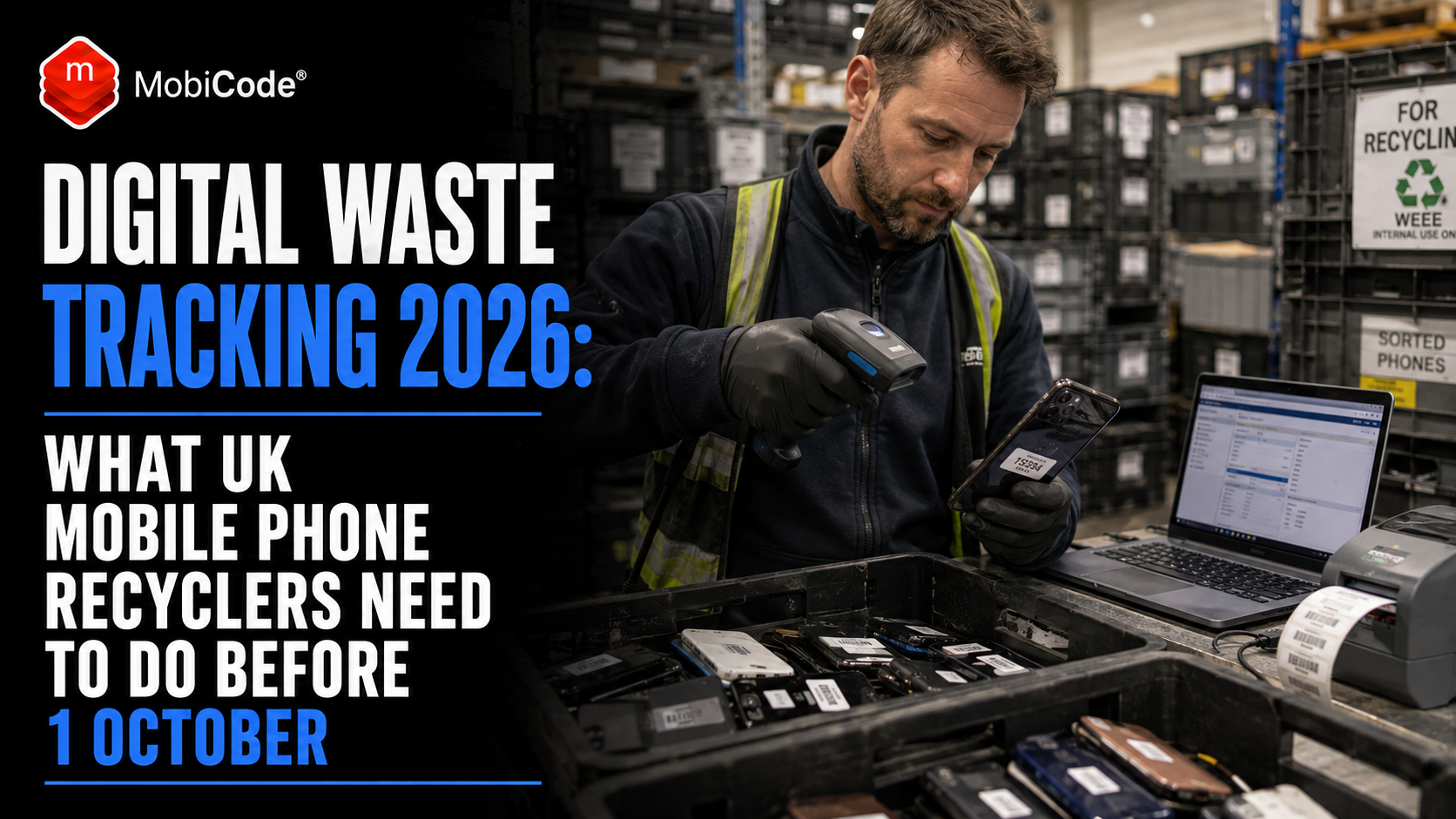
Digital Waste Tracking 2026 reaches its first mandatory deadline on 1 October 2026, when affected licensed or permitted sites receiving controlled waste in England and Wales must start reporting relevant waste receipts through the government’s new digital service.
For mobile phone recyclers, WEEE processors and ITAD businesses, this is more than another administrative change. The new rules increase the importance of knowing what has entered a site, where it came from, how it is classified and what happens to it afterwards.
However, not every business buying second-hand phones automatically falls within the new reporting requirement. A working phone bought as a product for resale is not necessarily waste, while a device received as waste electrical and electronic equipment may sit inside the waste regime.
Therefore, the first job is to understand whether your operation and the material you receive fall within the rules.
The change also exposes a wider operational question. Once a batch of mobile devices arrives, how well can your business trace individual handsets through IMEI checks, testing, repair, grading, secure erasure, reuse and recycling?
Digital Waste Tracking deals with the regulatory waste record. Meanwhile, professional device-processing systems deal with what happens to the individual phones inside that operational flow.
For modern recyclers, both levels matter.
What is Digital Waste Tracking?
Digital Waste Tracking is the UK government’s programme for creating a more consistent digital record of waste movements.
Its aim is to improve visibility across the waste chain, give regulators quicker access to useful information and make suspicious or illegal waste movements harder to hide.
Who is introducing the system?
The programme involves the UK governments and environmental regulators.
For businesses in England and Wales, the most important current guidance is available directly from GOV.UK’s Digital Waste Tracking guidance.
In England, the legal requirement is supported by the Digital Waste Tracking (England) Regulations 2026. Wales has corresponding requirements.
What happens first?
The first mandatory stage concentrates on organisations receiving controlled waste at relevant licensed or permitted sites.
Rather than digitising every part of the waste chain simultaneously, the government is introducing the system in stages.
Consequently, many recycling and treatment businesses are among the first organisations that need to prepare.
Digital Waste Tracking 2026: what changes on 1 October?
For affected waste receiving sites in England and Wales, the mandatory reporting requirement begins on:
1 October 2026.
From that date, licensed or permitted organisations in scope must enter details of relevant controlled waste loads they receive using the government’s reporting service.
The reporting deadline is short
Businesses generally need to submit the required record within two working days, starting on the day after they receive the waste.
For example, GOV.UK explains that waste received on a Monday must normally be successfully reported by 11:59pm on Wednesday, assuming neither day is affected by a bank holiday.
Therefore, Digital Waste Tracking 2026 cannot simply become another monthly administrative task.
Businesses can prepare before October
Organisations do not need to wait until the mandatory date to understand the service.
The government has published implementation information to help waste receivers and software developers prepare in advance.
Further details are available through the Digital Waste Tracking service guidance.
Affected recyclers should use the remaining preparation period to understand the workflow rather than discovering it during a busy October intake.
Who needs to use the new service?
Current government guidance states that organisations licensed or permitted to receive controlled waste must report relevant loads they receive.
Relevant sites can include permitted:
- waste operations;
- installations;
- mobile plants;
- other sites covered by the relevant receiving requirements.
Most household, commercial and industrial waste falls within the broad definition of controlled waste.
Do phone recyclers automatically need to report?
No. This distinction is important.
The fact that your business buys, sells, repairs or refurbishes used phones does not automatically mean every handset entering the premises is waste.
You need to consider both the regulatory status of the site and the status of the material entering it.
Therefore, businesses should review their own permits, exemptions and material flows rather than assuming that using the word “recycler” settles the issue.
When is a used phone actually WEEE?
One of the most important distinctions for the second-hand electronics industry is where a used product ends and waste begins.
A functioning handset transferred for continued reuse can sit in a very different regulatory position from a device that its holder has discarded for recycling or treatment.
Government guidance provides specific tests
The Environment Agency’s guidance on when EEE becomes WEEE explains the factors businesses need to consider.
For equipment to remain EEE for reuse, several conditions may need to apply. These concern issues such as the previous holder’s intention, whether repair is required, whether a genuine reuse market exists and how the equipment is handled.
Separate reuse stock from waste carefully
The guidance also highlights the importance of distinguishing equipment intended for reuse from equipment already treated as waste.
For mobile phone businesses handling several inbound streams, that makes classification and batch separation particularly important.
For example, a corporate reuse programme, customer trade-in batch and WEEE collection should not automatically enter an identical regulatory workflow.
What happens when WEEE is prepared for reuse?
A device that has already become WEEE requires more than a quick visual check before a business can treat it as an ordinary second-hand product again.
Environment Agency guidance explains that WEEE may need to complete an appropriate recovery process and meet the relevant conditions before returning to product status.
Functionality forms part of that decision
For mobile devices, useful assessment can include:
- visual inspection;
- functional testing;
- assessment of repair requirements;
- consideration of relevant hazardous-substance requirements;
- records showing what happened to the individual item.
As a result, structured device testing becomes particularly relevant to phone recycling operations aiming to recover suitable devices for reuse rather than automatically sending everything for material recycling.
What information must waste receivers submit?
The Digital Waste Tracking 2026 requirement goes considerably further than entering the weight of an incoming load.
Government guidance identifies several categories of information that can form part of a receipt record.
Waste movement information
Depending on the movement, businesses may need details relating to:
- the waste received;
- the waste carrier;
- the sender or producer;
- the receiving organisation;
- the waste movement itself.
Classification information
Waste classification codes also matter.
You may see these described as:
- List of Waste codes;
- LoW codes;
- European Waste Catalogue codes;
- EWC codes.
Relevant records can also involve recovery or disposal codes, hazardous-waste information and data concerning persistent organic pollutants.
How quickly must Digital Waste Tracking 2026 data be reported?
The two-working-day deadline is one of the most important operational details to build into the process.
For affected waste received in England or Wales, businesses generally need to submit the record within two working days, starting on the day after receipt.
Submission errors need attention quickly
If the service or connected software identifies a problem, the organisation should correct it promptly.
Current government guidance also sets requirements around correcting discovered errors.
Therefore, accurate data collection at goods-in becomes much more important.
If staff capture poor information when a load arrives, somebody may have to reconstruct the movement later while reporting deadlines are already approaching.
Existing waste records do not disappear immediately
The new digital service does not instantly remove every existing waste-record requirement.
Current GOV.UK guidance says businesses must continue completing relevant existing documents where those rules still apply.
Other reporting can continue during transition
Environmental-permit returns and other relevant waste records may also continue alongside Digital Waste Tracking during the initial implementation period.
Consequently, businesses should not assume that Digital Waste Tracking 2026 immediately replaces their entire existing compliance process.
How can businesses submit information?
The government has been preparing routes for organisations with different levels of software capability.
Software integration
Businesses using suitable commercial systems can investigate how their software provider intends to support the government’s reporting requirements.
Structured uploads
Alternative submission routes are also available for organisations that do not require deeper software integration.
Therefore, recyclers should establish how their existing waste-management process will interact with the new service before October.
Does MobiCode replace Digital Waste Tracking?
No.
This distinction matters.
Digital Waste Tracking is the government’s regulatory system for recording relevant waste receipts and movements.
MobiCode products focus on the individual mobile devices travelling through a commercial processing operation.
The systems answer different questions
For example, the regulatory record may establish that a particular load of WEEE arrived at a permitted facility.
Meanwhile, the device-processing workflow may need to establish:
- which individual phones were inside it;
- their IMEI numbers;
- whether status problems exist;
- whether account locks remain;
- whether the handsets function;
- which repairs they need;
- whether data has been securely erased;
- whether each device is suitable for reuse.
These records relate to each other, but they are not the same thing.
Why device-level traceability becomes more valuable
Waste regulation is moving towards stronger digital traceability.
Mobile-device processing is moving in the same direction.
A recycler increasingly needs to answer not only:
“What batch did we receive?”
but also:
“What happened to this individual handset?”
One device can take several routes
After intake, a phone might be:
- prepared for immediate resale;
- sent for repair;
- tested again;
- used for parts recovery where appropriate;
- securely erased;
- sent to a downstream recycling route.
Therefore, IMEI and serial information can become an important connection between the physical asset and its processing history.
Testing matters when devices are prepared for reuse
Functionality sits at the centre of deciding whether a handset can return to useful service.
A phone may look almost perfect while containing faults that make it unsuitable for resale.
Hidden faults can include:
- failed microphones;
- touchscreen dead zones;
- battery problems;
- camera faults;
- Bluetooth failures;
- charging problems;
- sensor faults.
Consequently, visual grading alone does not establish whether the device functions correctly.
How MobiTEST supports device assessment
MobiTEST helps professional businesses run repeatable mobile-device diagnostics.
MobiCode’s current platform uses guided automated and interactive testing to help teams identify cosmetic and functional faults.
Useful diagnostic areas include:
- display and touchscreen;
- physical controls;
- speakers and microphones;
- sensors;
- charging and USB behaviour;
- Wi-Fi and Bluetooth;
- other relevant device functions.
Consistency becomes more important at scale
An experienced technician may make strong decisions intuitively.
However, a large recycler may operate several processing lines, multiple shifts or different sites.
Guided testing can therefore reduce variation between operators and make results easier to compare.
Run device due diligence before expensive repair
A phone may be technically repairable but commercially unsuitable for resale.
For example, replacing a high-value OLED display makes little sense if the handset has an unresolved status issue that prevents normal resale.
Check commercial risk early
MobiCHECK provides professional IMEI and device-status checking against multiple independent data sources, including relevant GSMA blacklist information.
Depending on available data, checks can provide indicators relating to:
- network blocking;
- lost or stolen status;
- finance;
- insurance;
- device identity.
Consequently, businesses can investigate commercial risk before investing further labour and components in a handset.
Account locks can prevent reuse
A phone can pass every normal hardware test and still be unsuitable for resale.
Apple Activation Lock and Android Factory Reset Protection provide obvious examples.
Functional does not automatically mean reusable
Imagine an iPhone with a perfect screen, strong battery and working cameras.
If the previous owner’s Activation Lock remains, the next customer may not be able to activate the device normally.
Therefore, account-lock checks belong early in a reuse workflow rather than immediately before dispatch.
Data erasure remains a separate responsibility
Waste reporting tells regulators about waste movements.
It does not remove personal information stored on a handset.
That matters because mobile devices can contain highly sensitive information.
Old phones can still contain valuable personal data
Examples include:
- photographs;
- emails;
- messages;
- contacts;
- authentication information;
- browser data;
- business documents;
- account information.
The Information Commissioner’s Office guidance on deleting device data explains why personal information should be removed appropriately before hardware is sold or disposed of.
A dead phone can still present a data risk
A device failing to power on does not automatically mean the information stored inside it has disappeared.
Accordingly, “does not switch on” should not become a substitute for a controlled data-security decision.
How MobiWIPE fits into mobile recycling
MobiWIPE supports certificated mobile data-erasure workflows for professional device processors.
For businesses preparing devices for another user, the important question is not simply whether somebody pressed a reset button.
The organisation may also need evidence showing what happened to the individual handset.
Why erasure evidence matters
A professional record can help with:
- internal audits;
- customer reporting;
- ITAD contracts;
- data-protection processes;
- management oversight.
Consequently, the data-erasure stage becomes a recorded processing event rather than an informal task.
Digital Waste Tracking exposes disconnected systems
Many recycling operations have grown by adding software each time another operational requirement appears.
One system may handle waste records. Another contains IMEIs. A spreadsheet stores grades, while separate applications may handle diagnostics and data erasure.
At low volume, staff can bridge those gaps manually.
At scale, disconnected systems create problems
Common issues include:
- duplicate data entry;
- incorrect IMEIs;
- missing test records;
- devices entering the wrong workflow;
- inconsistent grading;
- unrecorded erasure outcomes;
- difficult audit investigations.
Therefore, Digital Waste Tracking 2026 provides a useful reason to review the wider device-processing architecture as well.
How MobiONE supports the device-processing layer
MobiONE brings several stages of pre-owned mobile-device processing into a more consistent workflow.
The platform brings together device due diligence, guided diagnostics, grading, workflow controls and secure-erasure tools.
MobiONE is not government waste-reporting software
This limitation should remain explicit.
MobiONE does not replace the government’s Digital Waste Tracking service or remove an organisation’s regulatory reporting responsibilities.
Instead, it helps manage device-level processing around the individual phones moving through the operation.
The records complement each other
For example:
Regulatory waste record: a facility received a relevant WEEE load and recorded it through the required process.
Device-processing record: a handset passed due diligence, failed a microphone test, received a repair, passed retesting, completed an appropriate data-erasure process and moved to resale.
Together, those records provide stronger operational visibility.
Multi-site recyclers need consistent rules
A process that works in one warehouse may become inconsistent when a business operates several sites.
Different operators can interpret condition, repair and routing rules differently.
Centralised rules can reduce variation
For example, a recycling business may decide that:
- blocked devices enter quarantine;
- account-locked devices move into an exception workflow;
- battery failures trigger a repair-cost assessment;
- devices passing required tests move to grading;
- staff record successful data processing before resale.
Consequently, similar devices can receive similar decisions regardless of which operator or site handles them.
What should a UK mobile recycler review before October?
The remaining period before mandatory Digital Waste Tracking 2026 reporting should be used deliberately.
1. Confirm whether your sites are in scope
Start by reviewing licences, permits and the types of controlled waste the business receives.
Where the position is uncertain, consult the relevant environmental regulator or obtain suitable specialist advice.
2. Map product and waste flows separately
Next, understand which inbound phones remain functioning EEE for reuse and which arrive as WEEE.
Avoid assuming that every handset follows the same regulatory route.
3. Review waste classification information
Then make sure appropriate staff understand which information must be captured for relevant receipts.
4. Test the reporting process
Finally, use the government’s preparation information rather than leaving implementation until 1 October.
Review your device workflow at the same time
The regulatory deadline also creates an opportunity to examine what happens after the waste receipt enters the system.
Can you identify each valuable handset?
Review whether the device-processing system reliably captures:
- IMEI;
- serial number;
- model;
- storage;
- supplier or batch;
- initial condition.
Can you explain why a device entered reuse?
Where WEEE moves through preparation for reuse, testing and processing records become particularly important.
Therefore, the business should be able to demonstrate more than a final cosmetic grade.
A practical mobile recycling workflow
Stage 1: Regulatory intake
- Determine whether the incoming material is waste.
- Capture the required waste movement information.
- Record relevant classification data.
- Submit required Digital Waste Tracking information within the deadline.
Stage 2: Device identification
- Capture IMEI and serial information.
- Confirm model and storage.
- Link each handset to the correct batch.
Stage 3: Due diligence
- Review relevant device-status information.
- Investigate lost or stolen indicators.
- Identify account-lock issues.
- Flag commercial exceptions.
Stage 4: Functional assessment
- Run appropriate diagnostics.
- Identify repair requirements.
- Decide whether reuse remains practical and commercially viable.
Stage 5: Repair and retest
- Complete approved repairs.
- Retest affected functions.
- Record the final functional result.
Stage 6: Data erasure
- Perform the appropriate data-erasure process.
- Confirm successful completion.
- Retain appropriate evidence.
Stage 7: Final routing
- Grade suitable reusable devices.
- Route compliant phones to resale.
- Send non-reusable material through the appropriate downstream route.
- Maintain the required audit trail.
Which metrics should recycling managers track?
Better records become far more valuable when managers use them to improve operations.
Reuse rate
Measure the proportion of suitable inbound devices that successfully return to use rather than moving directly to material recycling.
Testing failure rate
Identify models, suppliers and intake channels producing the greatest number of functional failures.
Data-erasure success rate
Monitor completed data-erasure processes and exceptions requiring another treatment route.
Processing time
Track how long devices remain between goods-in and their final reuse or recycling decision.
Supplier quality
Compare blocked, locked and faulty-device rates across different suppliers or collection channels.
Consequently, operational data begins influencing purchasing and processing decisions rather than existing only for audits.
Do not treat Digital Waste Tracking 2026 as a data-entry exercise
The easiest response to new regulation is to add another form.
However, that misses the wider opportunity.
Digital Waste Tracking aims to give regulators better and more timely visibility across the waste chain.
Professional recyclers should ask the same question internally.
Can management see what is happening?
Useful operational questions include:
- How many relevant devices entered yesterday?
- What proportion passed diagnostics?
- Which handsets contained account locks?
- How many completed data erasure?
- What number moved into preparation for reuse?
- Which devices entered downstream recycling?
A mature operation should increasingly answer those questions from reliable records rather than estimates.
What happens if an affected business does not comply?
Once the mandatory date arrives, reporting is not simply a voluntary government initiative for organisations within scope.
GOV.UK warns that failure to comply with the new rules can trigger enforcement action.
Potential consequences can be serious
Depending on the circumstances and applicable rules, enforcement action can include compliance requirements, financial penalties or prosecution.
Therefore, the practical objective is to avoid reaching 1 October with an untested process.
Common readiness gaps to avoid
For example, staff should not reach launch day unsure:
- whether a particular load is reportable;
- which information must be collected;
- how the relevant waste should be classified;
- when the reporting deadline expires;
- how the submission process works.
Preparation should become an operational project rather than an October administrative task.
What about Scotland and Northern Ireland?
Digital Waste Tracking is a UK-wide programme, but implementation arrangements are not necessarily identical across all four nations.
Businesses operating nationally should therefore follow the current guidance for each regulator and jurisdiction rather than assuming the England and Wales timetable applies everywhere.
National businesses should monitor current guidance
Implementation guidance may continue to evolve.
Accordingly, businesses should keep checking government and regulator information rather than relying indefinitely on an article published before the system went live.
Commercial takeaway
Digital Waste Tracking 2026 changes the regulatory landscape for many UK recycling operations from 1 October 2026.
For affected licensed and permitted waste receiving sites in England and Wales, relevant controlled waste receipts must enter the new digital reporting process, generally within two working days.
However, mobile recyclers should not view the change only as a waste-record problem.
The individual devices still need their own processing history
An incoming batch can contain valuable individual assets. Some phones may be suitable for reuse, others may require repair, while another group may need a downstream recycling route.
That creates a second layer of traceability beneath the regulatory waste record.
MobiCHECK supports professional device due diligence. MobiTEST supports repeatable functional assessment. MobiWIPE supports certificated data erasure, while MobiONE connects several device-processing stages into a more consistent workflow.
None of these products replaces the government’s Digital Waste Tracking service.
Instead, they address the next question every serious mobile recycler needs to answer:
Once the waste or used-device batch arrives, can you demonstrate what happened to each recoverable handset inside it?
A practical example: 400 smartphones arrive at a recycling facility
A permitted UK mobile recycling facility receives a commercial collection containing 400 smartphones.
Staff capture the required waste-receipt information at goods-in so the business can meet its Digital Waste Tracking obligations where the load falls within the rules.
However, that regulatory entry only describes the incoming movement.
The devices now need individual decisions
Staff identify the handsets and capture available IMEI, serial and model information.
Initial due diligence finds:
- eight devices requiring investigation because of status issues;
- 12 with unresolved account locks;
- 380 available to continue through functional assessment.
Testing separates reusable stock from repair stock
The remaining devices enter a guided diagnostic workflow.
Results show:
- 290 handsets passing the required functional checks;
- 56 with economically repairable faults;
- 34 unsuitable for the intended reuse route.
The repairable phones enter the appropriate technical queue rather than moving automatically to material recycling.
Data follows the appropriate security process
Devices intended for reuse go through the business’s data-erasure workflow.
The organisation links successful evidence to the relevant handset record.
Any exceptions remain on hold rather than entering saleable stock prematurely.
Two levels of traceability now exist
At regulatory level, the business can demonstrate how the incoming waste movement entered the required reporting process.
At device level, it can show which phones underwent due diligence, testing, repair, data erasure and preparation for reuse.
The distinction matters.
One record supports waste compliance. The other supports asset recovery, quality control, data protection and customer confidence.
For a high-volume mobile recycler, both are increasingly part of running a professional operation.
Frequently asked questions
Digital Waste Tracking compliance questions
When does Digital Waste Tracking 2026 become mandatory?
For affected licensed and permitted waste receiving sites in England and Wales, mandatory reporting begins on 1 October 2026.
Do mobile phone recyclers need Digital Waste Tracking?
That depends on the site’s regulatory status and whether the devices being received count as controlled waste. A business purchasing functioning used phones for genuine reuse may sit in a different position from a permitted facility receiving WEEE for treatment.
How quickly must waste receipts be reported?
Current government guidance says affected waste receipts in England and Wales generally need to be submitted within two working days, starting on the day after the waste is received.
What information does Digital Waste Tracking require?
Required information can include waste movement, carrier and receiver details, waste classification codes, recovery or disposal information and relevant hazardous-waste or POPs data. Businesses should review the current official requirements for their own activities and waste streams.
Mobile device processing questions
Does MobiONE submit Digital Waste Tracking records to the government?
No. MobiONE should not be treated as a replacement for the government’s Digital Waste Tracking service. Its role is focused on device-level processing and workflow control around pre-owned mobile devices.
Why do phone recyclers need device diagnostics?
Diagnostics help determine whether an individual handset functions correctly, requires repair or should follow another processing route. Structured testing becomes especially useful when businesses assess phones for reuse.
Do recycled phones need their data erased?
Mobile devices can contain personal and business information even when they are old or faulty. Organisations handling devices for reuse or disposal should use an appropriate data-erasure or destruction process based on the device and the data risk.
Which MobiCode products are relevant to mobile recyclers?
MobiCHECK supports professional device due diligence. MobiTEST provides guided diagnostics, while MobiWIPE supports certificated mobile data erasure. MobiONE brings several device-processing stages into a more consistent operational workflow.
References and further reading
- GOV.UK — Digital waste tracking: check if you need to report the waste you receive
- GOV.UK — Digital Waste Tracking service
- Environment Agency — When electrical and electronic equipment becomes WEEE
- ICO — Deleting data from computers, mobile phones and other devices
- MobiCode — Mobile phone recycling solutions
- MobiCode — MobiCHECK
- MobiCode — MobiTEST
- MobiCode — MobiWIPE
- MobiCode — MobiONE