

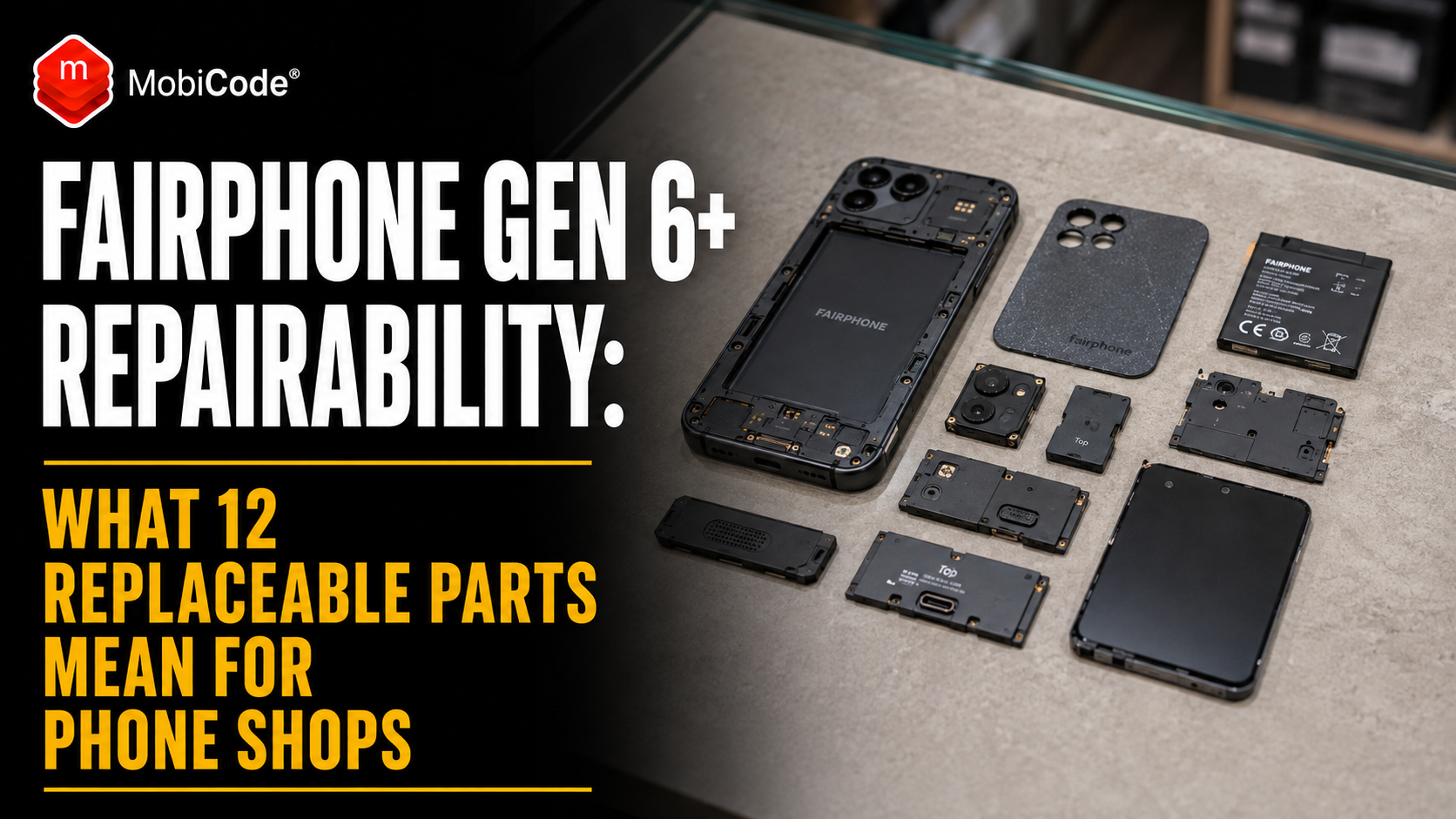
Fairphone launched the Fairphone Gen 6+ on 18 August 2026 with 12 user-replaceable parts, an A repairability class, a five-year warranty and software support through 2033. For repair shops and refurbishers, the bigger story is what happens when owners can replace a battery, display or USB-C port with far less effort.
Easier disassembly does not make professional repair irrelevant. Instead, it moves more of the commercial value towards accurate diagnosis, correct parts identification, consistent post-repair testing, grading, documentation and efficient device processing.
That distinction matters. A technician gains little from changing a component in five minutes if they diagnosed the wrong fault or failed to check the rest of the handset afterwards.
What happened with the Fairphone Gen 6+?
Fairphone announced the Gen 6+ on 18 August 2026. At the same time, the Dutch manufacturer officially expanded its smartphone business into the United States.
The Gen 6+ upgrades the existing Fairphone Gen 6 rather than replacing it with a completely different design. It uses Qualcomm’s Snapdragon 7s Gen 4 platform, increases memory to 12GB of RAM and ships with Android 16.
The repairable design remains the important part
For the repair industry, however, the processor upgrade is arguably the less interesting change. Fairphone has retained the modular construction around which it designed the Gen 6.
According to Fairphone, the Gen 6+ has 12 user-replaceable spare parts. Its official specifications also give the handset an A repairability class.
Fairphone deliberately makes several common repair items easy to reach. The company says owners can swap the USB-C port, battery, display and back cover in under five minutes.
Meanwhile, the handset carries a five-year warranty and Fairphone promises software support until 2033. Those commitments matter because physical repairability provides limited value if software support ends before the hardware reaches the end of its useful life.
It is also a significant geographic expansion
Fairphone has sold smartphones in Europe for years. The 2026 launch matters because the company now sells its flagship handset officially in the United States as well.
Consequently, a repair-focused phone architecture previously associated mainly with a relatively small European manufacturer will now reach a much larger consumer market.
Fairphone remains far smaller than Apple or Samsung. Nevertheless, its expansion provides a useful test of whether repairability can become a mainstream buying feature rather than a specialist concern.
What can you actually replace on a Fairphone Gen 6+?
Manufacturers often build modern smartphones around tightly integrated assemblies. Adhesive, delicate flex cables and densely packed components can turn a relatively simple fault into a labour-intensive repair.
Fairphone takes a different approach. Its Gen 6 platform uses modules that owners or technicians can remove and replace individually.
Common replacement parts include the battery and display
The removable 4,415mAh battery provides an obvious example. Battery degradation is one of the main reasons an otherwise functional smartphone becomes inconvenient to use, so straightforward battery access can extend the practical life of the handset.
Similarly, owners can replace the display as a module. That matters because screen damage remains one of the most visible and commercially important smartphone repair categories.
Fairphone also offers other components separately, including cameras, the earpiece, USB-C port, sections of the back cover and SIM tray.
Importantly, this does not mean owners can fix every possible fault themselves. Fairphone still directs repairs involving components such as microphones, side buttons and the fingerprint sensor towards repair centres.
The USB-C port is particularly interesting for repairers
A damaged charging port can make an otherwise good handset appear close to unusable. On many devices, however, technicians face a more complicated assembly or even board-level work when repairing that fault.
By contrast, Fairphone sells the Gen 6 USB-C port as an individual replacement component.
That changes the economics of the job. Instead of asking whether a relatively low-value charging fault justifies extensive labour, a technician can potentially isolate the problem, replace the module and verify the repair.
Therefore, modularity can make some previously marginal repairs commercially sensible.
Does an easy-to-repair phone reduce demand for repair shops?
At first glance, user-replaceable components might look like bad news for repair businesses. If a customer can change a battery with a Torx screwdriver, why pay a technician?
In practice, the picture is more complicated.
Some simple jobs may become genuinely DIY
A technically confident owner may choose to replace a worn battery or damaged module at home. Consequently, repairers cannot assume every modular component replacement will continue to generate the same labour revenue.
That represents a genuine commercial change.
However, consumers already have access to inexpensive repair tutorials and replacement parts for conventional smartphones. The existence of a repair guide does not mean every owner wants to diagnose a fault, open a device, handle small components and take responsibility for the outcome.
Diagnosis remains a professional service
A customer normally arrives with a symptom rather than a confirmed component failure.
They may report that the phone does not charge properly, calls sound distorted, Wi-Fi keeps dropping or the touchscreen occasionally stops responding.
Those symptoms do not always reveal which part has failed.
Therefore, the valuable part of the service increasingly involves answering three questions: what is actually wrong, what needs replacing, and did the repair resolve the entire problem?
That makes structured diagnostic testing more important rather than less important.
Customers also pay to transfer risk
A repair shop provides more than screwdriver time. Its technicians can inspect the handset, identify additional damage, source the correct component, complete the repair, test the result and stand behind the work.
For many customers, those services justify the cost even when the physical component swap is straightforward.
Accordingly, shops may need to think less about charging for difficult disassembly and more about selling a complete repair-and-verification service.
Easier repairs make accurate diagnostics more valuable
Modular devices create one important danger: because technicians can replace a component quickly, they may feel tempted to replace it before proving that it caused the fault.
That approach can waste both time and parts.
Test before replacing
Consider a phone with poor audio during calls. The obvious suspicion may be a microphone or earpiece problem.
However, a useful diagnostic process should separate the possible causes before the technician orders a new component.
Similarly, software, the display assembly or damage elsewhere in the handset could cause an intermittent touchscreen issue. Therefore, technicians should test the phone before repair wherever possible.
MobiTEST supports this type of professional workflow with guided phone diagnostics across areas such as the display, sound, physical hardware, sensors and connectivity.
Then test again after the repair
Replacing the suspected component only completes half of the job.
Once the technician reassembles the handset, they should repeat the relevant test and check the rest of the device. Otherwise, one fixed fault can conceal another problem that existed before the repair or appeared during handling.
For example, after fitting a display, the technician should do more than check whether the screen lights up. They should also check touch input, pixels, colour, sensors and other relevant functions.
Consequently, faster physical repairs can increase the proportion of workshop time that businesses devote to testing and quality assurance.
Repairability could change refurbishment economics
The implications extend beyond walk-in repair shops. Refurbishers and used-phone traders make buying decisions based on the difference between a handset’s acquisition cost, processing cost and achievable resale value.
Repairability directly affects that calculation.
More damaged phones may become economically recoverable
Suppose two devices have the same resale value and the same fault. One requires a complicated repair involving significant technician time, while the second needs an inexpensive module and a few minutes of labour.
The second handset can tolerate a much smaller purchase-to-resale margin before the repair becomes uneconomic.
As a result, businesses may find it profitable to refurbish devices that they would previously have routed towards parts harvesting or recycling.
This effect matters particularly with predictable faults such as battery degradation, damaged displays and charging-port problems.
But repair cost is not the only risk
A cheap repair should never justify buying a commercially problematic handset.
Before investing in parts and labour, a trader should establish the identity and status of the device.
For example, an otherwise repairable phone may have an unresolved blocklist issue, activation lock problem or another status concern that affects resale.
MobiCHECK supports professional device due diligence by helping businesses review IMEI information against relevant device-status and fraud-prevention datasets.
Therefore, the sensible sequence is commercial due diligence first, physical diagnosis second and repair only when the expected resale margin justifies the work.
What does the EU repairability class mean?
Fairphone’s A repairability class also places the launch within a wider change affecting smartphones sold in Europe.
Since 20 June 2025, new EU ecodesign and energy-labelling requirements have applied to smartphones and slate tablets within their scope.
Repairability is now visible on the label
The European smartphone energy label includes several measures beyond electricity use. These include battery endurance, resistance to repeated drops, ingress protection and a repairability class.
The repairability scale runs from A to E, with A representing the most repairable class.
Consequently, consumers can now compare repairability before buying rather than discovering how difficult a phone is to fix only after it breaks.
That marks an important shift for the wider industry.
The rules also address access to parts and software
The European Commission says the ecodesign requirements include obligations around disassembly and repair. Producers must make specified critical spare parts available to repairers within defined timeframes and continue supplying them for seven years after sales of the model end in the EU.
In addition, manufacturers must give professional repairers non-discriminatory access to software or firmware that they need for relevant component replacement.
The rules also address operating-system support. Manufacturers must keep upgrades available for at least five years after they place the last unit of a model on the EU market.
Therefore, the regulatory direction extends well beyond simply making phones easier to open.
What do EU repair rules mean for UK phone shops?
The European requirements apply to the EU market, so UK repair businesses should not assume that every specific EU dealer obligation also applies to a sale in Great Britain.
Nevertheless, UK repairers are unlikely to remain isolated from the hardware changes that those rules encourage.
Manufacturers operate across multiple markets
Large smartphone manufacturers rarely create every physical component exclusively for one national market.
Consequently, design decisions that help manufacturers satisfy European requirements can influence the devices, spare parts and repair processes that shops encounter elsewhere.
A UK repairer may therefore see the practical consequences through easier access to components, longer parts support, more repair information and growing customer awareness of repairability.
Customers may start asking different questions
Repairability labels also help consumers understand that two similarly priced phones can have very different repair characteristics.
Over time, that could change buying behaviour.
Instead of asking only about camera quality, storage and battery life, some buyers may increasingly ask whether they can replace the battery, how much a screen costs or how long the manufacturer will supply spare parts.
Repair shops can answer those questions particularly well because their technicians see the real cost of poor repairability every day.
Modular hardware does not remove the need for quality control
A simple repair procedure can create a false sense of certainty.
Successfully replacing one module does not prove that the rest of the phone works correctly.
A repaired phone still needs a complete functional test
A handset may arrive with a cracked display and also have a weak microphone, damaged proximity sensor or unreliable charging connection.
Repairing only the obvious fault can therefore produce a phone that looks ready for resale but returns days later with a separate problem.
That costs refurbishers money because returns consume shipping, support time, technician capacity and often another round of diagnostic work.
Accordingly, businesses should make post-repair testing part of the production process rather than treating it as an optional final glance.
Repeatable workflows matter when volumes increase
A technician working on five phones can remember what they have checked on each handset. A business processing 50, 500 or 5,000 devices faces a very different challenge.
At scale, businesses need a repeatable sequence for status checking, diagnosis, grading, repair decisions, retesting and data erasure.
MobiONE brings MobiCHECK, MobiTEST and MobiWIPE together within a device-processing workflow. Higher-volume businesses can therefore connect device checking, diagnostics and secure erasure within a consistent production process.
Importantly, automation does not decide whether every repair makes commercial sense. The business still needs to make that decision based on the device, fault, parts cost, resale value and required margin.
Could repairable phones improve the second-hand market?
Longer-lasting hardware has an obvious connection to the used-device industry.
If a manufacturer keeps supporting a phone and repairers can replace common failure points economically, that handset has a better chance of remaining commercially useful through multiple owners.
Battery replacement can extend resale life
Battery condition matters particularly in used smartphones.
A device can look excellent and function correctly while providing poor everyday usability because its battery has degraded significantly.
A readily replaceable battery makes that fault less likely to end the commercial life of the phone.
However, a refurbisher should still confirm battery condition and test charging performance rather than replacing batteries indiscriminately.
Repair history still matters
More replaceable parts will also put more devices into circulation after technicians or owners have changed components during their lifetime.
That is not inherently negative. A properly repaired phone with a documented replacement component can offer a better purchase than an untouched phone containing a failing original part.
Nevertheless, traders need to understand what work previous owners or technicians carried out and verify the resulting device condition.
Consequently, evidence and testing become increasingly important as repair becomes a normal part of extending smartphone life.
How should a phone shop process a highly repairable handset?
The physical construction may differ from a conventional smartphone, but the underlying commercial workflow remains familiar.
1. Identify the handset
First, confirm the make, model, storage configuration and device identity.
Do not rely only on a box, seller description or removable component. Device information should match the handset that the business actually has in front of it.
2. Complete relevant device-status checks
Next, perform appropriate due diligence before investing further money in the phone.
A low-cost screen or battery does not rescue the margin if a separate status problem later makes the handset unsuitable for resale.
3. Diagnose the reported fault
Afterwards, test the phone rather than assuming that the visible symptom identifies the failed part.
Where possible, record the condition before repair. That gives the business a useful baseline for comparison after the technician finishes the work.
4. Calculate the repair margin
Consider the replacement part, technician time, expected resale value and required margin.
For a modular phone, labour may represent a smaller proportion of the total repair cost. Nevertheless, businesses still need to include handling, testing and administration.
5. Replace the component
Once the technician understands the fault and the commercial case, they can fit the appropriate component using the manufacturer’s repair procedure.
Modularity should reduce unnecessary complexity. However, technicians should still follow appropriate handling procedures rather than treating an easy-to-open handset casually.
6. Retest the complete device
Finally, verify the repaired function and run the wider tests required by the business’s resale standard.
If the handset will enter refurbished stock, record its final grade and relevant processing information before listing it for sale.
A practical example: processing 50 modular trade-in phones
Consider a hypothetical refurbisher receiving a batch of 50 modular smartphones from a corporate trade-in programme.
The figures below provide an example rather than actual Fairphone failure rates.
The initial inspection
Visual inspection identifies eight phones with damaged displays, six with batteries that appear weak, three with charging problems and 33 with no obvious physical fault.
A poor workflow would immediately order eight screens, six batteries and three USB-C ports.
A better workflow tests first.
Diagnostics change the repair list
Structured testing finds that one of the eight cracked-screen phones also has a microphone fault. Meanwhile, charging issues rather than battery failures explain two of the six suspected battery problems.
Cleaning debris from one apparently faulty USB-C port also resolves the charging problem when the technician retests it.
Consequently, the original visual assessment would have produced several unnecessary component orders while missing another fault entirely.
Status checks prevent wasted refurbishment
Before expensive work begins, the refurbisher also performs the appropriate device-status checks.
Suppose one of the phones requiring a display has an unresolved status issue. The business may decide not to commit additional refurbishment spend until staff investigate it.
Repairing that display first would have tied up both a part and technician time unnecessarily.
Repairability then improves the economics
For the devices that do proceed, modular construction reduces the time technicians need to replace several components.
The team can therefore spend less time heating adhesive and dismantling assemblies and more time moving devices through diagnosis, repair and verification.
Afterwards, every repaired handset returns to the testing stage.
The result is not simply faster repair. It is a more efficient sequence of check, test, repair and retest.
That distinction becomes increasingly important as a business moves from occasional repairs to high-volume device processing.
Will Apple, Samsung and Google follow the same model?
It would be premature to assume that every major manufacturer will copy Fairphone’s modular architecture.
Different manufacturers make different compromises between thinness, water resistance, construction, performance, manufacturing cost and serviceability.
Nevertheless, the direction of travel is worth watching.
Repairability is becoming measurable
The European repairability class gives consumers a standardised way to compare products. Meanwhile, regulators increasingly address spare-part access, software support and professional repair.
Fairphone demonstrates one extreme of that trend by designing user replacement directly into its hardware.
Other manufacturers may pursue different solutions. Therefore, repair shops should focus less on predicting which construction method wins and more on building workflows that can adapt to changing devices.
The repairer’s advantage is knowledge across brands
A customer does not usually own five identical Fairphones. They may have an iPhone today, a Samsung Galaxy next year and a Pixel after that.
Independent repair businesses can create value by understanding those differences.
For example, the correct repair procedure, diagnostic process, parts availability and software behaviour can vary substantially between models.
Consequently, a shop that combines technical knowledge with consistent testing can remain valuable even when manufacturers make individual components easier to fit.
What should repair shops do now?
There is no reason for an independent repairer to rebuild its business around one newly launched phone.
Fairphone volumes may remain small compared with the dominant brands in many markets.
However, the Gen 6+ provides a useful example of how the repair market could change.
Price the diagnosis, not only the screwdriver time
If repairs become physically easier, labour pricing based purely on disassembly complexity becomes less defensible.
Instead, shops can emphasise diagnosis, correct parts selection, installation, verification, warranty and convenience.
Build testing into every repair
Every repaired handset should have a defined route back through quality control.
That process matters particularly when several technicians work across multiple stores or when teams process refurbished devices in batches.
Track which repairs are actually profitable
Modular components can make more devices economically repairable, but not every repair deserves approval.
Businesses should compare acquisition cost, expected resale price, parts, labour, failure risk and warranty exposure.
Accordingly, an inexpensive replacement component only creates value when the complete device still produces an acceptable margin.
Commercial takeaway
The Fairphone Gen 6+ matters to the repair industry for a simple reason: Fairphone treats repairability as a core product feature rather than an afterthought.
The device offers 12 user-replaceable parts, an A repairability class, a five-year warranty and software support through 2033. Its expansion into the US also exposes that approach to a substantially wider market.
However, easier component replacement does not eliminate the difficult parts of professional device processing.
Businesses still need to establish device identity, investigate status risks, identify the correct fault, decide whether a repair makes economic sense and prove that the completed handset functions correctly.
Therefore, the commercial opportunity for repair shops may gradually move away from charging simply because manufacturers make phones difficult to dismantle.
Instead, value increasingly sits in doing the whole job reliably.
For professional operations, MobiCHECK can support device due diligence, while MobiTEST provides structured functional diagnostics. Higher-volume businesses can use MobiONE to bring checking, testing and secure erasure into a more consistent device-processing workflow.
Frequently asked questions
Fairphone Gen 6+ repairability and replacement parts
Is the Fairphone Gen 6+ easy to repair?
Yes. Fairphone gives the Gen 6+ an A repairability class and offers 12 user-replaceable spare parts. The company says owners can swap components including the battery, display, USB-C port and back cover in under five minutes.
What parts can you replace on the Fairphone Gen 6+?
Fairphone uses a modular design covering parts such as the battery, display, main and ultra-wide cameras, selfie camera, earpiece, USB-C port, back-cover sections and SIM tray. Fairphone directs some other component repairs to professional repair centres.
Can you replace the Fairphone Gen 6+ battery yourself?
Yes. The Gen 6+ uses a removable 4,415mAh battery that owners can replace. Fairphone provides repair guidance, and owners should use the correct replacement part and follow the manufacturer’s current instructions.
Diagnostics and repairability rules
Does a repairable phone still need diagnostic testing?
Yes. Easy replacement does not prove which component caused a fault. Testing before repair helps technicians identify the problem, while post-repair testing confirms that the replacement worked and checks for other faults before the phone returns to a customer or enters resale stock.
What does an A smartphone repairability class mean?
Under the EU smartphone energy-labelling system, the repairability scale runs from A to E. A represents the most repairable class. The calculation considers several repair-related parameters, while consumers and businesses can find detailed model information through the European Product Registry for Energy Labelling.
Do the EU smartphone repair rules apply in the UK?
The rules govern the EU market, so UK businesses should not assume that every EU requirement also applies to sales in Great Britain. Nevertheless, they can influence the design, parts supply and repairability of models that manufacturers sell across several international markets.
What repairability means for phone shops
Will repairable smartphones hurt independent phone repair shops?
Some consumers may complete straightforward component swaps themselves. However, professional shops still provide diagnosis, parts selection, installation, testing, warranty and convenience. Easier repairs may also make more damaged phones economically viable for refurbishers to recover.
What software can phone shops use to test devices after repair?
MobiTEST provides guided professional diagnostics covering areas including hardware, displays, sound, sensors and connectivity. MobiONE brings device checking, diagnostics and secure data erasure into a broader processing workflow for businesses handling larger volumes of phones.
References and further reading
- Fairphone — “The Fairphone (Gen. 6+) is all about giving you more”, 18 August 2026
- Fairphone — Fairphone Gen 6+ specifications, repairability and spare parts
- Fairphone Support — How to replace spare parts on the Fairphone Gen 6
- iFixit — “Fairphone 6 Teardown: Proof Phones Don’t Have to Be Disposable”, 3 July 2025
- European Commission — Smartphones and Tablets: Ecodesign and Energy Labelling requirements
- WIRED — “You Can Finally Buy a Fairphone—a Sustainable, Repairable Smartphone—in the US”, 18 August 2026
- MobiCode — MobiTEST
- MobiCode — MobiCHECK
- MobiCode — MobiONE