

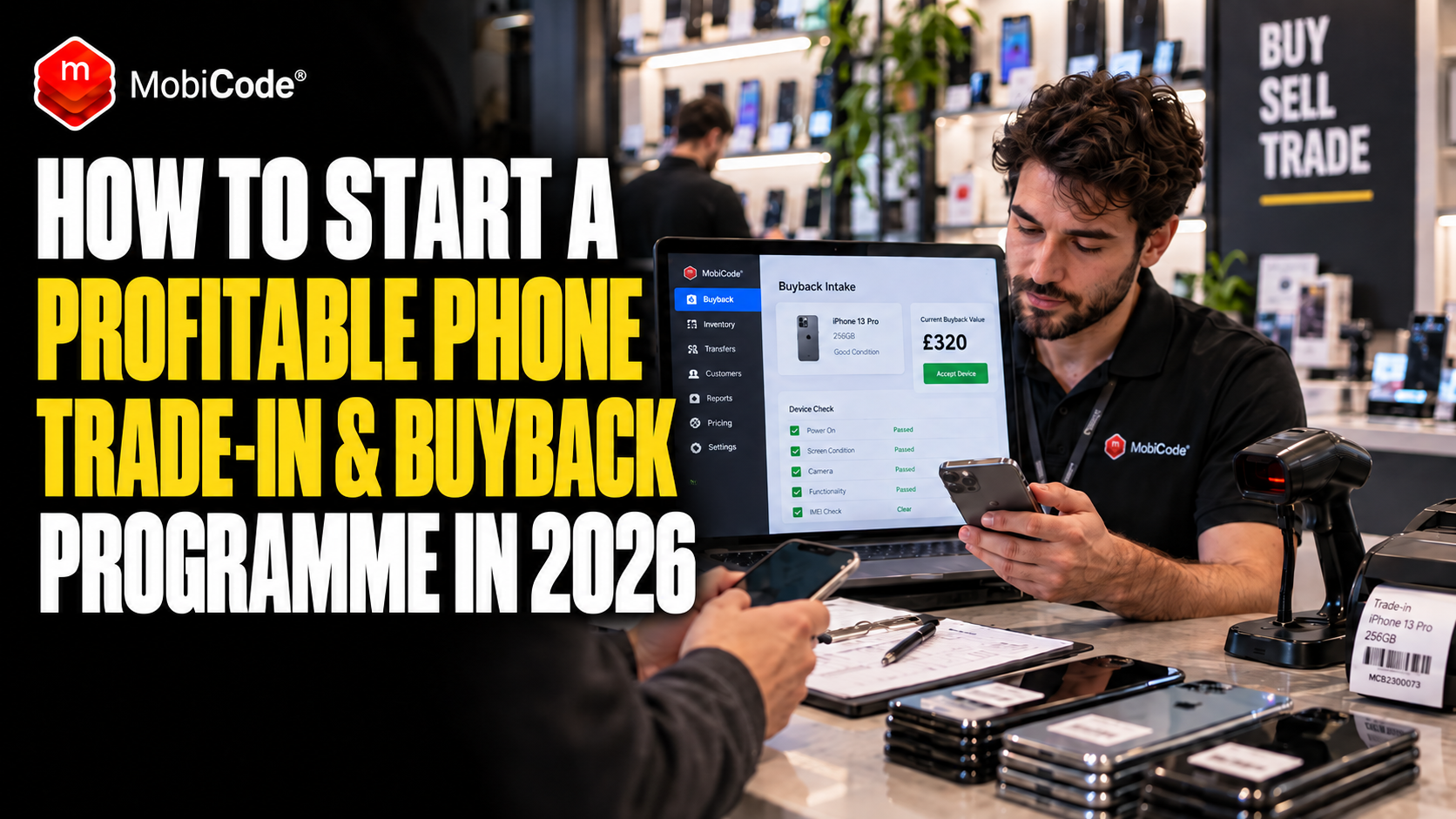
A profitable phone trade-in programme is not simply a price list and a till. Every handset creates a chain of decisions: what is it worth, is it safe to buy, does it work, is it locked, what condition is it really in, has its data been handled correctly and can the business resell it at a worthwhile margin?
Get those decisions right and used phones can become valuable stock. Get them wrong and one blocked flagship, missed hardware fault or poor grading decision can erase the profit from several successful purchases.
This guide explains how retailers, phone shops, recyclers and refurbishers can build a repeatable phone buyback operation — and where IMEI checks, diagnostics, data erasure, workflow software and device protection fit.
The basic model
Buy the right device at the right price, verify its status before payout, test and grade it consistently, deal with previous-user data correctly and move it back into sale quickly. Profit comes from controlling every stage — not simply buying phones cheaply.
Why launch a phone trade-in programme now?
The second-hand smartphone market continues to become a more important part of the wider mobile industry.
Recommerce’s 2026 Trade-In Index puts the average European smartphone trade-in value at €189, more than 10% above the previous year’s €170.
Recent flagship launches also create predictable surges in supply.
Recommerce found that Apple represented almost 80% of its trade-in mix immediately following the iPhone 17 launch. Samsung’s Galaxy S26 launch produced a similar seasonal effect for Android devices.
The wider market is moving in the same direction.
GSMA expects second-hand smartphone activity to grow during 2026 while new-device sales face substantial pressure.
For independent retailers and phone shops, that creates an opportunity to capture more of the device lifecycle rather than earning money only when somebody purchases a new or refurbished handset.
Is phone buyback actually profitable?
It can be, but the real calculation involves considerably more than the difference between the buy price and selling price.
A useful simplified calculation is:
Gross resale value − acquisition cost − repair cost − processing cost − selling fees − expected returns = contribution margin
That is why buying accurately matters so much.
Imagine two visually identical flagship phones.
One has clean device status, healthy hardware and no expensive repair requirement.
The other has a future block risk, weak battery and a damaged camera module.
Paying the same amount for both is not good purchasing. The second phone simply hides its costs until later.
Step 1: Decide which phones you will buy
Before opening a buyback service, define the devices your business actually wants.
Consider:
- manufacturers and model generations;
- minimum and maximum device age;
- storage capacities;
- acceptable cosmetic grades;
- damaged-device policies;
- activation-lock rules;
- network-lock policies;
- minimum resale value;
- parts-only devices;
- devices the business should reject automatically.
The goal is not to buy every phone presented to you.
The goal is to buy devices your operation knows how to process and resell profitably.
Step 2: Identify the exact device before valuing it
Model identification should happen before the final quote.
Capture the IMEI, serial number, exact model and storage capacity and connect them to the transaction.
This matters because apparently small differences can produce large differences in resale value.
Storage capacity alone can materially change the value of a recent iPhone or Galaxy flagship.
Regional versions can also differ in SIM configuration, network compatibility and customer appeal.
Step 3: Run an IMEI and device-status check before payout
This is one of the most important controls in a professional buyback operation.
A phone can look perfect while carrying information that makes it commercially risky.
Relevant issues can include:
- network blocklist status;
- lost or stolen reports;
- finance information;
- insurance-related records;
- invalid or suspicious device identifiers.
Where MobiCHECK fits
MobiCHECK gives businesses live device-status due diligence at the point where the buying decision takes place.
It checks IMEIs against multiple independent datasets, including the GSMA Global Blacklist Registry.
MobiCHECK can identify relevant information around network blocks, lost and stolen devices, finance and insurance records while also validating the IMEI submitted.
Most importantly, the check can happen before the business pays for the phone.
Step 4: Protect against post-purchase status changes
Even a clean result at intake cannot guarantee that a device’s status will never change.
A report, claim or block may appear after the business acquires the handset.
This creates a particular risk when expensive devices sit in stock before resale.
MobiCHECK+ can monitor an IMEI for 30 days, helping businesses identify relevant status changes after the original check.
MobiCHECK also supports watchlists and alerts for businesses managing larger pools of devices.
Step 5: Check Activation Lock and FRP
Device status and account locks solve different problems.
Apple advises buyers not to take ownership of an iPhone while Activation Lock remains enabled.
Android devices can present a similar resale problem through Factory Reset Protection.
The safest point to resolve an account lock is while the original owner is still standing in front of you.
Discovering it later creates delays, customer contact and potentially unusable stock.
Step 6: Test the phone properly
Once a device passes due diligence, establish whether the hardware actually works.
A quick visual inspection is not enough for a modern smartphone.
Relevant checks can include:
- touchscreen response;
- display quality and dead pixels;
- front and rear cameras;
- autofocus and stabilisation;
- speakers;
- microphones;
- buttons;
- Wi-Fi;
- Bluetooth;
- sensors;
- charging;
- biometric functionality.
Where MobiTEST fits
MobiTEST provides a guided diagnostic process for mobile devices.
Rather than asking each employee to decide what they should test, the software guides the operator through a structured series of automated and interactive checks.
That matters increasingly as the business adds staff.
The owner may know instinctively what to inspect on an iPhone. A new employee needs a process that produces the same result.
Step 7: Grade devices consistently
Grading influences both sides of the transaction.
It affects what you can afford to pay the seller and what the next buyer will expect when the device reaches your website or display cabinet.
A vague grading system creates problems.
If one employee considers a handset Grade A and another calls the same condition Grade B, your acquisition prices and resale descriptions will drift.
Define clear rules for:
- screen scratches;
- frame marks;
- rear-glass condition;
- camera housing damage;
- battery condition;
- previous repairs;
- functional defects;
- missing accessories.
Step 8: Build the process into software rather than memory
A checklist works well until the shop gets busy.
Then somebody skips a status check.
Another employee forgets a microphone test.
A third grades a phone differently from everybody else.
This is where workflow software becomes commercially valuable.
Where MobiONE fits
MobiONE brings MobiCHECK, diagnostics, grading and secure data erasure into a broader device-processing workflow.
It is designed for retail stores and larger processing operations that need staff to follow the same sequence repeatedly.
Smart Alerts and Workflow Blocks can also highlight relevant issues rather than relying on the operator to notice everything manually.
The difference at scale
A procedure says what staff should do.
A good workflow helps make sure they actually do it.
Step 9: Calculate the final purchase price
Only now does the business have enough information to make a properly informed offer.
The valuation should reflect:
- current resale value;
- device model and storage;
- status-check result;
- hardware condition;
- cosmetic grade;
- battery condition;
- parts or repair requirements;
- selling fees;
- warranty and return exposure;
- the margin your business requires.
Your maximum purchase price should come from the expected economics of that specific phone, not from the seller’s asking price.
Step 10: Securely deal with previous-user data
Once the business acquires the phone, it also needs an appropriate process for the information stored on it.
The ICO advises organisations to use and document secure disposal methods where personal information is involved.
For used-device businesses, the challenge is making that process consistent and retaining evidence that it happened.
Where MobiWIPE fits
MobiWIPE is MobiCode’s secure mobile data-erasure application for Apple and Android devices.
MobiWIPE supports multi-device processing and integrates its erasure activity with MobiCode reporting.
MobiCode also describes the product as ADISA-approved.
For a buyback operation, the practical benefit is straightforward: data erasure becomes another controlled production stage rather than an informal task somebody remembers to perform before resale.
Step 11: Keep an audit trail
Each device should leave behind a record.
At minimum, a professional operation may want to retain relevant information about:
- IMEI and serial number;
- seller or transaction reference;
- device-status check;
- diagnostic result;
- grade;
- purchase value;
- repairs;
- data erasure;
- eventual resale or disposition.
Good records help management analyse performance, investigate disputes and identify weak points in the buying process.
Step 12: Protect devices when the risk moves the other way
Buyback businesses normally think about protecting themselves from acquiring somebody else’s problematic device.
However, some phone businesses eventually develop the opposite problem.
They retain an ownership or financial interest in devices that other people possess.
Examples include:
- rental phones;
- leased devices;
- financed handsets;
- loan devices;
- business fleets;
- online sales involving disputed delivery or returns.
Where MobiBLOCK fits
MobiBLOCK adds device-level asset protection to the MobiCode suite.
Eligible organisations can use it to block or flag appropriate stolen, lost, fraudulently retained or unreturned devices.
Businesses can also flag active finance, rental or lease interests where appropriate.
That makes MobiBLOCK particularly relevant to phone businesses expanding beyond straightforward over-the-counter resale.
MobiBLOCK and MobiCHECK create a useful closed loop
MobiBLOCK and MobiCHECK solve opposite sides of the same problem.
One allows an organisation with a legitimate interest in an at-risk handset to act.
The other helps a potential downstream buyer investigate that handset before paying for it.
Block or flag an appropriate stolen, unreturned or agreement-linked device.
Investigate relevant device-status information before buying or processing the handset.
Importantly, MobiCHECK can show devices that MobiBLOCK has blocked or flagged.
That means the status created when one organisation protects its asset can help another legitimate business avoid making a poor purchasing decision later. MobiCode describes this same relationship across its current MobiBLOCK service. :chatgpt-content-reference{index=”1″}
What should the complete trade-in workflow look like?
Capture model, IMEI, serial number and capacity.
Investigate relevant device status before payout.
Resolve Activation Lock, FRP and relevant account restrictions.
Run consistent diagnostics across the handset.
Apply your agreed cosmetic and functional grading rules.
Calculate the purchase price from expected resale economics.
Complete the acquisition only when the required checks pass.
Process previous-user data using the defined erasure workflow.
Keep the relevant device and transaction evidence.
What KPIs should a phone buyback business track?
Revenue alone will not tell you whether the programme is healthy.
Useful operational metrics include:
- devices offered per week;
- purchase conversion rate;
- average acquisition value;
- average resale value;
- average gross margin per handset;
- device rejection rate;
- blocklist or due-diligence failure rate;
- post-purchase block rate;
- diagnostic failure rate;
- average repair cost;
- grading variance between operators;
- customer return rate;
- average days in stock;
- average processing time per handset.
Those measurements show where profit actually leaks out of the workflow.
The hidden cost of slow processing
Margin is not the only consideration.
Stock also consumes capital.
A phone bought today but not tested, wiped, graded and listed for another ten days ties up money that could otherwise fund more purchases.
Smartphone values also depreciate over time.
Recommerce’s 2026 analysis estimates that, after the first year, smartphone values decline by roughly 15% annually on average.
Faster, controlled processing therefore has financial value beyond staff efficiency.
Should an independent phone shop offer trade-in?
A national recycler does not have exclusive access to the opportunity.
Independent shops have several potential advantages:
- existing local customers;
- face-to-face inspection;
- same-day payment;
- repair capability;
- local reputation;
- the ability to combine a trade-in with a replacement purchase.
The challenge is making professional controls economical at smaller volumes.
That is where per-check services and modular software can make more sense than building bespoke systems internally.
When should a retailer automate the workflow?
A small owner-operated shop may begin with a structured manual process.
Automation becomes increasingly useful when:
- several employees buy phones;
- intake volume grows;
- the business operates several branches;
- devices arrive through postal trade-in;
- grading starts to vary between staff;
- too many faults reach customers;
- management wants central reporting;
- processing time begins limiting growth.
At that point, MobiONE can turn separate checks into a more repeatable processing workflow.
Which MobiCode products fit each stage?
| Need | Product | Role |
|---|---|---|
| Check before buying | MobiCHECK | IMEI and device-status due diligence |
| Test functionality | MobiTEST | Guided mobile diagnostics |
| Standardise processing | MobiONE | Workflow, grading, alerts and controls |
| Remove previous-user data | MobiWIPE | Secure data erasure and reporting |
| Protect owned or financed devices | MobiBLOCK | Blocking, flagging and asset protection |
Commercial takeaway
The profit is made when you control the buying decision
Resale price matters, but many of the biggest losses originate much earlier — a risky handset bought without adequate due diligence, a hardware fault missed during intake, inconsistent grading or previous-user data handled badly.
A successful trade-in programme therefore needs more than a valuation engine. It needs a controlled device-processing workflow.
MobiCHECK, MobiTEST, MobiONE and MobiWIPE cover the main stages from acquisition to resale, while MobiBLOCK extends protection to stolen, unreturned, rented, leased and financed devices.
Build your phone trade-in stack with MobiCode
MobiCHECK — reduce purchasing risk
Check relevant IMEI and device-status information before committing money to used stock.
MobiTEST — diagnose before resale
Give employees a consistent process for testing mobile-device hardware and functionality.
MobiONE — scale your processing workflow
Connect checks, diagnostics, grading, alerts and secure erasure into a repeatable workflow.
MobiWIPE — protect previous-user data
Perform secure mobile-device data erasure and retain useful processing records.
MobiBLOCK — protect devices your business still has an interest in
Block or flag appropriate stolen, lost, fraudulently retained or unreturned devices and identify relevant finance, rental or lease interests.
Building or improving a phone trade-in programme?
Talk to MobiCode about live IMEI checks, mobile diagnostics, grading workflows, secure data erasure and MobiBLOCK asset protection.
Frequently asked questions
Is a phone trade-in programme profitable?
A phone trade-in programme can be profitable when the business controls acquisition cost, device status, grading, repair cost, processing expense and resale value. Profitability depends on the complete unit economics rather than simply the difference between the purchase and selling prices.
What should a shop check before buying a phone?
Professional buyers should identify the exact device, check relevant IMEI and device-status information, verify account locks, test hardware functionality, assess physical condition and calculate the offer using current resale economics.
What is phone trade-in software?
Phone trade-in software helps retailers and recyclers manage parts of the used-device purchasing and processing workflow. This can include IMEI checks, diagnostics, grading, data erasure, reporting and workflow controls.
What does MobiCHECK do?
MobiCHECK provides live IMEI and device-status due diligence for businesses buying or processing used mobile devices. It can surface relevant information including network blocks, lost or stolen status, finance and insurance records.
What does MobiBLOCK do?
MobiBLOCK helps eligible businesses block or flag appropriate stolen, lost, fraudulently retained or unreturned devices. Businesses can also use it to flag relevant finance, rental or lease interests.
How do MobiBLOCK and MobiCHECK work together?
MobiBLOCK allows an eligible organisation to block or flag an appropriate at-risk device. MobiCHECK allows another business to investigate relevant device status before buying or processing it, and can show devices that MobiBLOCK has blocked or flagged.
Sources and further reading
- GSMA / Recommerce — Trade-In Index 2026
- GSMA — Mobile Net Zero Report 2026
- Counterpoint Research — Smartphone Market Outlook, September 2026
- Apple Support — Buying a pre-owned iPhone
- Apple Support — Activation Lock
- Information Commissioner’s Office — secure device and data disposal guidance
- MobiCode — MobiCHECK
- MobiCode — MobiTEST
- MobiCode — MobiONE
- MobiCode — MobiWIPE
- MobiCode — MobiBLOCK