

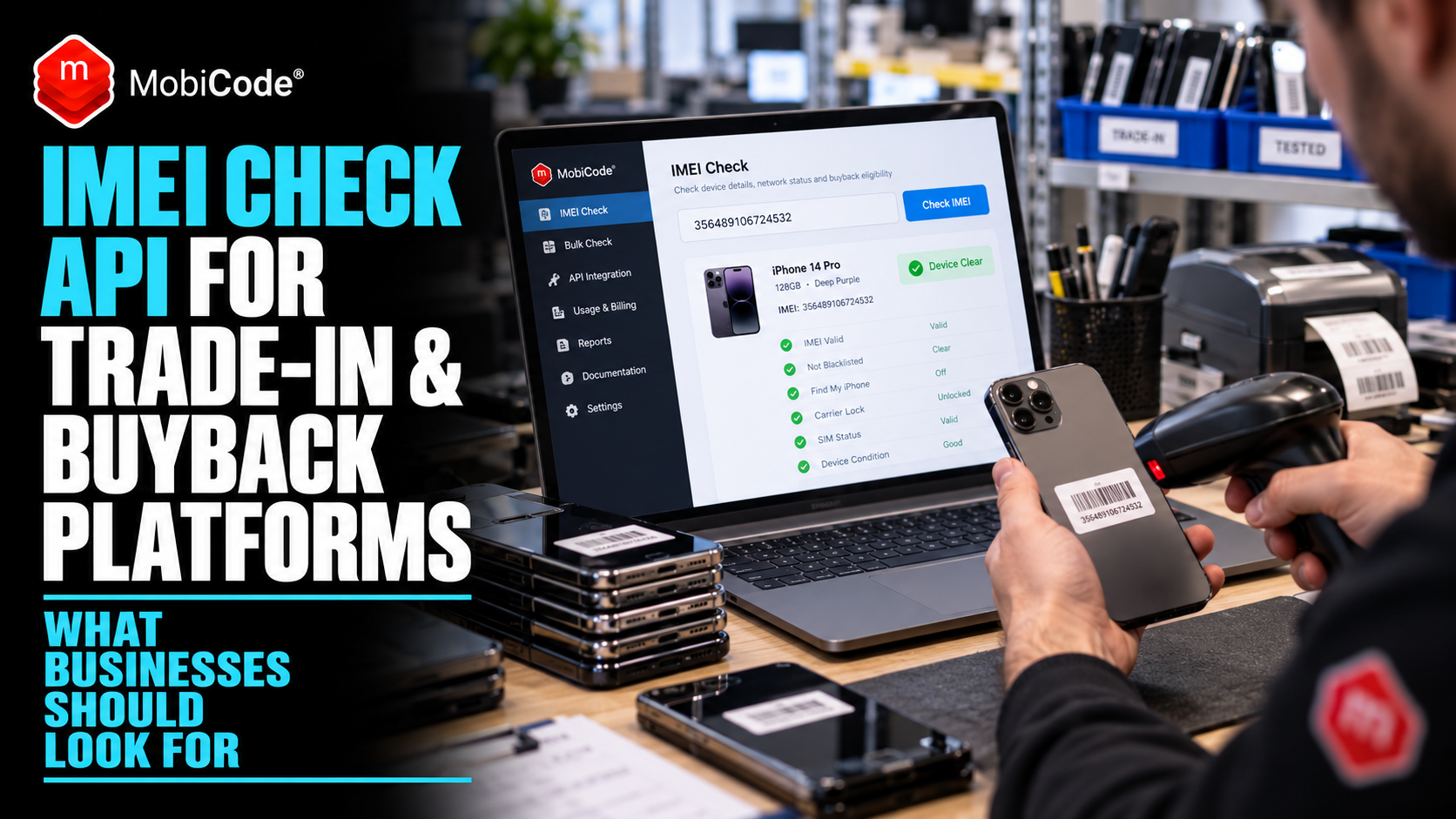
An IMEI check API allows a phone trade-in, buyback or refurbishment platform to assess device risk automatically while the transaction is still happening. Instead of asking staff to copy an IMEI into a separate website, the business can build live device-status checks directly into its own checkout, intake or processing workflow.
For businesses processing devices at scale, that matters. A phone can look genuine, power on normally and pass basic diagnostics while still carrying a blocklist entry, lost or stolen report, finance indicator, insurance-related record or an invalid device identity.
This guide explains what an IMEI check API should do, where it fits in a professional device workflow and why live status intelligence can become one of the most important controls in a high-volume used-phone business.
The commercial reason to use an API
A manual IMEI check can work when you buy a handful of phones. Once you process hundreds or thousands, the bigger problem becomes consistency. An API lets the business make the check part of the transaction itself.
What is an IMEI check API?
An IMEI check API allows software systems to submit a device IMEI programmatically and receive relevant device-status information in return.
Instead of an employee manually opening a separate service, entering the IMEI and interpreting the result, a trade-in or buyback platform can call the API automatically.
The result can then feed directly into the business workflow.
For example:
- a customer enters an IMEI into an online trade-in form;
- the platform submits that IMEI through the API;
- the system receives relevant status data;
- the platform decides whether to continue, stop or send the device for manual review;
- the result stays linked to the transaction.
That turns device due diligence from an optional staff task into part of the system.
Who needs an IMEI check API?
The strongest use cases are businesses that make repeated purchasing or processing decisions around mobile devices.
These include:
- phone trade-in platforms;
- mobile buyback businesses;
- recyclers;
- refurbishers;
- high-street phone retailers;
- multi-site repair and resale chains;
- mobile networks and MVNOs;
- insurers;
- marketplaces;
- ITAD and device-processing businesses;
- businesses buying returned or corporate devices in bulk.
GSMA Device Check itself identifies traders, retailers, repair centres and recyclers as organisations that benefit from checking lost or stolen device status before buying or processing a handset.
Why manual IMEI checks become a problem at scale
The problem is not that manual checking never works.
It is that every manual step introduces variation.
One employee checks every device.
Another checks only expensive ones.
Somebody else forgets during a busy period.
A fourth employee sees an amber result and interprets it differently from the rest of the team.
Over hundreds of transactions, small inconsistencies become commercial risk.
APIs make the check repeatable
If the platform calls the API automatically, the same check can run every time the defined condition occurs.
That is much easier to control than a policy that simply says “remember to check the IMEI”.
What should an IMEI check API tell you?
A useful commercial service should provide more than a simple valid-or-invalid response.
Depending on the provider and available data, businesses may want to investigate:
- whether the IMEI is valid;
- the actual make and model;
- whether the device appears on a blocklist;
- whether somebody has reported it lost or stolen;
- whether relevant finance information exists;
- whether an insurance-related record exists;
- whether the result requires further investigation;
- whether the device status changes after purchase.
Where MobiCHECK fits
MobiCHECK is MobiCode’s live IMEI and device-status due-diligence service for businesses handling pre-owned phones.
MobiCode says MobiCHECK checks IMEIs live against several independent datasets, including the GSMA Global Blacklist Registry.
Current MobiCHECK results can help businesses identify whether a device is:
- network blocked;
- reported lost or stolen;
- linked to finance;
- associated with an insurance claim;
- consistent with the expected make and model.
MobiCode also provides full API access with integration support for volume traders.
That makes MobiCHECK particularly relevant when an organisation wants device due diligence to happen inside its own platform rather than through a separate manual process.
API use case
Customer submits IMEI → MobiCHECK checks live status → platform receives result → transaction passes, stops or moves to review.
Why live data matters
Device status is not necessarily static.
A handset that appeared clear several days ago may later receive a block, loss report or another relevant status change.
That is why professional buyers should care about when the check happened, not just whether somebody checked the phone at some point in the past.
MobiCHECK is designed around live lookups so the business can make the purchasing decision using current information at the point of intake.
Check before payout, not after
The timing of the status check matters commercially.
Imagine a trade-in platform offering £650 for a recent flagship handset.
If the business checks the IMEI before approving the transaction and identifies a serious problem, the check has prevented a loss.
If staff discover the same problem after payment, the business already owns the risk.
IMEI validation can also help identify the wrong device
Blocklist status is only one part of due diligence.
MobiCHECK also validates the submitted IMEI and can confirm the associated make and model.
That can help identify situations where the handset presented does not match the identity expected by the system.
For automated trade-in platforms, model verification can also reduce mistakes caused by customers selecting the wrong device during an online quotation.
How an IMEI API can improve an online trade-in journey
Consider a typical online buyback transaction.
1. Customer enters the IMEI
The platform captures the device identity at the beginning of the process.
2. API validates the handset
The system can confirm relevant device information and compare it with what the customer selected.
3. Status check runs automatically
MobiCHECK can provide relevant live status information before the platform commits to the normal purchase route.
4. Rules decide the next action
A clear result may allow the journey to continue.
A warning may trigger manual review.
A serious exception may stop the transaction altogether, depending on the business’s policy.
5. The result stays connected to the transaction
That gives the business a clearer record of what information it used when making the buying decision.
Why this matters for high-street retailers too
API integration is not only useful for online businesses.
A retailer with several branches can build the same status logic into an in-store trade-in application.
The employee scans or enters the IMEI.
The system performs the check.
Staff receive a clear decision or escalation route without needing separate logins or multiple browser tabs.
That can make due diligence much easier to enforce across many stores.
What are red, amber and green device-status results?
MobiCHECK provides colour-coded results designed to make commercial decisions easier.
In practice, businesses should define their own internal rules around how different statuses affect a transaction.
For example:
- Green: normal workflow can continue if other required checks pass;
- Amber: operator or fraud team investigates further;
- Red: transaction stops under the business’s policy.
The key advantage is not the colour itself.
It is the ability to turn complex status information into a repeatable business decision.
Post-purchase blocking is another risk
A phone can pass an initial check and later acquire a relevant block or status.
That creates risk for businesses that hold stock for several days or weeks before resale.
Where MobiCHECK+ fits
MobiCHECK+ can monitor an IMEI for 30 days to reduce the risk around post-purchase blocking.
MobiCode also offers watchlist functionality and instant alerts.
This gives high-volume buyers another layer of protection after the initial purchasing decision.
A practical example: a 5,000-device monthly buyback platform
Suppose a trade-in business processes 5,000 devices each month.
A manual approach requires staff to perform thousands of repeated status checks, move between systems and record results accurately.
Even if each manual interaction takes only 30 seconds, that represents more than 40 staff hours every month before accounting for mistakes or rechecks.
An API does not simply make the lookup faster.
It removes repeated handling from the transaction entirely.
Staff can concentrate on exceptions rather than routine checks.
What should happen when the API finds an exception?
Automation should not mean blindly rejecting every unusual result.
Businesses need a clear exception policy.
Depending on the result, that could include:
- stopping the transaction;
- requesting more information;
- sending the device to a fraud team;
- asking the seller to resolve an account or finance issue;
- quarantining the handset;
- recording evidence for later review.
The API supplies information.
The business still defines what action the information should trigger.
IMEI checking and diagnostics solve different problems
A clean status result does not mean the handset works.
Likewise, a perfect diagnostic result does not prove the device is commercially safe to buy.
Professional intake therefore needs both layers.
| Question | Relevant MobiCode tool |
|---|---|
| Is this handset commercially safe to buy? | MobiCHECK |
| Does the hardware work properly? | MobiTEST |
| How do we combine those checks into one workflow? | MobiONE |
| How do we erase previous-user data before resale? | MobiWIPE |
How MobiONE can sit above the API workflow
Businesses with broader processing requirements may need more than an API response.
MobiONE brings device checking, diagnostics, grading and secure erasure into a wider processing workflow.
That means MobiCHECK can act as the device-status layer while MobiONE controls what happens next.
For example:
IMEI lookup → status decision → diagnostics → grading → exception handling → data erasure → reporting
That architecture becomes particularly useful for recyclers, refurbishers and trade-in operations processing large numbers of devices.
How MobiBLOCK adds new status information into the ecosystem
MobiBLOCK addresses the opposite side of device-status management.
MobiCHECK helps a buyer discover relevant status before buying.
MobiBLOCK helps an eligible organisation block or flag a device when theft, fraud, non-return or an active finance, rental or lease interest gives it a legitimate reason to act.
Importantly, MobiCHECK can surface devices that MobiBLOCK has blocked or flagged.
That means information created upstream can become visible to another legitimate business later in the device lifecycle.
What should businesses look for when comparing IMEI APIs?
Price matters, but it should not be the only comparison point.
Consider:
- which data sources the provider uses;
- whether checks are live;
- global network coverage;
- lost and stolen status;
- blocklist information;
- finance and insurance indicators;
- IMEI validation;
- model verification;
- API documentation and integration support;
- response speed;
- post-purchase monitoring;
- alerting and watchlist features;
- pricing at the volumes you actually process;
- how easily results fit into your existing workflow.
Global coverage matters for international device trading
Used phones routinely cross borders.
A refurbisher in the UK may buy stock that originated in another country, while a device processed in Europe may later reach customers elsewhere.
MobiCode says MobiCHECK connects to data covering more than 120 networks worldwide.
That international dimension matters because device risk does not necessarily stop at a national border.
Why API integration can improve customer experience too
Fraud controls often sound like friction.
Good integration can do the opposite.
If the platform validates the device and receives the status result in the background, the customer does not need to wait while an employee manually checks several systems.
Clear devices can continue quickly.
Only genuine exceptions need extra attention.
That can produce both stronger controls and a smoother transaction.
How much should an IMEI check cost?
The useful comparison is not simply the cost per lookup.
Businesses should compare the check with the financial exposure it helps control.
MobiCode currently advertises MobiCHECK pricing from a few pence per device, depending on the service and volume.
When the handset being purchased may be worth hundreds of pounds, the cost of due diligence can be small relative to the value at risk.
The ROI question businesses should ask
Instead of asking:
ask:
For a high-volume operation, avoiding even a small number of expensive problem devices can materially affect the economics.
A recommended automated trade-in workflow
Get the IMEI
Capture the device identity early and link it to the transaction.
Confirm the device
Check that the identifier matches the expected make and model.
Run live status due diligence
Investigate relevant blocklist, loss, theft, finance and insurance information.
Pass, review or stop
Apply your own commercial rules to the API result.
Run functional diagnostics
Check the hardware after the device passes the relevant status controls.
Grade and erase
Complete the normal refurbishment or resale workflow.
Watch valuable stock where appropriate
Use monitoring or watchlist functionality where post-purchase status changes create material risk.
When does API integration become worth it?
There is no universal transaction threshold.
However, API integration becomes increasingly attractive when:
- staff perform the same lookup repeatedly;
- the business processes hundreds or thousands of devices;
- several stores or teams need the same decision rules;
- an online quotation needs instant device validation;
- manual entry creates errors;
- management wants status results linked automatically to transactions;
- the business needs to route exceptions consistently;
- processing speed affects conversion or throughput.
Commercial takeaway
The best IMEI check is the one your workflow does not let staff forget
Manual due diligence can work at low volume. At scale, the bigger opportunity is to make live device-status intelligence part of the transaction itself.
An API can validate devices, surface relevant risk and route exceptions before the business commits money or processing time.
MobiCHECK is designed for exactly that use case, combining live IMEI checks, global device-status data, validation, watchlists, post-purchase monitoring and API access for high-volume traders.
Build MobiCHECK into your trade-in or buyback platform
MobiCHECK gives businesses access to live device-status intelligence without forcing every operator to work through a separate manual lookup.
Current capabilities include:
- live IMEI checks;
- GSMA Global Blacklist Registry data;
- lost and stolen indicators;
- finance and insurance information;
- IMEI validation;
- make and model verification;
- colour-coded results;
- global network coverage;
- watchlists and alerts;
- 30-day MobiCHECK+ monitoring;
- full API access;
- integration support.
Need IMEI checks inside your own platform?
Talk to MobiCode about integrating MobiCHECK into your trade-in, buyback, recycling or refurbishment workflow.
Frequently asked questions
What is an IMEI check API?
An IMEI check API allows a business system to submit a mobile-device IMEI automatically and receive relevant validation or device-status information in return. It can be built into trade-in, buyback, recycling and refurbishment workflows.
What can MobiCHECK identify?
MobiCHECK can provide relevant information about network blocks, lost or stolen status, finance and insurance-related records, while also validating the IMEI and associated make and model.
Does MobiCHECK offer API access?
Yes. MobiCode offers full MobiCHECK API access with integration support for businesses that want to build live device-status checking into their existing systems.
Can an IMEI check API stop a trade-in automatically?
The API supplies the relevant status information. The business can then define its own workflow rules to continue, stop or send a transaction for manual review based on the returned result.
Can MobiCHECK monitor a phone after purchase?
MobiCHECK+ can monitor an IMEI for 30 days to help reduce the risk associated with relevant post-purchase status changes. MobiCHECK also provides watchlist and alert features.
How do MobiCHECK and MobiBLOCK work together?
MobiCHECK helps businesses investigate device status before buying or processing a handset. MobiBLOCK allows eligible organisations to block or flag appropriate at-risk devices. MobiCHECK can show devices that MobiBLOCK has blocked or flagged.
Sources and further reading
- MobiCode — MobiCHECK device-status due diligence and API
- MobiCode — MobiCHECK features, watchlists and API integration
- GSMA Device Check — device status and lost/stolen checking
- MobiCode — MobiBLOCK device blocking and asset protection
- MobiCode — MobiONE device-processing workflow
- MobiCode — MobiTEST mobile diagnostics
- MobiCode — MobiWIPE secure mobile data erasure