

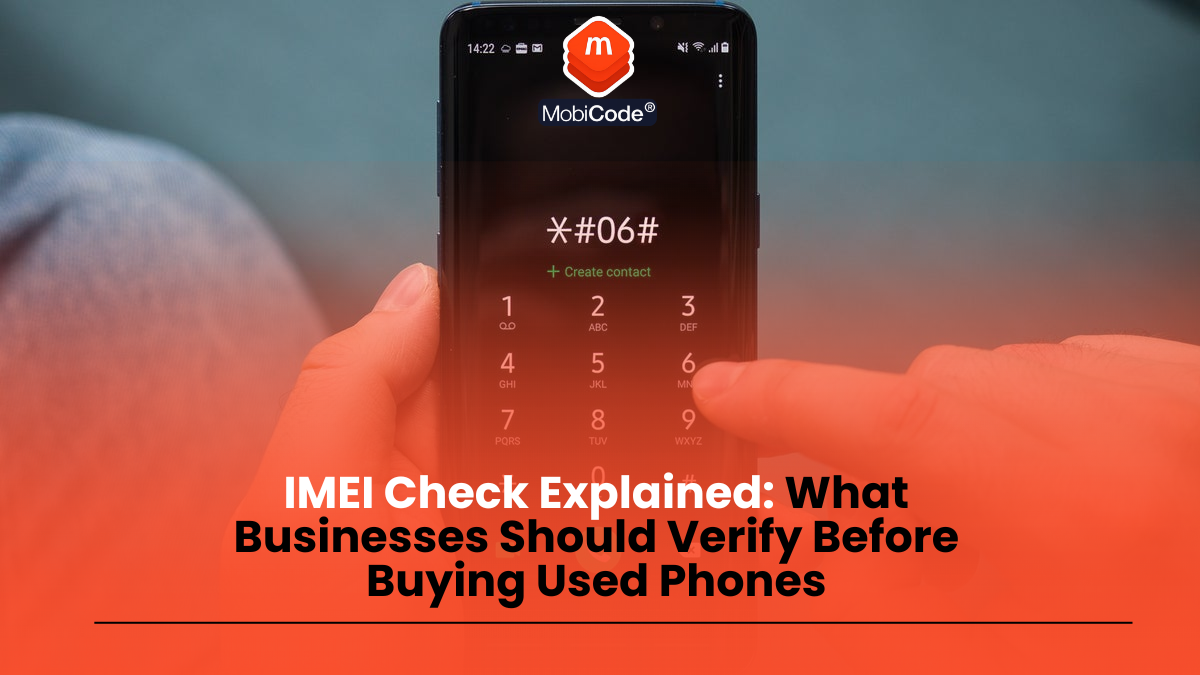
IMEI check explained simply: an IMEI check helps a business verify key details about a used phone before buying, processing, repairing or reselling it. It can help confirm device identity, highlight blacklist or block risk, flag potential status issues and reduce the chance of accepting stock that later becomes difficult to sell.
For businesses buying used phones, an IMEI check is not just a technical lookup. It is a commercial risk-control step. A handset can look clean, switch on normally and still carry a status issue that affects resale value, customer trust or the route it should take through the processing workflow.
This guide gives an IMEI check explained view for recyclers, refurbishers, trade-in teams, networks, insurers and bulk buyers. It covers what businesses should verify before buying used phones, where IMEI checks fit in the wider workflow, and how tools such as MobiCHECK and MobiCode CHECK help teams make better device decisions.
Short answer: an IMEI check helps businesses verify whether a used phone matches its expected identity and whether it may carry status risks such as blacklist, block, lock, lost or stolen, finance or resale concerns. However, businesses should not rely on IMEI checks alone. A strong buying workflow should combine IMEI checks with functional testing, cosmetic grading, data erasure and clear device records.
IMEI check explained: what is an IMEI check?
An IMEI check uses the phone’s International Mobile Equipment Identity number to support device-level verification. The IMEI is normally a 15-digit identifier linked to the mobile device itself, not the SIM card or phone number.
In practice, an IMEI check can help a business understand whether the device matches the expected model, whether it may carry blacklist or block risk, and whether the handset should move forward in a resale, trade-in, repair or recycling workflow.
That matters because two phones can look identical but have very different commercial value. One may be clean, unlocked and ready for resale after testing and wiping. Another may have a status issue that makes it unsuitable for normal resale. Therefore, an IMEI check should sit close to the start of the buying process.
Why businesses need IMEI checks before buying used phones
Businesses that buy used phones usually deal with speed, volume and uncertainty. A device may come from a consumer trade-in, insurance return, corporate refresh, repair shop, recycler, network, marketplace seller or wholesale stock batch.
Without a reliable check, the buyer may not know enough about the device before committing money. As a result, the business can overpay, misgrade stock, accept higher-risk devices or send phones into the wrong processing route.
IMEI checks help businesses reduce several common risks:
- Buying blocked or blacklisted phones: devices may have limited or no normal resale value.
- Accepting misdescribed stock: the device may not match the expected model or record.
- Missing commercial restrictions: lock, finance or status issues can affect resale route.
- Creating customer disputes: buyers may challenge stock that later proves problematic.
- Wasting repair spend: teams may repair devices that should have been held or rejected.
More importantly, the check gives the business a decision point. The phone can be accepted, rejected, held, downgraded, escalated or routed differently before cost builds up.
What should businesses verify in an IMEI check?
An IMEI check should not be treated as a single yes-or-no step. For commercial used-phone buying, it should support a wider due diligence decision.
In practice, businesses should verify the following areas before buying used phones:
1. Device identity
The first thing to verify is whether the phone matches the expected identity. The business should confirm the make, model, storage capacity and any relevant device details against the supplied information.
This matters because incorrect device identity can lead to wrong pricing. For example, a higher-storage model may command a different price from a lower-storage version. Equally, a similar-looking model from a different generation may have a very different resale value.
2. Blacklist or block status
A key reason to run an IMEI check is to identify whether a phone may be blocked or blacklisted. Lost or stolen devices can be reported and blocked from mobile networks. If a business buys this type of device without checking, resale options can become limited or impossible.
In simple terms, a blacklisted or blocked phone may look normal but carry serious commercial risk. For that reason, businesses should treat blacklist checks as a core buying step, not a later admin task.
3. Lost or stolen risk
IMEI checks may help identify whether a device has been reported lost or stolen. This matters for obvious reasons: a business should not knowingly buy or resell stolen stock, and even an accidental purchase can create disputes, losses and reputational damage.
However, an IMEI result should be treated as part of a risk process rather than a complete legal guarantee. Businesses should also use clear supplier controls, purchase records, audit trails and escalation rules.
4. Network and lock status
Some devices may carry network-related restrictions or lock status issues. These can affect whether the device works for the intended buyer, market or resale route.
For example, a phone that is locked, restricted or region-specific may still have value, but it may not have the same value as an equivalent unlocked device. Therefore, status information should influence pricing and routing.
5. Finance or ownership risk
Some used phones may carry finance, leasing or ownership-related concerns. If a device remains linked to an unresolved agreement, it can create future risk for the buyer or reseller.
An IMEI check may help flag issues that require further review. In addition, a business should consider supplier reliability, proof of purchase, chain-of-custody records and contractual protections when buying stock at volume.
6. Model mismatch or record mismatch
Sometimes the physical device does not match the information supplied by the seller. The business may expect one model, storage size or device variant and receive another.
This may happen through honest error, poor admin or deliberate misdescription. Either way, mismatch risk affects pricing, grading and stock control. A proper IMEI-led workflow helps reduce those errors early.
7. Resale suitability
Finally, businesses should verify whether the phone is suitable for the intended resale route. A device may not be suitable for retail resale but may still work for wholesale, parts recovery or responsible recycling.
This is where IMEI checks should connect with testing, grading and wiping. The result should support a commercial route, not sit separately from the rest of the processing decision.

IMEI check explained: what an IMEI check cannot prove
An IMEI check can be extremely useful, but it cannot prove everything about a used phone. A clean IMEI result does not automatically mean the device is fully working, worth the asking price or ready for resale.
For example, an IMEI check usually cannot prove:
- whether the screen has hidden faults
- whether the battery performs well enough for resale
- whether the camera, speaker, microphone or charging port works properly
- whether all personal data has been securely removed
- whether the cosmetic grade is accurate
- whether the device is worth repairing
- whether the seller is commercially reliable
Therefore, businesses should use IMEI checks as part of a broader device processing workflow. MobiCode TEST supports functional testing, while MobiWIPE supports secure mobile data erasure.
Where IMEI checks fit in a used-phone buying workflow
The best point to run an IMEI check is early. Ideally, a business should check status before final valuation, payment, repair authorisation or resale listing.
A practical buying workflow may look like this:
- Receive device information: collect expected model, storage, condition and seller details.
- Capture the IMEI: record the IMEI accurately against the physical handset.
- Run the IMEI check: verify identity, status and risk indicators.
- Review any concern: hold or escalate devices with unclear or problematic results.
- Test functionality: check core hardware and software functions.
- Grade the device: assess cosmetic and commercial condition.
- Wipe data securely: remove personal or business data before resale or reuse.
- Choose the route: resale, repair, wholesale, parts recovery or responsible recycling.
In practice, this workflow helps prevent risk from moving downstream. It also gives operators a clearer basis for pricing and routing decisions.
Why IMEI checks matter for recyclers and refurbishers
Recyclers and refurbishers often handle mixed-condition devices at volume. Some phones are resale-ready, some need repair, some are useful for parts and some should not move into normal resale routes at all.
An IMEI check helps decide which route makes sense. For example, a clean and working device may move into resale after testing and wiping. A device with a status issue may need review. Meanwhile, a device with limited value may move into parts recovery or recycling.
MobiCode solutions for recyclers support businesses that need to connect checks, tests, erasure and device records across reuse, resale, refurbishment and recycling workflows.
Why IMEI checks matter for trade-in and buyback teams
Trade-in and buyback teams need fast decisions, but they also need accurate ones. If a business pays a customer before running proper checks, it may later discover that the device is worth less than expected.
That creates a difficult commercial problem. Either the business absorbs the loss, challenges the customer, delays processing or reroutes the device into a lower-value channel.
By contrast, early IMEI checks support clearer pricing. They also help teams decide whether a device should be accepted, declined, manually reviewed or processed under a different value rule.
Why IMEI checks matter for insurers and networks
Insurers and networks often process returned phones, claim devices, trade-ins, upgrades and customer replacement stock. In these environments, device identity and status matter because similar-looking devices can move through complex workflows.
IMEI checks help link the physical handset to a record. As a result, teams can reduce confusion, support reporting and avoid processing devices that do not match the expected claim, return or trade-in route.
More importantly, a structured IMEI process helps organisations reduce disputes and keep device histories clearer.
Common mistakes businesses make with IMEI checks
Many problems happen not because businesses ignore IMEI checks entirely, but because they run them inconsistently or too late.
Common mistakes include:
- Checking after payment: the business finds a problem only after it has already bought the phone.
- Manual typing errors: an operator records one wrong digit and links the result to the wrong device.
- No escalation rule: staff do not know what to do when a check returns a concern.
- Disconnected records: the IMEI result does not connect to testing, grading or wiping records.
- Assuming clean status means full resale readiness: the device may still fail testing.
- Using inconsistent supplier controls: high-risk stock enters the workflow without enough evidence.
Over time, these mistakes increase returns, disputes, admin workload and margin leakage. More importantly, they make the business less confident in its own stock.
How MobiCode helps businesses verify used phones
MobiCode supports the operational layer behind IMEI-led used-phone checks. For businesses buying devices at volume, the challenge is not simply running a lookup. The real challenge is connecting that lookup to a wider processing workflow.
In practice, MobiCode supports:
- IMEI and status checks: MobiCHECK and MobiCode CHECK help teams verify device status and reduce commercial risk.
- Connected device processing: MobiONE helps teams manage device records and processing workflows more consistently.
- Functional testing: MobiCode TEST supports device testing before grading, resale or repair decisions.
- Secure data erasure: MobiWIPE helps teams wipe devices as part of a controlled workflow.
- Recycler and refurbisher workflows: MobiCode for recyclers supports businesses handling resale, reuse, refurbishment and recycling routes.
Ultimately, MobiCode helps businesses turn IMEI checks into better decisions. The check becomes part of a complete record, rather than a separate manual step that operators may forget, mistype or fail to act on.
A practical example: buying a batch of used phones
Imagine a refurbisher is offered 300 used smartphones from a trade supplier. The batch appears attractive: popular models, decent cosmetic condition and a price that looks commercially viable.
A weak process would focus mainly on appearance and headline model value. That approach may miss blocked devices, model mismatches, lock issues, finance concerns or phones that should never enter the normal resale route.
A stronger process works differently:
- the team records each device and captures the IMEI accurately
- operators run IMEI and status checks before final buying decisions
- devices with concerns move into review or exclusion
- clean devices continue into functional testing and grading
- secure wiping links back to the correct handset record
- the business routes each phone based on status, condition and value
As a result, the buyer protects margin before committing unnecessary cost. Good devices move forward, risky devices receive attention, and poor-fit stock does not quietly enter the resale workflow.
Commercial takeaway: IMEI check explained
The simplest IMEI check explained answer is this: an IMEI check helps a business understand whether a used phone is what it claims to be and whether it carries status risk before the business buys, repairs or resells it.
However, the strongest businesses do not treat IMEI checks as a standalone admin task. They connect IMEI verification with testing, grading, secure data erasure and clear device routing. That is how used-phone buyers reduce risk, protect resale value and make better commercial decisions at volume.
Frequently asked questions
Simple answers to common questions about IMEI checks, used-phone buying, blacklist risk and commercial device processing.
What is an IMEI check?
An IMEI check uses a phone’s unique IMEI number to help verify device identity, status and potential risk before buying, processing or reselling the handset.
What should a business check before buying used phones?
A business should check device identity, blacklist or block status, lost or stolen risk, lock status, finance concerns, model accuracy, functional condition, cosmetic grade and whether data can be securely erased.
Can an IMEI check tell if a phone is stolen?
An IMEI check may help identify whether a phone has been reported lost, stolen, blocked or blacklisted. However, businesses should treat it as part of a broader risk process, not as a complete proof of ownership.
When should businesses run an IMEI check?
Businesses should run an IMEI check as early as possible, ideally before final valuation, payment, repair approval or resale listing. Early checks reduce the risk of overpaying for problematic stock.
Is an IMEI check enough before reselling a used phone?
No. An IMEI check is important, but businesses should also test functionality, grade cosmetic condition, verify data erasure and keep clear device records before resale.