

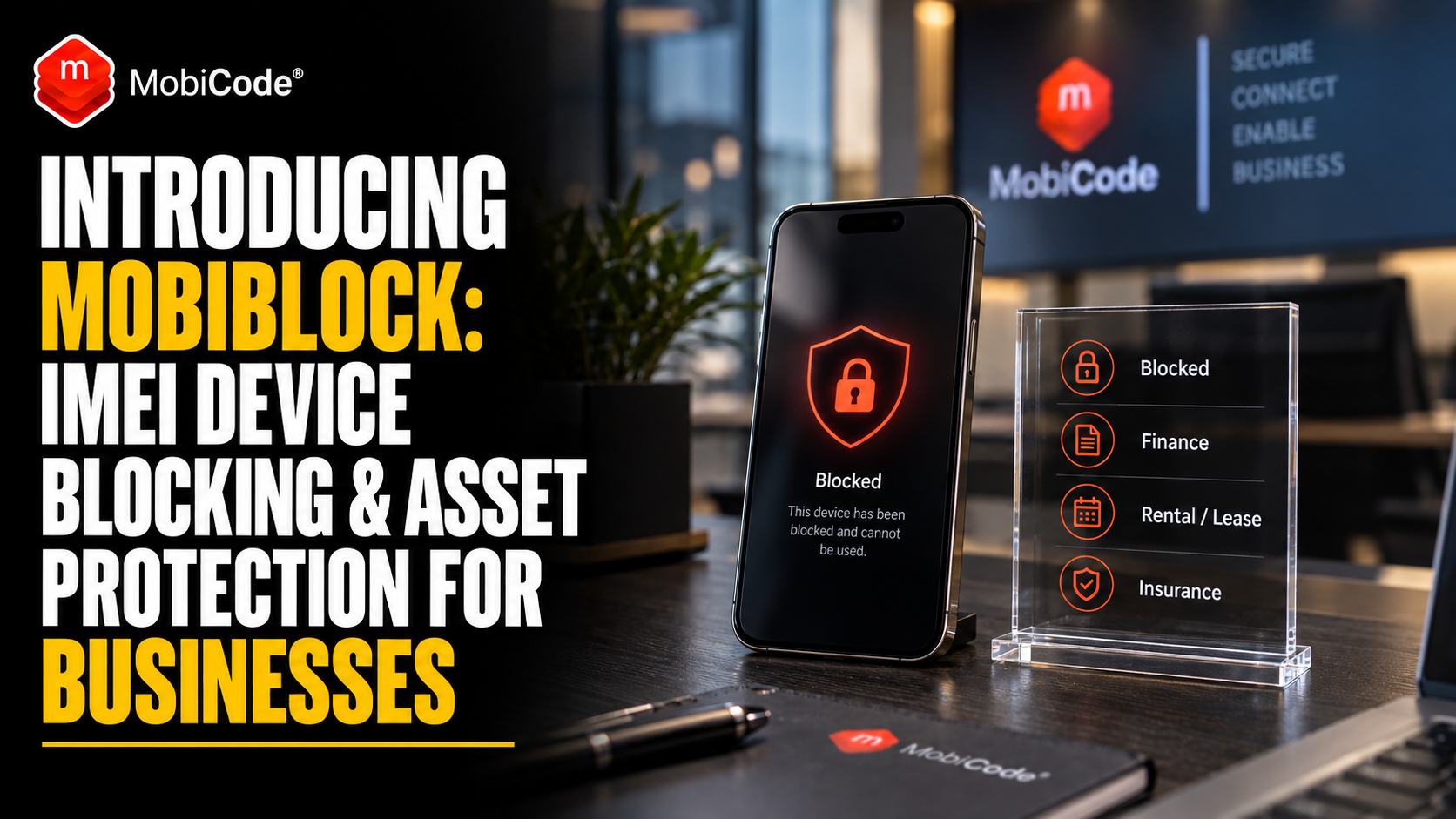
MobiCode is launching MobiBLOCK, an IMEI-based device protection service designed to help businesses block or flag mobile devices when they are stolen, lost, fraudulently retained, not returned or still subject to finance, rental or lease agreements.
For businesses that sell, rent, lease, finance, insure or process mobile devices, the financial risk does not always end when a handset leaves the building.
A customer may dispute a delivery, keep a rented phone beyond the agreed period or try to resell a device while finance remains active. Meanwhile, a stolen business handset can retain substantial resale value unless the organisation takes further action.
What is MobiBLOCK?
MobiBLOCK helps eligible businesses block at-risk mobile devices, flag active finance, rental or lease interests and maintain a clearer written evidence trail around the action they take.
Get started with MobiBLOCK
There are two routes depending on whether your organisation already uses MobiCode.
Existing MobiCode customer
Request MobiBLOCK access directly
Use the dedicated Blocklist Access page through your existing MobiCode account. You do not need to submit a separate general enquiry.
New to MobiCode
Talk to the MobiCode team
Contact us to discuss how device blocking, finance and rental flagging, and asset protection could fit into your existing workflow.
You can also view the full MobiBLOCK product page.
Why has MobiCode launched MobiBLOCK?
Modern smartphones, tablets and connected devices can retain hundreds or even thousands of pounds of value. Consequently, theft, fraud and non-return can create significant losses for businesses that handle devices at scale.
Traditionally, companies have often relied on contractual recovery, marketplace dispute systems, courier investigations or insurance claims. However, those processes mainly focus on the transaction or the customer.
MobiBLOCK adds another layer by allowing the business to act against the device’s IMEI status itself.
The device becomes part of the response
Consider a rental company that does not receive a £900 handset back at the end of an agreement. The business can continue its normal recovery process, while MobiBLOCK gives it another route to reduce the usefulness and resale appeal of the device by blocking or flagging the relevant IMEI where appropriate.
What is IMEI device blocking?
IMEI stands for International Mobile Equipment Identity. It is the identifier used to distinguish cellular devices on mobile networks.
IMEI blocking targets the handset
When an authorised organisation reports an IMEI for blocking, participating mobile networks can deny cellular service to that device.
The GSMA Device Registry provides a central system through which participating organisations and operators can share relevant block-list information. Therefore, IMEI blocking differs from simply cancelling a SIM or mobile subscription.
Blocking a SIM and blocking a phone are different
A SIM relates to the mobile subscription. By contrast, the IMEI identifies the physical device.
Someone may remove one SIM and insert another. However, an IMEI block follows the handset itself across participating mobile networks.
What does MobiBLOCK do?
MobiBLOCK brings three important device-protection functions into one business service.
Block at-risk devices
Businesses can submit appropriate devices for IMEI blocking when theft, loss, fraudulent retention or non-return creates a legitimate reason to act.
Flag finance, rental or lease interests
Businesses checking those devices can see that another organisation may still hold a financial or contractual interest.
Build an evidence trail
Written records can support internal investigations, marketplace disputes, insurance claims, police reports or legal escalation where relevant.
How does MobiBLOCK work?
A controlled process starts with the device and the evidence behind the case.
Step 1
Identify the correct device
Confirm the IMEI and link it to the relevant transaction, customer, rental, finance agreement or asset record.
Step 2
Review the evidence
Relevant evidence may include courier tracking, delivery confirmation, marketplace messages, rental agreements, finance records, customer correspondence and return records.
Step 3
Take the appropriate device action
Where the evidence supports it, the organisation can use MobiBLOCK to block or flag the device.
Step 4
Keep the record
Retain evidence of what happened and why so the action becomes part of a documented process.
What happens when an IMEI is blocked?
An IMEI block aims to stop a device from accessing participating cellular networks.
Participating organisations can exchange relevant records through systems such as the GSMA Device Registry. Consequently, a device that one network denies service may also lose access to other participating networks.
A blocked phone may still use Wi-Fi
IMEI blocking targets cellular-network access rather than every function inside the handset. Wi-Fi may continue to work. Nevertheless, removing ordinary mobile-network access can substantially reduce the convenience and resale appeal of a device.
MobiBLOCK for marketplace sellers
Online marketplaces give device sellers access to enormous audiences. However, they can also expose businesses to expensive delivery, return and refund disputes.
A buyer might claim that a device never arrived. Alternatively, somebody may say they returned a phone when the seller has not received the correct handset.
Start with the evidence
MobiBLOCK does not replace a proper investigation. Instead, the seller should first review:
- delivery tracking;
- proof of delivery;
- warehouse records;
- the original IMEI;
- customer correspondence;
- return tracking;
- marketplace messages.
Once the business understands the facts, it can decide whether a device-level response is appropriate.
A warning can form part of the process
The seller may notify the customer that it has recorded the handset’s IMEI and may block or flag the device if the unresolved claim and available evidence justify further action. Meanwhile, the seller can continue through the marketplace’s formal dispute process.
A simple marketplace fraud workflow
- 1
Receive the claim. The buyer reports that the phone did not arrive, went missing or was returned. - 2
Review the records. Check delivery information, IMEI records, messages and return evidence. - 3
Contact the customer. Explain the evidence and any next steps clearly. - 4
Use MobiBLOCK where justified. If the evidence supports further action, block or flag the handset. - 5
Preserve the evidence. Keep the relevant records for the dispute, investigation or escalation process.
MobiBLOCK for rental companies
Rental businesses face a straightforward risk: they own a device while another person physically controls it.
Most customers return equipment correctly. However, some devices may become lost, stolen, retained after the agreement ends or resold without permission.
Non-return does not remove the device’s value
A high-value smartphone can remain attractive on the second-hand market even after the rental customer breaches the agreement.
MobiBLOCK provides another deterrent by allowing the business to block or flag the relevant IMEI where appropriate.
MobiBLOCK for leasing and financed devices
Leasing businesses
The customer uses the handset while the leasing company retains an ongoing interest in the asset.
Contractual recovery remains important. Nevertheless, MobiBLOCK adds a device-level deterrent when a handset is not returned.
Financed phones
A customer may try to sell a handset while a finance agreement remains active.
MobiBLOCK can record that active interest so relevant checks can expose the status before another business buys, recycles or resells the handset.
Why finance and rental flagging matters
Risk can move quickly through the second-hand supply chain.
Example:
Customer finances phone → sells it early → trader buys it → refurbisher acquires it → another customer eventually buys it.
Without status information, several parties may make decisions without knowing that another business still has an interest in the device. By contrast, flagging gives buyers and processors another opportunity to investigate before committing money.
Why MobiBLOCK matters to recyclers and refurbishers
Recyclers and refurbishers can benefit from the information that MobiBLOCK adds to the device ecosystem.
After all, a technically perfect smartphone may still carry a serious commercial risk.
Status and functionality answer different questions.
Functional testing tells the business whether the handset works. Device-status intelligence can reveal reasons to investigate before buying or reselling it.
How MobiBLOCK and MobiCHECK work together
MobiBLOCK and MobiCHECK address opposite sides of the same device-status problem.
Act
MobiBLOCK
Helps an eligible organisation block or flag a device when theft, fraud, non-return or an active agreement creates a legitimate reason to do so.
Check
MobiCHECK
Helps another organisation investigate relevant device-status information before buying, trading or processing a handset.
Importantly, MobiCHECK can show devices that MobiBLOCK has blocked or flagged. As a result, information created by one business can help another business avoid a poor purchasing decision later.
What MobiBLOCK does not replace
MobiCHECK
MobiBLOCK acts on at-risk devices. MobiCHECK investigates device status before a commercial decision. Businesses may use one or both depending on their role in the device lifecycle.
Data erasure
Blocking a phone does not securely remove photographs, messages, documents or account information stored on the handset. MobiWIPE supports professional mobile-device data erasure.
Device location
IMEI blocking does not locate a missing phone. Device-location tools, remote locking, data erasure and IMEI blocking solve different parts of the wider device-protection problem.
Think of device protection as several layers
May help locate a missing device.
May protect access.
Protects information.
Restricts cellular use.
Communicate an active interest.
Support investigation and escalation.
Why evidence matters before a business blocks a device
Changing a handset’s status can affect the person using it. Therefore, businesses should make blocking and flagging part of a controlled process.
Confirm the facts first
- the correct IMEI;
- device ownership or financial interest;
- the agreement or transaction;
- delivery or return evidence;
- customer communication;
- your internal policy.
Who can benefit from MobiBLOCK?
MobiBLOCK is designed for businesses with a financial or operational interest in mobile devices.
Support disputed delivery, return or retention workflows.
Protect devices customers fail to return.
Strengthen asset-recovery processes.
Flag active financial interests.
Investigate device status before buying stock.
Support loss, claim and asset-control workflows.
How MobiBLOCK fits into the wider MobiCode suite
MobiBLOCK adds asset protection to a broader set of MobiCode tools for device businesses.
MobiCHECK — device-status due diligence before purchase, trade-in or processing.
MobiTEST — guided diagnostics across hardware, display, audio, sensors and connectivity.
MobiWIPE — professional mobile-device data erasure.
MobiONE — consistent multi-stage device-processing workflows.
MobiBLOCK — device blocking, agreement flagging and asset protection.
A practical MobiBLOCK workflow
Businesses can make MobiBLOCK most effective by building IMEI records and device-status controls into their normal workflow before a problem occurs.
Before the device leaves the business
Record the IMEI, link it to the correct customer or agreement, store relevant transaction details and set clear return or payment terms.
If a problem occurs
Review the evidence, confirm the correct device, contact the customer where appropriate and follow the normal dispute or recovery process.
If device action becomes necessary
Use MobiBLOCK to block or flag the appropriate IMEI and retain the evidence explaining why the business took that action.
If the handset later appears elsewhere
Relevant MobiCHECK results can expose the block or flag so another business has an opportunity to investigate before purchasing.
MobiBLOCK can also strengthen deterrence
Asset protection works best before a loss becomes final.
If customers know a business records the IMEI and can take action against an improperly retained device, non-return becomes less attractive.
Clear communication matters
Rental, leasing and finance agreements should explain customer obligations clearly. Similarly, marketplace communication should remain factual and professional. Where appropriate, a business can explain that unresolved fraud, theft or non-return may lead to blocking or flagging of the relevant device.
Commercial takeaway
Turn device risk into something your business can act on
MobiBLOCK gives businesses a practical device-level response when valuable mobile assets become stolen, disputed, unreturned or subject to an active finance, rental or lease agreement.
Marketplace sellers can use it as part of a structured fraud-response process. Rental and leasing companies can reduce the value of devices that customers fail to return, while finance providers can flag active interests.
In turn, recyclers, refurbishers and retailers can benefit from greater visibility when those devices later enter the used market.
Combined with MobiCHECK, MobiTEST, MobiWIPE and MobiONE, MobiBLOCK extends the MobiCode ecosystem from checking and processing devices into active asset protection.
Practical example
A £900 phone is reported as not received
A mobile-device retailer sells a £900 smartphone through an online marketplace. Courier records show delivery. However, the buyer opens a claim and says the handset never arrived.
The retailer checks the evidence
Staff review the dispatch record, courier tracking, delivery evidence, handset IMEI and marketplace messages. The evidence supports further investigation, so the retailer contacts the buyer and explains the information it holds.
The business explains the possible next step
The retailer states that it has recorded the device IMEI and may take appropriate device-protection action if the issue remains unresolved. At the same time, the business continues through the marketplace’s formal dispute process.
MobiBLOCK adds a device-level response
If the evidence justifies action, the retailer can use MobiBLOCK to block or flag the relevant handset. In addition, the business keeps a record explaining why it took that step.
What if the handset later enters the used market?
Suppose the phone later reaches a recycler or second-hand retailer. Before buying it, the business checks the IMEI through an appropriate device-status service.
MobiCHECK can show relevant information when MobiBLOCK has blocked or flagged the handset. Consequently, the downstream buyer receives information that the physical appearance of the phone could never reveal.
Ready to get started?
Choose the route that applies to your organisation.
Frequently asked questions
Key questions about MobiBLOCK, IMEI blocking and getting access.
What is MobiBLOCK?
MobiBLOCK is MobiCode’s business service for device blocking, flagging and asset protection. It helps organisations respond when devices become stolen, lost, fraudulently retained, unreturned or subject to an active finance, rental or lease interest.
What is IMEI device blocking?
IMEI device blocking uses the handset’s unique device identifier to restrict access to participating cellular networks.
Can MobiBLOCK help with marketplace device fraud?
Yes. Sellers can use MobiBLOCK as part of a structured response to disputed delivery, return or retention cases after reviewing the available evidence.
Can rental companies use MobiBLOCK for unreturned phones?
Yes. Rental and leasing companies can use MobiBLOCK as part of their asset-protection process when customers fail to return relevant devices.
Can MobiBLOCK flag a device that is still under finance?
Yes. MobiBLOCK can flag an active finance, rental or lease interest so relevant device checks can expose that information before purchase, processing or resale.
How do MobiBLOCK and MobiCHECK work together?
MobiBLOCK helps eligible businesses block or flag at-risk devices, while MobiCHECK helps organisations investigate device status before they buy, trade or process a handset.
How do existing MobiCode customers request MobiBLOCK access?
Existing customers can request access directly through the Blocklist Access page in MobiCode Server. They do not need to submit a separate general enquiry.
How do new customers enquire about MobiBLOCK?
New customers can contact MobiCode to discuss how device blocking, finance and rental flagging, and asset protection could fit their workflow.
References and further reading
- MobiCode — MobiBLOCK device blocking and asset protection
- MobiCode Server — Blocklist Access for existing customers
- MobiCode — MobiCHECK device status intelligence
- MobiCode — MobiTEST device diagnostics
- MobiCode — MobiWIPE secure data erasure
- MobiCode — MobiONE device processing
- GSMA Device Check — Device and IMEI block-list FAQs
- GSMA — IMEI Database and Device Registry