

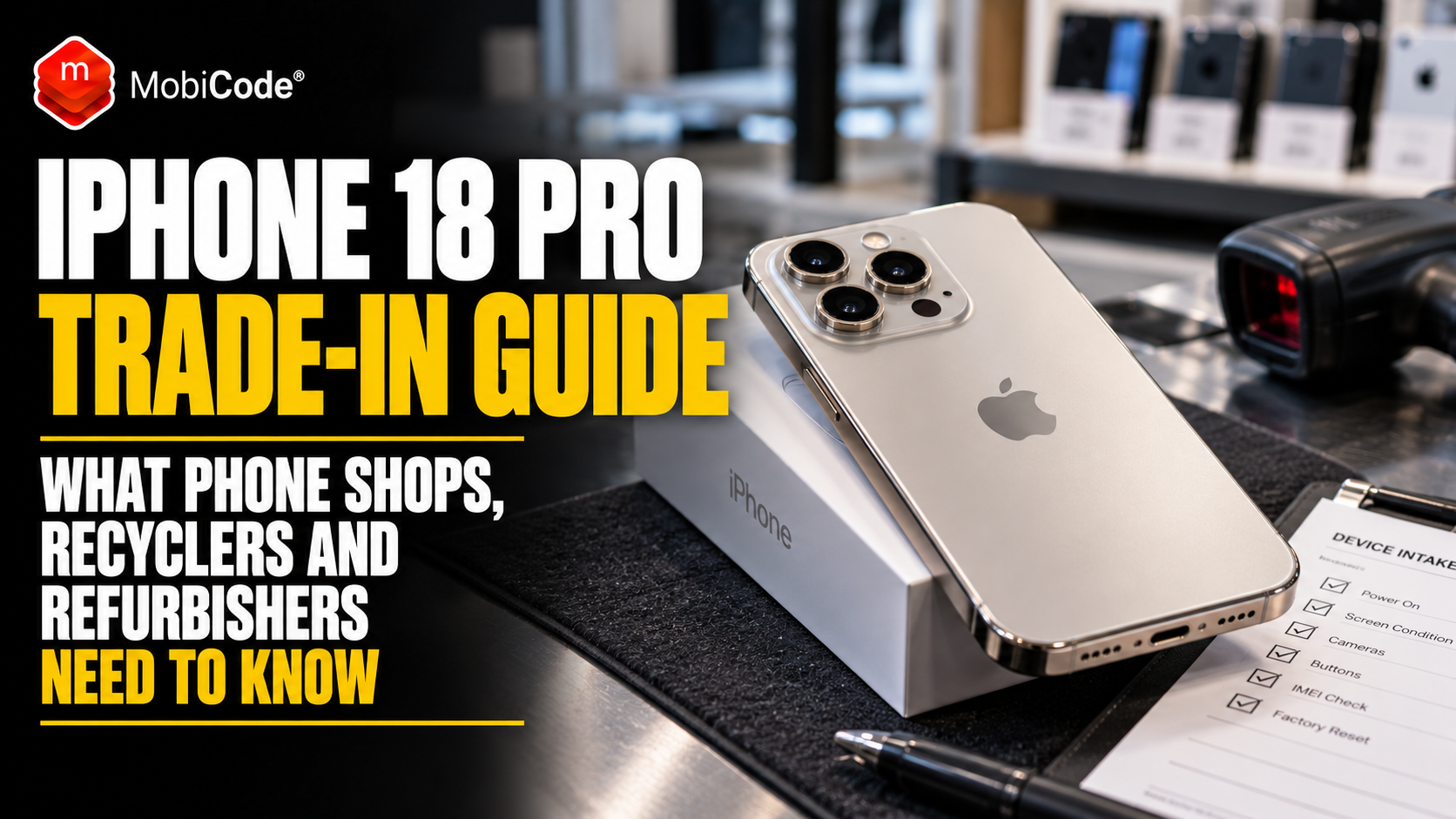
The iPhone 18 Pro trade-in cycle is already under way. For mobile phone shops, recyclers and refurbishers, the interesting story is not simply Apple’s new camera or processor — it is the wave of iPhone 17, 16 and 15 Pro models now moving back into the second-hand market.
Apple released the iPhone 18 Pro and iPhone 18 Pro Max on 18 September 2026. With UK launch prices starting at £1,199 and £1,299 respectively, many buyers are using the residual value of an existing handset to fund the upgrade.
That creates an immediate opportunity for trade-in businesses. It also raises the stakes: high-value inbound iPhones need accurate identification, live device-status checks, consistent diagnostics, secure data erasure and sensible grading before they can become profitable resale stock.
Why phone businesses should care
New iPhone launches consistently trigger trade-ins of the previous generations. The opportunity is not only selling the iPhone 18 Pro. It is acquiring the right iPhone 17, 16 and 15 models at the right price, identifying risky devices early and turning good stock back into resale inventory efficiently.
iPhone 18 Pro is already creating a new trade-in cycle
Major smartphone launches have an immediate effect on the secondary market.
Recommerce’s 2026 Trade-In Index describes manufacturer launches as major catalysts for trade-in activity. Its data shows that consumers increasingly use the value locked inside their current handset to help fund the next one.
Across its European data, the average smartphone trade-in value rose to €189 in 2026, more than 10% higher than the €170 recorded in 2025.
Apple launches have an especially pronounced effect.
Recommerce reported that after the iPhone 17 launch, Apple devices temporarily represented nearly 80% of its trade-in mix.
The same mechanism is now repeating around the iPhone 18 Pro.
Older Pro Max phones are already coming back into the market
SellCell’s trade-in activity between 9 and 20 September 2026 provides an early indication of which phones consumers are replacing.
In that dataset, the iPhone 17 Pro Max accounted for 12.8% of all iPhone trade-in activity, followed by the iPhone 16 Pro Max at 9.7% and the iPhone 15 Pro Max at 8.7%.
Four of the five most commonly traded iPhones in the sample were Pro Max models.
Those figures come from one trade-in comparison platform rather than the whole market, but the pattern is commercially interesting: relatively recent, high-value flagship devices are flowing into resale channels immediately after the new launch.
What is new on the iPhone 18 Pro?
Understanding the new model helps a trade-in business understand why customers are upgrading and which features may support future residual value.
Apple launched two Pro models:
- iPhone 18 Pro — from £1,199 in the UK;
- iPhone 18 Pro Max — from £1,299 in the UK.
Both are available with 256GB, 512GB, 1TB or 2TB of storage and in black, silver, glacier and burgundy.
A20 Pro and new thermal design
The new A20 Pro processor sits alongside a redesigned vapour-chamber cooling system.
Apple says the combination produces significantly higher sustained performance than the previous generation, particularly for demanding workloads and AI features.
For the used-device market, the important point is less about benchmark numbers and more about product positioning: these are expensive flagship handsets intended to remain desirable for several years.
The main camera now has variable aperture
One of the biggest hardware changes is the 48MP Fusion Main camera with variable aperture.
It can operate at several aperture settings, while the wider Pro camera system includes 48MP Main, Ultra Wide and Telephoto cameras.
For repairers and refurbishers, increasingly sophisticated camera hardware reinforces the need for proper functional testing rather than judging a handset solely by whether the Camera app opens.
Battery life has moved again
Apple rates iPhone 18 Pro Max for up to 43 hours of video playback and iPhone 18 Pro for up to 34 hours.
Faster wired charging can reach around 50% in 15 minutes with compatible equipment.
Battery performance remains one of the most visible differences between a strong refurbished handset and one that creates a dissatisfied customer later.
Why the iPhone 18 Pro matters more to used-phone businesses than its sales figures
A new flagship does two things at once.
It creates demand at the top of the new-device market while releasing previous-generation phones into the secondary market.
That second effect is particularly important in 2026.
New smartphone prices are under pressure from higher component costs, while industry analysts continue to expect growth in organised second-hand sales.
CCS Insight has described the opportunity for the secondary market as substantial as consumers look for alternatives to increasingly expensive new phones.
GSMA research published this year also found that almost half of consumers surveyed would consider buying a refurbished smartphone for their next device, even though actual refurbished adoption remains considerably lower in many markets.
That gap represents both an opportunity and a challenge.
Consumers want the saving. They also want confidence that the phone they are buying is genuine, working, appropriately graded, securely wiped and commercially safe.
Which iPhones should shops expect to see after the iPhone 18 Pro launch?
Early trade-in data suggests the obvious answer: premium previous-generation iPhones.
The iPhone 17 Pro Max is particularly important because consumers upgrading annually can unlock significant residual value while the device is still relatively new.
However, the trade-in wave extends further back.
Recommerce’s 2026 data shows that iPhone 13, iPhone 14 and iPhone 15 generation devices remain among the most commonly traded smartphones.
That means stores should be prepared for a mixed intake containing:
- recent high-value iPhone 17 Pro and Pro Max devices;
- iPhone 16 Pro-series devices with strong remaining resale value;
- iPhone 15 devices entering a more mature resale price band;
- older iPhone 13 and 14 devices that remain commercially relevant at the right acquisition cost.
The first mistake: valuing before verifying the exact device
High-value trade-ins need accurate identification.
Storage capacity alone can materially change value, particularly when the Pro range now extends from 256GB to 2TB.
A useful intake record should therefore connect the IMEI and serial number with the exact model, capacity, condition and transaction.
That sounds basic, but mistakes at this stage propagate through everything that follows.
Watch for regional iPhone 18 Pro differences
The iPhone 18 Pro also illustrates why device businesses should understand regional variants.
Apple’s UK specification supports a physical nano-SIM and eSIM as well as dual eSIM.
However, Apple sells eSIM-only versions of the iPhone 18 Pro in several markets, including the United States, Canada, Japan, the UAE and a number of other countries.
Those versions use the space normally occupied by the physical SIM tray for additional battery capacity.
An imported handset may therefore differ from the version a UK customer expects.
For a reseller, that does not automatically make the device unsuitable. It does mean the model and regional configuration should be understood before valuation and resale description.
Check the IMEI before committing money
The biggest visible upgrade can distract from the least visible risk.
A premium iPhone can look immaculate, pass a quick functional test and still be a poor purchase because of its device status.
Before a trade-in or buyback business commits significant money, it should investigate the IMEI and relevant status information.
MobiCHECK provides live device-status due diligence using multiple independent datasets, including the GSMA Global Blacklist Registry.
It can surface relevant information around blocked, lost or stolen devices, active finance and insurance-related records.
The higher the handset value, the more expensive a bad intake decision becomes
A poor decision on a low-value phone may be irritating.
A poor decision on a recent Pro Max can tie up hundreds of pounds of stock value immediately.
That makes early due diligence one of the cheapest points at which to stop a problematic device.
MobiBLOCK adds the other side of the status equation
MobiBLOCK is relevant because high-value flagship phones are not only trade-in stock. They are also valuable business assets.
Retailers, rental firms, leasing businesses, finance providers and other organisations can retain a financial or operational interest in a handset after it leaves their immediate control.
If a device becomes stolen, lost, fraudulently retained or is not returned, an eligible business may have a legitimate reason to take action against the handset itself.
MobiBLOCK allows appropriate devices to be blocked or flagged and can record active finance, rental or lease interests.
Why this matters to the next phone shop
A device does not cease to carry risk simply because it moves to another owner or another part of the supply chain.
MobiCHECK can surface devices that MobiBLOCK has blocked or flagged.
That means a downstream trade-in operator has another opportunity to investigate before paying for an iPhone that another organisation still has a legitimate interest in.
The useful relationship
MobiBLOCK: act on an at-risk device.
MobiCHECK: check relevant status before buying it later.
Check Parts and Service History on incoming iPhones
Device history is increasingly visible within iOS itself.
Apple’s Parts and Service History can show information about replacement components on supported iPhone models.
For iPhone 12 and later, Apple can provide information covering areas including the battery, display, logic board, front camera and rear cameras.
Depending on the handset and component, iOS may identify a part as genuine, used or otherwise unable to be verified as expected.
That does not replace a physical and functional inspection.
It does provide another useful signal when grading and valuing a recently repaired handset.
Test the hardware — don’t assume a recent iPhone is fault-free
The age of a handset is not a diagnostic result.
A recent iPhone can still arrive with damage to its camera system, screen, microphones, speakers, buttons, charging components, sensors or connectivity.
MobiTEST provides guided device diagnostics designed to make functional testing more consistent across operators.
For shops handling a launch-driven spike in trade-ins, consistency matters because intake volume often rises precisely when staff are busiest.
Camera testing deserves particular attention
The iPhone 18 Pro’s triple 48MP camera system and variable-aperture main camera make imaging one of its most important selling points.
A problem that affects autofocus, stabilisation, one lens or camera switching may therefore have a disproportionate effect on resale value.
The correct approach is not to assume a premium camera system is working because one photograph looks acceptable.
Securely erase the previous owner’s data
Once the business has decided to acquire and process the handset, previous-owner data needs appropriate handling before resale.
MobiWIPE provides controlled mobile-device data erasure for Apple and Android devices.
For commercial operations, the value is not simply pressing a reset button. It is carrying out the erasure consistently and retaining a useful device-level record of the process.
MobiONE can join the stages together
A shop processing a handful of devices can often keep each stage mentally separate.
A recycler or multi-site operation handling hundreds or thousands of phones needs something more systematic.
MobiONE brings MobiCHECK, diagnostics and secure erasure into a broader device-processing workflow.
It also supports alerts and workflow controls around issues such as blocklist status and activation locks.
The commercial objective is straightforward: prevent a busy operator from accidentally skipping the stage that later costs the business money.
A practical iPhone 18 trade-in workflow
For phone shops preparing for more Apple trade-ins, a strong intake process can remain simple.
Capture IMEI, serial number, exact model, storage capacity and regional variant.
Investigate blocklist, theft, finance, insurance and relevant device-status information before payout.
Check relevant lock status and Apple’s Parts and Service History where available.
Run consistent functional diagnostics rather than relying on a quick visual demonstration.
Use physical condition, functionality, capacity and market demand to make the commercial decision.
Securely remove previous-owner data before the handset returns to sale.
Keep the relevant status, diagnostic, grading and erasure information against the correct device.
Do not overlook Activation Lock
An otherwise valuable iPhone can become difficult to resell if it remains linked to the previous owner’s account.
Activation Lock and IMEI status are separate issues.
One concerns Apple’s ownership and activation protections. The other concerns device-status information associated with the handset’s IMEI.
A professional intake process should therefore avoid treating one successful check as proof that every other relevant check has passed.
How should phone shops value iPhone 17 Pro Max after the iPhone 18 launch?
There is no universal value because the answer depends on capacity, physical condition, battery condition, repair history, device status, region and current resale demand.
The more important commercial lesson is that launch periods can change prices quickly.
More sellers enter the trade-in market at exactly the same time, increasing supply.
That means buy prices and expected resale prices should be reviewed frequently rather than treated as static for weeks at a time.
Higher-value devices can support better margins — but magnify mistakes
A clean recent-generation Pro Max can be excellent resale stock.
It also requires substantially more working capital than an older mid-range device.
Accurate status checking, diagnostics and grading therefore become increasingly important as average intake value rises.
The refurbished iPhone opportunity is bigger than one launch
The wider market context is favourable for professional used-device businesses.
GSMA research indicates strong consumer interest in refurbished phones but also identifies trust as one of the barriers holding the market back.
Buyers want to know what they are getting.
That puts professional recyclers and refurbishers in a strong position when they can provide consistent grading, reliable functionality and confidence around device history.
Rising new-phone prices may make that proposition even stronger.
Counterpoint’s September outlook suggests that pressure on component costs is particularly severe lower down the new-device market and could push more consumers towards repair, used and refurbished alternatives.
What should mobile phone shops prepare for now?
The iPhone 18 Pro launch is already live, so this is not a theoretical future wave.
Businesses handling Apple trade-ins can prepare by reviewing:
- buy prices for the iPhone 17, 16 and 15 families;
- capacity-specific valuations;
- regional and eSIM-only variants;
- IMEI and device-status checks;
- Activation Lock controls;
- Parts and Service History checks;
- camera, battery and functional diagnostics;
- grading consistency across staff;
- secure data-erasure procedures;
- how exceptions are recorded and escalated.
Commercial takeaway
The iPhone 18 Pro opportunity is really an inbound-stock opportunity
The newest iPhone attracts the headlines, but for second-hand businesses the real opportunity sits in the devices consumers trade to fund it.
Recent iPhone 17 Pro Max, iPhone 16 Pro Max and other premium Apple handsets can represent valuable resale stock — provided businesses know exactly what they are buying.
That means checking device status before payout, testing hardware consistently, handling data correctly and keeping enough evidence to explain the buying and processing decision later.
Where the MobiCode products fit
MobiCode’s product suite addresses different stages of that used-iPhone workflow.
| Question | MobiCode product |
|---|---|
| Is this iPhone commercially safe to buy? | MobiCHECK |
| Does the handset actually work correctly? | MobiTEST |
| Has previous-owner data been securely erased? | MobiWIPE |
| How do we standardise processing across volume? | MobiONE |
| What if our high-value device becomes stolen, unreturned or improperly resold? | MobiBLOCK |
Why MobiBLOCK is relevant to premium iPhones
The launch price of the iPhone 18 Pro is also a reminder of how much financial value can sit inside a single mobile asset.
For businesses that rent, lease, finance or manage high-value phones, that value remains exposed when a device is stolen, fraudulently retained or not returned.
MobiBLOCK gives eligible organisations a device-level response by allowing appropriate handsets to be blocked or flagged.
Those flags can also become useful further down the second-hand chain because MobiCHECK can surface devices that MobiBLOCK has blocked or flagged.
That helps connect the organisation protecting a valuable handset with the trade-in or recycling business that may encounter it later.
Expecting more iPhone trade-ins?
MobiCode can help businesses check incoming iPhones, test devices consistently, securely erase previous-user data and protect high-value mobile assets.
Frequently asked questions
When was the iPhone 18 Pro released?
Apple announced the iPhone 18 Pro and iPhone 18 Pro Max on 9 September 2026. They became available in the UK and many other markets on 18 September 2026.
How much does the iPhone 18 Pro cost in the UK?
At launch, the iPhone 18 Pro started at £1,199 in the UK and the iPhone 18 Pro Max started at £1,299. Prices vary by storage capacity.
Which iPhones are being traded in after the iPhone 18 Pro launch?
Early SellCell data from the launch period showed the iPhone 17 Pro Max as its most frequently traded iPhone, followed by the iPhone 16 Pro Max and iPhone 15 Pro Max among the leading models. Exact patterns vary between trade-in channels and markets.
Are all iPhone 18 Pro models the same worldwide?
No. Regional configurations differ. UK iPhone 18 Pro models support nano-SIM and eSIM, while Apple sells eSIM-only versions in a number of other markets. Businesses handling imported devices should confirm the exact regional model before resale.
What should a phone shop check before buying a used iPhone?
Professional buyers should identify the exact handset, check relevant IMEI and device-status information, confirm lock status, inspect repair history where available, test hardware functionality, grade the physical condition and securely erase previous-user data before resale.
What is MobiBLOCK?
MobiBLOCK is MobiCode’s business asset-protection service. It helps eligible organisations block or flag appropriate stolen, lost, fraudulently retained or unreturned devices and can record active finance, rental or lease interests.
How do MobiBLOCK and MobiCHECK work together?
MobiBLOCK helps an eligible organisation act on an at-risk handset, while MobiCHECK helps a downstream business investigate relevant device status before buying or processing it. MobiCHECK can surface devices that MobiBLOCK has blocked or flagged.
Sources and further reading
- Apple — iPhone 18 Pro and iPhone 18 Pro Max announcement
- Apple — iPhone 18 Pro technical specifications
- Apple Support — iPhone Parts and Service History
- GSMA / Recommerce — Trade-In Index 2026
- SellCell — iPhone trade-in activity following the iPhone 18 Pro launch
- GSMA — consumer trust and the refurbished smartphone market
- MobiCode — MobiCHECK device-status due diligence
- MobiCode — MobiTEST guided diagnostics
- MobiCode — MobiWIPE secure data erasure
- MobiCode — MobiONE device processing
- MobiCode — MobiBLOCK device blocking and asset protection