

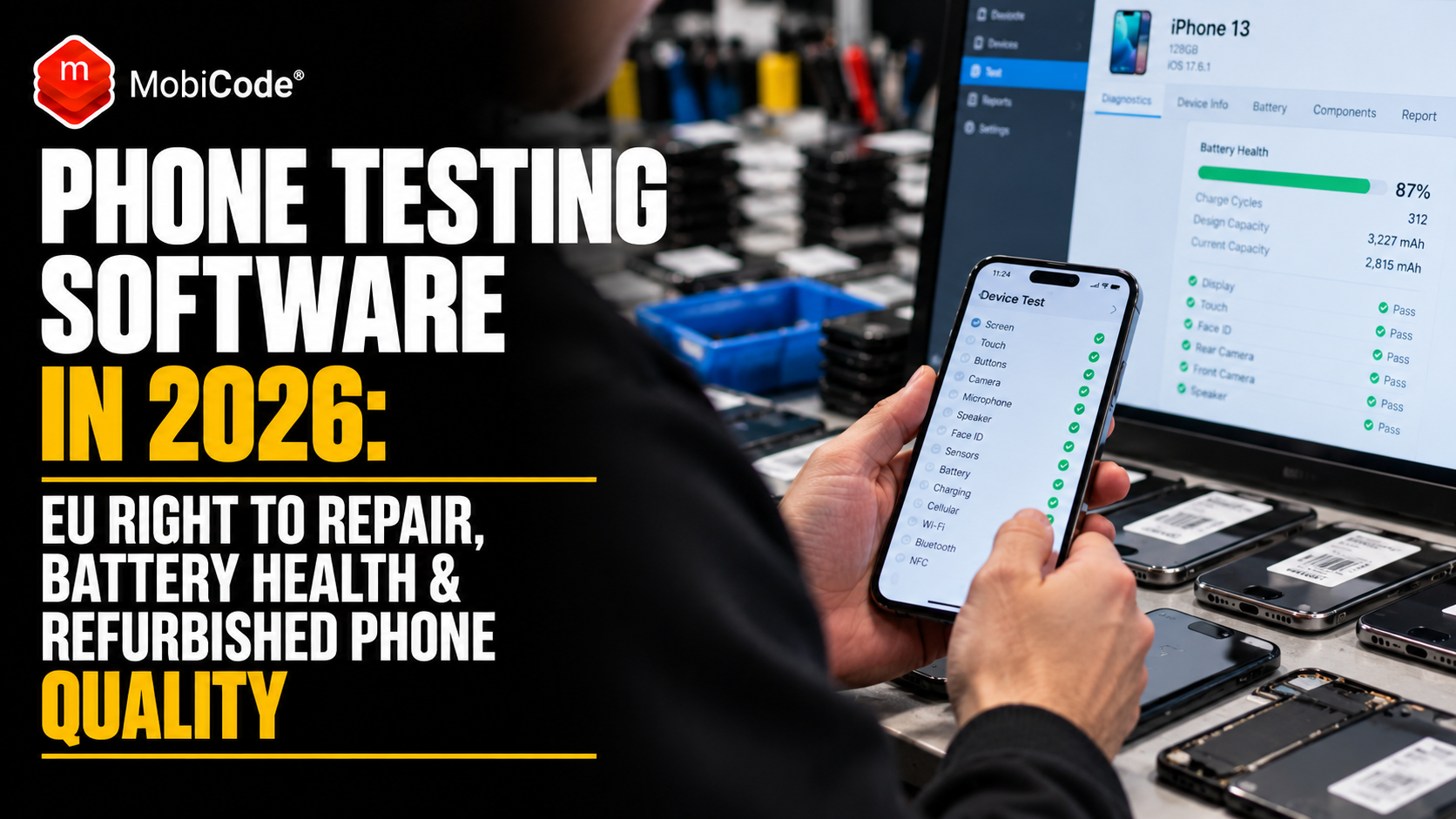
Phone testing software is becoming more important as smartphone repairability, battery longevity and refurbished-device quality move higher up the agenda. New EU Right to Repair rules now strengthen consumers’ ability to request repairs, while smartphone energy labels reveal far more about durability and repairability than they did before.
However, those labels describe the model when it enters the market. They cannot tell a refurbisher whether the individual three-year-old handset on the bench has a faulty microphone, damaged touchscreen, weak speaker, failed sensor or unreliable Bluetooth connection.
Therefore, businesses buying, repairing and reselling used devices still need a repeatable way to test each physical handset. This guide explains what changed in 2025 and 2026, what the new repair rules actually mean and where professional phone testing software such as MobiTEST fits into a modern refurbishment workflow.
The key distinction
A repairability score tells you something about a smartphone model. Phone testing software tells you whether the individual used handset in front of you actually works.

Why phone testing software matters more in 2026
Europe has spent the last several years pushing smartphones towards longer useful lives.
First, new smartphone and tablet ecodesign and energy-labelling requirements began applying to relevant products placed on the EU market from 20 June 2025.
According to the European Commission’s smartphone and tablet guidance, the measures focus on repairability, battery durability, software support, spare parts, drop resistance and protection from dust and water.
Then, on 31 July 2026, Member States began applying the EU’s new Right to Repair rules.
The European Commission says the Directive aims to encourage repair instead of premature replacement, including for mobile phones and tablets.
Consequently, repairability is becoming a much more visible part of the smartphone buying decision.
For refurbishers, however, this creates another challenge: more repairable devices still need accurate diagnosis.
What changed for smartphones under the EU ecodesign rules?
The rules introduce minimum requirements that aim to extend the useful life of smartphones.
For example, batteries in relevant smartphones must withstand at least 800 charge and discharge cycles while retaining at least 80% of their initial capacity.
In addition, manufacturers must make specified critical spare parts available within defined delivery periods. Those obligations can continue for seven years after sales of the model end in the EU.
The rules also require longer operating-system support. Specifically, relevant software upgrades must remain available for at least five years from the end of placement of the final unit of that model on the EU market.
Moreover, professional repairers must receive non-discriminatory access to software or firmware required for component replacement.
Therefore, the regulation addresses several of the barriers that historically made some smartphones difficult or uneconomic to repair.
The EU smartphone energy label now shows repairability
The energy label is particularly interesting for the refurbished-device sector.
Relevant smartphones and tablets now display information covering energy efficiency, battery endurance, drop resistance, battery cycle durability, repairability and ingress protection.
A QR code also links buyers to additional information in the European Product Registry for Energy Labelling, or EPREL.

Repairability is now graded from A to E
For the first time, the EU energy label includes a repairability class for smartphones and tablets.
The scale runs from A to E, with A representing the strongest repairability performance.
The underlying assessment considers several factors connected to disassembly, spare parts, repair information and the practical ability to restore the product.
As a result, consumers can compare two phone models on more than price, camera quality and battery life.
Nevertheless, refurbishers must not confuse repairability with current condition.
An A-rated phone can still be faulty
Consider a smartphone model with an excellent repairability score.
Three years later, a used example arrives at a trade-in desk.
The model may have been designed to last well. However, that particular handset might have suffered several drops, a poor-quality previous repair or years of heavy use.
For instance, its microphone may fail intermittently. The touchscreen may contain a dead area. Bluetooth may drop connections. A proximity sensor may no longer respond correctly.
Therefore, the repairability label cannot replace diagnostics.
How phone testing software fills the information gap
Phone testing software answers the question that regulations and specifications cannot:
That answer affects several commercial decisions.
A refurbisher needs to decide whether to buy the device, repair it, grade it, resell it or route it elsewhere.
Similarly, a repair business needs to know whether a component replacement actually solved the original fault.
Consequently, diagnostic quality influences both acquisition margin and customer returns.
Where MobiTEST fits
MobiTEST is MobiCode’s guided diagnostic platform for businesses processing pre-owned smartphones.
MobiCode says the system has been designed to reduce testing times while improving diagnostic consistency.
In particular, its guided workflow can test handset functionality in under two minutes.
Furthermore, MobiTEST supports multiple device connections simultaneously or independently, which makes it relevant to businesses processing larger volumes.
Instead of allowing every operator to create their own test routine, the software guides staff through a defined workflow.
Therefore, the business can increase throughput without deliberately removing important diagnostic checks.
What should phone testing software test?
Good phone testing software should cover several parts of the handset because no single test can establish whether a used smartphone is commercially ready.
MobiTEST currently includes checks across hardware buttons, displays, touch response, pixels, colour, speakers, microphones, headphones, pressure sensors, proximity sensors, gyroscopes, accelerometers, USB, Wi-Fi and Bluetooth.
In addition, the platform can capture custom grading information directly during the diagnostic process.
Consequently, functional testing and condition assessment can form part of one repeatable intake routine.
Screen problems are easy to underestimate
A phone display can appear fine when an employee opens the home screen.
However, closer testing may reveal problems with touch sensitivity, colour, pixel behaviour or sections of the display.
Those issues can become expensive after resale because customers interact with the display constantly.
Therefore, MobiTEST includes dedicated screen checks rather than treating visual inspection as sufficient.
Microphone and speaker faults can hide during intake
Audio faults provide another good example.
A device may switch on, charge correctly and look almost perfect while a microphone performs poorly.
Unless the operator actively tests it, the fault can remain invisible until a customer makes a call.
Likewise, internal and external speaker issues may not become obvious during a quick cosmetic assessment.
MobiTEST therefore includes sound testing as part of the guided diagnostic workflow.
Sensors matter even when customers cannot see them
Modern phones rely on several sensors that users rarely think about until something goes wrong.
For example, the proximity sensor helps control the screen during calls, while gyroscope and accelerometer data support orientation and movement-dependent functions.
Consequently, a handset can look fully operational while still containing a sensor fault.
MobiTEST includes guided sensor checks so staff do not need to remember each one manually.
Connectivity needs testing too
Wi-Fi, Bluetooth and USB connectivity influence everyday use and refurbishment workflows.
Therefore, a phone that connects successfully once to a mobile network should not automatically pass functional testing.
MobiTEST includes connectivity checks covering USB, Wi-Fi and Bluetooth.
As a result, businesses can include those functions in the same standard testing process.
Why phone testing software helps reduce human variation
An experienced technician often develops an instinctive testing routine.
However, that approach becomes difficult to scale.
Imagine a refurbisher with 15 employees processing phones across two shifts.
One operator checks microphones every time. Another concentrates on screen condition. A third remembers Bluetooth only when something appears wrong.
Meanwhile, new employees may follow an entirely different process.
As volume increases, those small differences create operational variance.
Phone testing software helps turn individual knowledge into a repeatable workflow.
Right to Repair makes diagnostics more valuable, not less
Better access to spare parts does not eliminate the need for testing.
Instead, it can increase the value of accurate fault identification.
If a business can economically replace a faulty component, it first needs to know which component is actually causing the problem.
For example, a device with one repairable microphone fault may be worth buying and restoring.
By contrast, a handset with several expensive failures may not justify the repair cost.
Therefore, diagnostics help the refurbisher decide where to invest labour and parts.
Recent research suggests smartphone repairability is improving
There is already evidence that the regulatory direction is having an effect.
In June 2026, European consumer organisation BEUC published a cross-European repairability check.
The BEUC research found that smartphones covered by specific EU repair requirements generally offered better access to spare parts and repair instructions than products without equivalent requirements.
However, the research also identified cost as a continuing barrier.
For example, the most expensive smartphone display found during the study cost around €400, roughly 30% of that device’s original purchase price.
Consequently, refurbishers still need to know whether a repair makes economic sense before ordering expensive components.
Good diagnostics can protect refurbishment margin
Consider a used phone purchased for £250 and expected to resell for £400.
On paper, the margin looks attractive.
However, a missed camera, display or charging fault can quickly consume much of that difference.
Furthermore, the cost does not end with the repair.
Staff may already have cleaned, graded, photographed, listed, packed and shipped the handset before the customer discovers the fault.
Therefore, finding problems earlier is usually cheaper than dealing with them after resale.
Phone testing software also helps after repair
Repair should not automatically mean pass.
Instead, a business should verify that the repair solved the problem and did not introduce another one.
MobiTEST supports retesting of all or part of a workflow.
Therefore, after replacing a component, the operator can repeat the relevant checks before the handset returns to sale-ready stock.
This is particularly useful when the business wants a consistent quality-control step after repair.
Battery durability rules do not replace battery assessment
The EU rules require relevant smartphone batteries to meet defined durability standards when products enter the market.
However, a refurbisher may receive the phone several years later.
Consequently, the original design requirement cannot reveal the present condition of that individual battery.
Usage patterns, heat exposure, charging habits and age can all affect battery performance over time.
Therefore, current device condition remains more important to the resale decision than the original specification alone.
Repairability and testing solve different problems
The distinction is simple.
| Question | What answers it? |
|---|---|
| How repairable is this smartphone model? | Repairability information and manufacturer documentation |
| Does this individual used phone actually work? | MobiTEST |
| Is the device commercially appropriate to buy? | MobiCHECK |
| How do we control the entire processing workflow? | MobiONE |
Commercial status must be checked separately
A phone can pass every hardware test and still be a poor purchase.
For example, it could carry a blocklist issue or activation restriction.
MobiTEST includes built-in blocklist and activation-lock functionality as part of MobiCode’s wider device-processing environment.
Meanwhile, MobiCHECK provides MobiCode’s dedicated device-status due-diligence service.
Therefore, diagnostics and device-status checking should complement one another rather than compete.
A better used-phone testing workflow
1. IDENTIFY
Confirm the device
First, capture the IMEI, serial number, model, storage and relevant transaction or batch reference.
2. CHECK
Run device due diligence
Next, identify relevant blocklist, activation-lock or commercial-status issues before investing unnecessary processing time.
3. TEST
Run guided diagnostics
Then test the display, hardware, sound, sensors and connectivity through the defined diagnostic workflow.
4. DIAGNOSE
Identify repair requirements
Afterwards, use the results to decide whether repair makes commercial sense.
5. REPAIR
Fix the relevant fault
Where the economics work, repair or replace the relevant component using the appropriate procedure.
6. RETEST
Verify the result
Crucially, repeat the necessary diagnostics before returning the device to normal stock.
7. GRADE
Record final condition
Finally, apply the business’s agreed cosmetic grade and retain the relevant test information.
Why phone testing software matters at high volume
Efficiency becomes much more important when a business processes hundreds of devices.
Suppose a refurbisher receives 500 phones in one working day.
Saving just one minute of unnecessary handling per handset removes more than eight hours of work from the total daily processing requirement.
Across five days, that exceeds 40 hours.
Therefore, even small workflow improvements can have a meaningful operational effect.
MobiCode says MobiTEST can complete its guided testing workflow in under two minutes while also supporting multiple connected devices.
As a result, the goal is not simply to test one device quickly. It is to increase total throughput while keeping the process consistent.
Phone testing software can make new staff productive faster
Training is another hidden cost in refurbishment.
Experienced technicians may have accumulated years of informal knowledge.
However, a growing business cannot wait years for every new employee to develop the same instincts.
Guided diagnostics give staff a defined process to follow.
Moreover, MobiCode says MobiTEST works with existing PCs rather than requiring expensive dedicated testing hardware.
Consequently, smaller phone shops can adopt a structured testing process without necessarily rebuilding their workstation environment.
Reporting turns testing into evidence
A test is more useful when the business can retrieve the result afterwards.
MobiTEST provides reporting through MobiCode’s platform and can produce detailed device-test information.
That becomes useful when a manager reviews a processing decision or a customer later returns a handset.
For example, instead of saying “we normally test every microphone”, the business can retain a clearer device-processing record.
In addition, reporting can help identify differences between operators and locations.
How phone testing software can support consistent grading
Functional condition and cosmetic condition are different, yet both influence resale value.
MobiTEST allows businesses to capture custom grading information during processing.
Therefore, grading does not need to sit in a completely separate manual process.
Although cosmetic grading still requires human judgement, a defined workflow can help employees apply the business’s own standards more consistently.
When MobiONE becomes the better fit
MobiTEST primarily addresses guided diagnostics.
However, some organisations eventually need to control more of the device lifecycle.
MobiONE combines device lookup, testing, grading, workflow controls and secure data erasure in a wider PC-based processing platform.
Therefore, MobiONE becomes particularly relevant when a refurbisher moves from “we need better testing” to “we need one controlled process for everything”.
What should you look for in phone testing software?
Businesses should evaluate the complete operational value rather than simply comparing the number of tests.
- guided diagnostics that staff can follow consistently;
- screen and touch testing;
- speaker and microphone testing;
- sensor testing;
- Wi-Fi, Bluetooth and USB checks;
- retesting after repair;
- multiple simultaneous devices;
- custom grading;
- activation-lock and blocklist checks;
- reporting and oversight;
- simple staff training;
- support for existing business hardware.
Do EU energy labels replace phone testing software?
No.
The EU label provides useful information about the model’s original energy efficiency, battery endurance, repairability and durability characteristics.
However, a used handset may have experienced years of wear, accidental damage and previous repair.
Therefore, the label cannot certify the current condition of that individual phone.
Phone testing software remains relevant because used-device businesses make decisions about physical handsets, not theoretical new examples of the model.
Will Right to Repair increase the value of diagnostics?
Potentially, yes.
If repair becomes easier and manufacturers keep parts available for longer, businesses can economically restore more devices.
However, that opportunity depends on knowing what is wrong first.
Consequently, diagnostics become the bridge between “this handset is faulty” and “this handset is worth repairing”.
Better fault detection can therefore support both environmental goals and commercial margin.
Why UK phone businesses should pay attention
The EU rules described above apply to relevant devices placed on the EU market.
Therefore, businesses should not present them as automatic UK domestic requirements.
Nevertheless, UK repairers and refurbishers still have good reasons to watch them closely.
Manufacturers sell many of the same smartphone models across Britain and the EU. Furthermore, used-device supply chains routinely cross borders.
In addition, consumer expectations around battery life, repairability and longer device lifetimes are unlikely to remain confined to one jurisdiction.
As a result, UK businesses that build strong testing and repair processes now may be better positioned as those expectations continue to rise.
Commercial takeaway
More repairable phones make accurate diagnostics more valuable
Europe’s latest rules are designed to keep smartphones useful for longer and make repairs easier.
However, a repairability rating still cannot tell a recycler or refurbisher whether the individual used device in front of them works.
MobiTEST gives professional device businesses a fast and repeatable phone testing software workflow so staff can identify faults, retest repairs, apply grading and make more consistent processing decisions.
Use MobiTEST phone testing software to standardise diagnostics
MobiTEST is designed for phone shops, recyclers and refurbishers that repeatedly process pre-owned smartphones.
Its current feature set includes guided testing in under two minutes, multiple connected devices, screen tests, sound diagnostics, sensor checks, connectivity testing, custom grading, retesting, reporting and workflow controls.
Furthermore, MobiTEST integrates device due diligence into the process through blocklist and activation-lock checking.
Consequently, businesses can reduce reliance on informal manual testing while improving consistency across staff and locations.
Still testing used phones manually?
Standardise screen, sound, sensor, hardware and connectivity checks with MobiTEST — guided phone testing software built for professional device processing.
Frequently asked questions about phone testing software
What is phone testing software?
Phone testing software guides or automates checks across smartphone hardware, displays, sound, sensors and connectivity. Professional systems can also support grading, retesting, reporting and device-status checks.
What does the EU smartphone energy label show?
The EU smartphone energy label includes energy efficiency, battery endurance per charge, battery cycle durability, drop resistance, repairability class and ingress-protection information for relevant products placed on the EU market.
Does an EU repairability score show whether a used phone works?
No. The repairability score describes characteristics of the phone model. It does not certify the current functional condition of an individual second-hand handset, so refurbishers still need appropriate diagnostics.
What does MobiTEST test?
MobiTEST provides guided diagnostics covering hardware buttons, screens and touch input, pixels and colour, speakers, microphones, sensors, USB, Wi-Fi and Bluetooth connectivity, with grading and reporting capabilities.
Can MobiTEST test several phones at once?
Yes. MobiTEST supports multiple devices connected simultaneously or independently, helping higher-volume refurbishment and recycling operations increase diagnostic throughput.
What is the difference between MobiTEST and MobiONE?
MobiTEST focuses on guided smartphone diagnostics. MobiONE extends that capability into a wider device-processing workflow combining due diligence, diagnostics, grading, workflow controls and secure data erasure.
Sources and further reading
European Commission — Smartphones and Tablets
Current ecodesign, battery, repairability and energy-labelling requirements.
European Commission — Directive on Repair of Goods
Current EU Right to Repair framework applying from 31 July 2026.
BEUC — Repairing the Market, June 2026
Cross-European research into smartphone repairability, spare parts and repair costs.
MobiCode — MobiTEST
Guided smartphone diagnostics, grading, retesting and reporting.
MobiCode — MobiCHECK
Device-status due diligence for professional used-device buyers.
MobiCode — MobiONE
Wider device-processing workflow combining checking, testing, grading and secure erasure.