

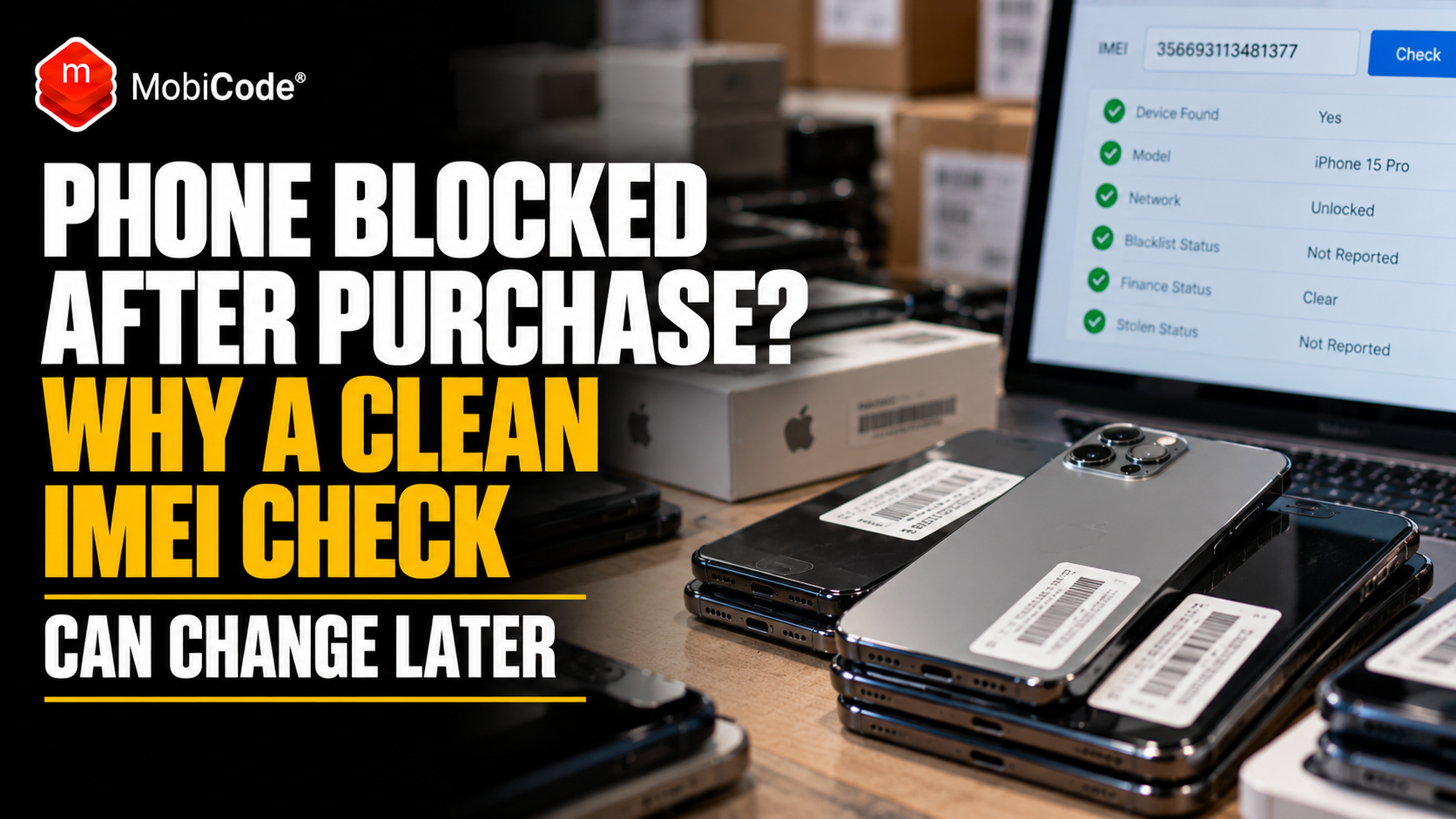
Phone blocked after purchase? It can happen even when an IMEI check looked clear at the point of sale. Device status is not necessarily permanent: a phone may be reported lost or stolen later, new information can enter industry databases after the original check, and some network-specific blocks may not appear on the global block list at all.
For an individual buyer, that can be frustrating. For a phone shop, recycler or trade-in business holding hundreds of used devices, it can become a recurring financial problem.
This guide explains why a phone can become blocked after purchase, what the GSMA says about changing IMEI status, why a one-time check cannot remove every risk and how MobiCHECK and MobiCHECK+ can help professional device buyers protect stock before and after they pay for it.
The important point
A clear IMEI result tells you what the available data says at the time of the check. It does not guarantee that the device’s status can never change afterwards.

Can a phone be blocked after you buy it?
Yes.
The GSMA makes this point explicitly in the terms for its Device Check service.
It warns that consumers may take time to report a device lost or stolen and that the status of a device can change after a check has been performed.
According to the GSMA Device Check terms, information relating to a newly reported lost or stolen phone can take up to 24 hours, and sometimes longer, to reach the GSMA Block List.
Therefore, a device that appears clear at 10am may not necessarily retain that same status indefinitely.
That timing gap is one reason a professional used-phone business should think beyond a single point-in-time lookup.
Why does a phone get blocked after purchase?
There is no single explanation.
However, several situations can produce a change in device status after a sale or trade-in.
1. The previous owner reports the phone lost or stolen later
Reporting does not always happen immediately.
A device could change hands before its previous owner contacts the relevant provider.
Once an eligible organisation reports the handset and the IMEI reaches the relevant block-list systems, its status can change.
Consequently, a check performed earlier may have accurately shown the information available at that moment even though the device later becomes flagged.
2. Information can take time to reach the GSMA Block List
Even after a report occurs, database updates are not necessarily instantaneous.
The GSMA itself warns that data can take up to 24 hours, and sometimes longer, to appear.
Therefore, there can be a window between the underlying event and the status becoming visible to another business.
3. A network may apply its own block
A clean GSMA Block List result is useful, but it does not cover every possible network decision.
The GSMA notes that a carrier can sometimes block a device because of billing issues with the owner even though that handset does not appear on the GSMA Block List.
Other networks may or may not treat the handset in the same way.
As a result, “not currently on the GSMA Block List” should not be interpreted as a guarantee that no network-specific restriction could exist.
4. An insurance or fraud investigation develops later
Device information can also evolve when insurers, networks, law enforcement or other authorised organisations receive new evidence.
For businesses dealing in pre-owned phones, the practical lesson remains the same: device status is information that can change over time.
What does an IMEI block actually do?
An IMEI is the unique device identifier used by cellular equipment.
The GSMA Device Check guidance explains that network blocking occurs when a mobile network operator prevents a device from accessing its network by blocking the IMEI.
Operators can share relevant reports through the GSMA Device Registry so participating networks can act on block-listed devices.
However, an IMEI block is not the same as physically disabling every function on the handset.
For example, blocking network access does not necessarily stop the device from using Wi-Fi.
Likewise, IMEI blocking is different from Apple Activation Lock, Android Factory Reset Protection and remote data erasure.
What does a red GSMA status mean?
GSMA Device Check uses a straightforward distinction.
A green result means the IMEI is not currently flagged on the GSMA Block List.
A red result means the identifier has been added to the Block List because the device has been reported lost, stolen or is otherwise considered unsuitable for use on cellular networks.
Importantly, the word currently matters.
A green status describes the information available at that time.
Why a phone blocked after purchase hurts businesses more
For a consumer, one problem handset is one problem transaction.
High-volume device businesses have a different exposure.
Imagine a recycler buying 2,000 used smartphones each month.
Even if only a small percentage later develop relevant status problems, the losses can accumulate.
The business may already have spent money on:
- buying the handset;
- shipping;
- cleaning;
- hardware diagnostics;
- repair;
- grading;
- data erasure;
- listing;
- packaging;
- customer fulfilment.
Therefore, post-purchase blocking is not simply an IMEI problem.
It can turn into an inventory, margin and customer-service problem.
The most expensive point to discover a problem is often after you have bought, processed, repaired and sold the handset.
The refurbished-phone market is growing in 2026
The size of the opportunity makes better due diligence increasingly important.
The GSMA’s 2026 Mobile Net Zero Report says the secondary smartphone market is projected to grow by around 8% annually over the next few years.
Meanwhile, nearly half of consumers surveyed by the GSMA said they would consider a refurbished device for their next phone.
Therefore, businesses have two opportunities at the same time:
- process more used devices as the market grows;
- give customers more confidence that those devices have undergone professional due diligence.
Phone theft makes strong IMEI checks even more relevant
There is also a current UK crime angle.
On 8 October 2026, the Metropolitan Police announced the results of its largest-ever crackdown on mobile phone theft.
The Met said more than 700 people had been arrested and hundreds of suspected stolen phones seized during one month of activity.
Officers also visited 220 second-hand phone shops to gather intelligence and build relationships with legitimate businesses.
Moreover, police executed more than 50 warrants, including at shops suspected of handling stolen devices.
That makes professional due diligence increasingly relevant to legitimate retailers and recyclers that want to keep problematic devices out of their stock.
Used-phone businesses cannot identify this risk visually
A blocked or soon-to-be-blocked phone does not necessarily look suspicious.
The handset may:
- look almost new;
- turn on normally;
- have its original box;
- pass hardware diagnostics;
- connect to Wi-Fi;
- have no cracked screen;
- appear completely ordinary.
Consequently, visual inspection cannot replace device-status due diligence.
Where MobiCHECK fits
MobiCHECK is MobiCode’s live IMEI and device-status due-diligence service.
MobiCode says it checks device IMEI numbers live against several independent datasets, including the GSMA Global Blacklist Registry.
Current MobiCHECK information can help businesses investigate whether a device is:
- network blocked;
- reported lost or stolen;
- linked to finance;
- associated with an insurance claim;
- consistent with the expected make and model.
The objective is simple: identify relevant risk before committing money or processing time.

A single IMEI check still cannot predict the future
This is an important limitation to understand.
MobiCHECK can provide current information from its available data sources.
However, no legitimate point-in-time status service can guarantee that nobody will submit new information tomorrow.
That is precisely why post-purchase monitoring exists.
Where MobiCHECK+ solves a different problem
MobiCHECK+ extends the checking process beyond the initial transaction.
MobiCode currently states that MobiCHECK+ monitors an IMEI for 30 days.
In addition, MobiCHECK offers watchlist functionality and instant alerts.
Therefore, a professional buyer can think about device risk in two stages:
BEFORE PURCHASE — MobiCHECK
Investigate the current IMEI, device identity and relevant status before paying for the handset.
AFTER PURCHASE — MobiCHECK+
Monitor valuable stock for 30 days so a relevant status change does not necessarily remain invisible until the handset reaches a customer.
Why 30-day monitoring can matter
Used devices often sit in stock before reaching their final buyer.
During that period, a handset may move through:
- goods-in processing;
- diagnostics;
- repair;
- grading;
- data erasure;
- photography;
- listing;
- warehouse storage;
- dispatch.
Therefore, the time between acquisition and final resale creates a natural monitoring window.
If relevant device status changes during that period, earlier visibility gives the business a better chance of investigating before the phone leaves its control.
A phone blocked after purchase can destroy the expected margin
Consider a simple commercial example.
A trade-in business buys a flagship smartphone for £500.
It expects to resell the handset for £650 after processing.
On paper, the gross difference is £150 before labour, delivery, payment fees and overhead.
However, if the phone later becomes commercially problematic, the business can put far more than that expected £150 margin at risk.
Therefore, the correct comparison is not:
A better commercial question is:
IMEI validation is another important layer
Device status is only useful if staff are checking the correct identifier.
The GSMA notes that a mismatch between device details and the handset being inspected can indicate a counterfeit device or tampering with its electronic identity.
MobiCHECK validates submitted IMEIs and can confirm the associated make and model.
Therefore, businesses can investigate two different risks:
- does the identifier represent the phone we think it does?
- what does current status information say about that identifier?
Red, amber and green results make decisions easier to standardise
MobiCHECK provides colour-coded results to simplify operational decision-making.
However, the colour should support a business policy rather than replace one.
For example, an operator might use an internal workflow such as:
- Green: continue if all other required checks pass;
- Amber: investigate before committing money;
- Red: stop the transaction under the business’s policy.
The precise rules belong to the business.
Nevertheless, clear status information can make those rules easier to enforce across multiple employees or stores.
Why phone shops should check before payout
Timing matters.
Once the customer has left with payment, investigating an unexpected status becomes more difficult.
Therefore, the strongest point for initial due diligence is while the transaction can still be paused.
A professional intake workflow might capture the IMEI as soon as staff identify the handset, run the relevant checks and then proceed to hardware diagnostics only after the device passes the required commercial controls.
Check commercial status before spending money on refurbishment
The sequence also matters for recyclers.
Imagine spending 20 minutes repairing a phone before discovering a serious status problem.
The business has invested labour and parts in a handset it might not want to put into normal resale stock.
Therefore, checking early can protect more than the purchase price.
A better used-phone buying workflow
Get the IMEI
Capture the device identifier early and connect it to the transaction or stock record.
Confirm the device identity
Check that the IMEI is valid and consistent with the make and model being offered.
Run live device-status due diligence
Investigate relevant blocklist, loss, theft, finance and insurance information.
Pass, review or stop
Apply the business’s own rules to the returned status before committing money.
Check functionality
Once the commercial checks pass, run the required hardware and diagnostic tests.
Grade, repair and erase
Move suitable devices through the normal refurbishment or resale workflow.
Watch valuable stock after purchase
Use MobiCHECK+ or relevant watchlist functionality where post-purchase status changes create material commercial risk.
Phone blocked after purchase: what should a retailer do?
First, do not assume why the block occurred.
Instead, identify the IMEI and review the available status information.
If the relevant record identifies the organisation responsible for the flag, follow the appropriate escalation route.
GSMA guidance says commercial users who believe a Block List status is incorrect should contact the organisation that flagged the device.
Meanwhile, businesses should preserve their original purchase, seller and device-check records.
Those records can be useful when investigating what was known at the time of acquisition.
Why keeping the original check matters
Suppose a retailer checks a handset on Monday and receives a clear result.
On Friday, the status changes.
The original record helps establish that staff did perform the required due diligence when the transaction occurred.
Therefore, reporting is not merely a convenience.
It creates a clearer audit trail around the business decision.
MobiCHECK can also work through an API
High-volume businesses do not necessarily need employees manually opening a separate checking page for every handset.
MobiCode provides full MobiCHECK API access with integration support for volume traders.
This allows a trade-in, buyback or recycling platform to incorporate device-status checking directly into its own workflow.
For example:
Consequently, due diligence becomes harder for staff to forget.
Bulk checks matter when stock arrives in batches
Not every used-phone business buys one handset at a time.
Recyclers and wholesalers may receive entire batches.
MobiCHECK supports bulk IMEI processing, which allows organisations to investigate multiple devices without treating every handset as a separate manual task.
This becomes particularly useful when stock moves between trade businesses.
Global device trading creates another reason to check
Used phones routinely move between countries.
A handset sold in Britain may originally have been supplied elsewhere, while UK devices can later enter international resale markets.
MobiCode says its MobiCHECK data coverage extends across more than 120 networks worldwide.
Therefore, professional due diligence should consider the international nature of the used-device market rather than treating every handset as purely domestic stock.
How MobiONE can make checking harder to skip
Larger processing businesses may want device checking to form part of an even wider workflow.
MobiONE combines checking with diagnostics, grading, workflow controls and secure data erasure.
Therefore, businesses can move from:
towards:
What should businesses look for in an IMEI checking service?
Price matters, but it should not be the only criterion.
Professional buyers should consider:
- whether data is checked live;
- GSMA Block List access;
- lost and stolen indicators;
- finance information;
- insurance-related records;
- IMEI validation;
- make and model verification;
- international coverage;
- post-purchase monitoring;
- alerting and watchlists;
- bulk processing;
- API availability;
- reporting;
- integration with wider device-processing workflows.
Why the cheapest check is not always the cheapest process
Imagine saving a few pence per device on due diligence but missing one £600 problem handset.
The saving disappears quickly.
Likewise, checking software that requires several manual steps may cost little per lookup but create unnecessary labour across thousands of transactions.
Therefore, businesses should compare the total risk and processing cost rather than focusing entirely on the headline price of one check.
Can you completely eliminate phone blocked after purchase risk?
No legitimate checking service can guarantee that new information will never appear after a transaction.
The GSMA itself acknowledges that device status can change after a check.
The more realistic objective is to reduce exposure.
Businesses can do that by:
- checking devices immediately before purchase;
- validating the IMEI;
- keeping the original result;
- using clear pass, review and stop rules;
- monitoring valuable stock after purchase;
- acting promptly when relevant status changes appear.
Commercial takeaway
Checking once is better than not checking. Knowing when status changes is better again.
The GSMA explicitly recognises that a device’s status can change after a check. That makes post-purchase blocking a real operational risk rather than a theoretical edge case.
MobiCHECK helps businesses investigate live device status before purchase. MobiCHECK+ then extends protection by monitoring an IMEI for 30 days, while watchlists and alerts provide another layer of visibility.
For retailers, recyclers and refurbishers buying valuable used smartphones, the goal is simple: discover problems while the device is still under your control — not after it reaches your customer.
Protect used-phone stock with MobiCHECK and MobiCHECK+
MobiCHECK is designed for professional businesses making repeated decisions about pre-owned mobile devices.
Current capabilities include:
- live IMEI checks;
- GSMA Global Blacklist Registry data;
- lost and stolen status information;
- network-block information;
- finance indicators;
- insurance-related information;
- IMEI validation;
- make and model verification;
- red, amber and green results;
- global network coverage;
- bulk IMEI processing;
- watchlists and instant alerts;
- 30-day MobiCHECK+ monitoring;
- full API access and integration support.
Buying phones worth hundreds of pounds each?
Check live device status before you pay — then use MobiCHECK+ to monitor valuable stock for 30 days and reduce exposure to relevant post-purchase status changes.
Frequently asked questions about a phone blocked after purchase
Can a phone be blocked after purchase even if the IMEI was clean?
Yes. A device can receive a relevant status after an earlier check. The GSMA warns that people may take time to report phones lost or stolen and that device status can change after a check has been performed.
How long can a lost or stolen report take to reach the GSMA Block List?
The GSMA says relevant status information can take up to 24 hours, and sometimes longer, to reach the GSMA Block List after a device is reported lost, stolen or found.
Does a clean GSMA Block List check guarantee a phone will never be blocked?
No. A clean result shows that the device is not currently flagged on the GSMA Block List. The GSMA also notes that some carriers may apply network-specific blocks that do not appear on the global Block List.
What does MobiCHECK check?
MobiCHECK provides live IMEI due diligence using several independent datasets, including the GSMA Global Blacklist Registry. It can surface relevant network-block, lost or stolen, finance and insurance information while also validating the IMEI and associated make and model.
What is MobiCHECK+?
MobiCHECK+ is MobiCode’s post-purchase monitoring service. It can monitor an IMEI for 30 days, helping businesses gain additional visibility if relevant device status changes after the initial purchase.
Who should use MobiCHECK?
MobiCHECK is particularly relevant to phone shops, recyclers, refurbishers, trade-in businesses, retailers and other professional buyers that need current device-status information before purchasing or processing used smartphones.
Sources and further reading
GSMA Device Check — Terms of Use
GSMA guidance confirming that device status can change after a check and that updates may take time to reach the Block List.
GSMA Device Check — FAQs
Guidance on red and green status, network blocking, lost and stolen devices and IMEI identity.
GSMA — IMEI Database and Device Registry
Information about the global Device Registry, Block List and pre-purchase device checking.
Metropolitan Police — Phone theft crackdown, 8 October 2026
Latest major London operation targeting phone theft, handling and organised resale networks.
GSMA — Refurbished Smartphone Trust Gap, August 2026
Research on consumer interest and confidence in refurbished phones.
MobiCode — MobiCHECK
Live IMEI due diligence, device-status checking, watchlists and MobiCHECK+ monitoring.
MobiCode — MobiONE
Wider checking, diagnostics, grading and device-processing workflow.