

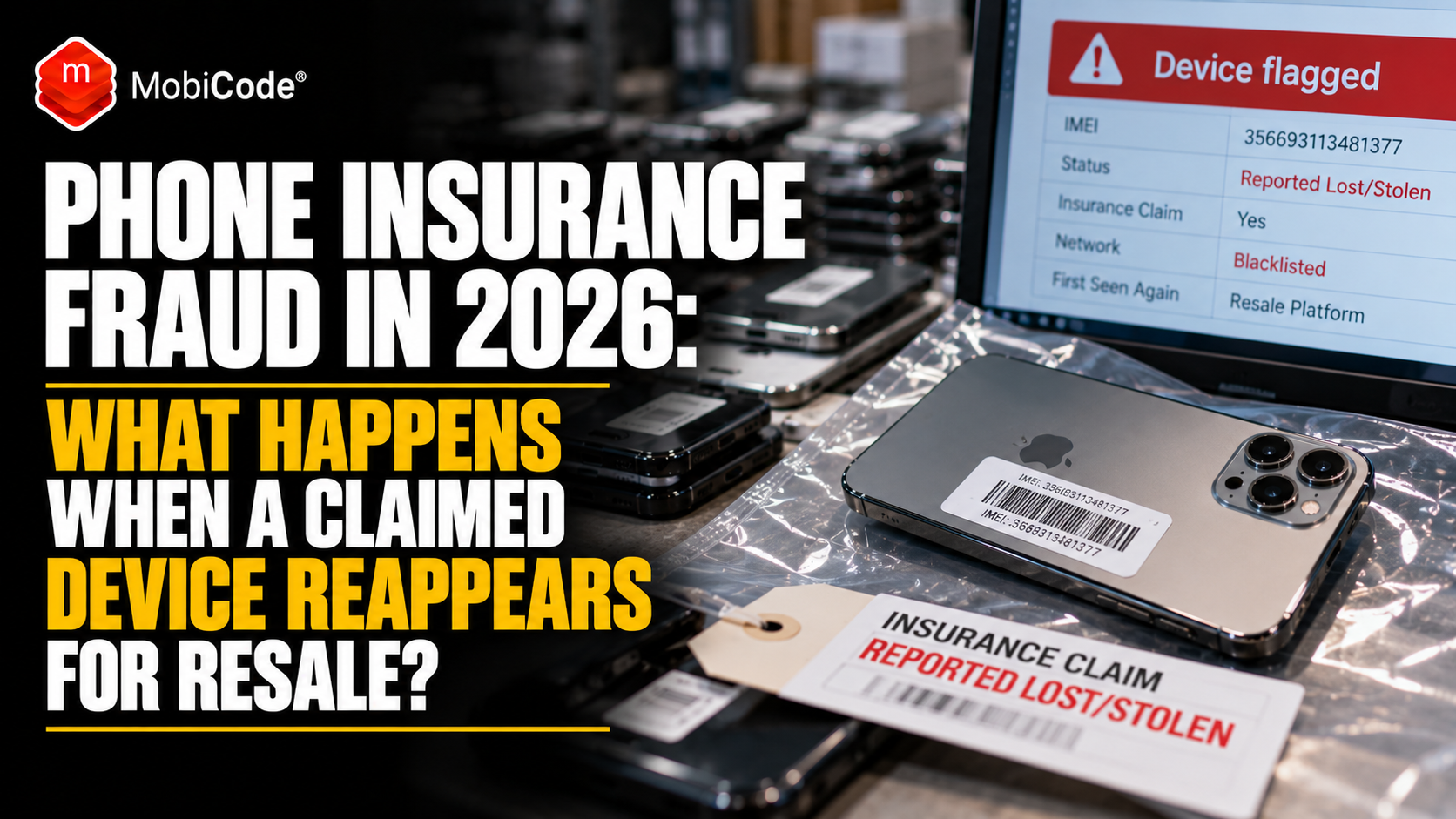
Phone insurance fraud does not necessarily end when an insurer approves a claim. A handset reported lost or stolen can later reappear at a recycler, trade-in desk, retailer or other point in the second-hand market — and without shared device intelligence, the organisation that sees it may have no idea that an insurance claim already exists.
That information gap matters more as smartphone values rise, fraud becomes more sophisticated and police intensify efforts to disrupt the resale of stolen devices.
This guide explains the 2026 phone insurance fraud landscape, why IMEI-level intelligence matters, what happens when claimed devices reappear in legitimate trading channels and how MobiCHECK SHARE helps insurers, recyclers, networks and law enforcement connect information that would otherwise remain isolated.
The commercial problem
An insurer knows that a handset has been claimed as lost or stolen. A recycler later sees the same handset being offered for sale. If those organisations cannot connect their information, the device can move through the market without either side seeing the complete picture.

Why phone insurance fraud deserves attention in 2026
The wider insurance-fraud picture is becoming more expensive.
On 6 October 2026, the Association of British Insurers published its latest detected-fraud figures.
The ABI reported £1.34 billion of detected fraudulent insurance claims during 2025, up 14% from £1.18 billion the previous year.
Meanwhile, insurers detected 93,900 fraudulent claims overall.
The average detected fraudulent claim reached £14,300.
Importantly, those figures cover insurance fraud across multiple sectors. They are not figures for mobile phone insurance alone.
Nevertheless, they demonstrate the wider financial environment in which gadget and mobile insurers are operating: fewer easy assumptions, larger potential losses and a growing need to connect useful fraud signals.
Gadget insurance fraud is a real enforcement priority
Mobile and gadget claims have also received direct law-enforcement attention.
In November 2025, the City of London Police’s Insurance Fraud Enforcement Department, or IFED, carried out a week-long operation specifically targeting gadget-insurance fraud.
The operation targeted suspected false claims involving mobile phones, televisions and laptops.
IFED said fraudulent claims increase costs for honest policyholders and can form part of more organised attempts to exploit insurance products.
Therefore, phone insurance fraud should not be treated simply as a claims-handling inconvenience.
The problem can extend beyond the original claim into resale, recycling and the wider used-device market.
What can phone insurance fraud look like?
There is no single pattern.
Genuine customers lose and damage phones every day. Therefore, a claim should never be treated as suspicious merely because a device is valuable or cannot immediately be located.
However, fraud teams may investigate scenarios such as:
- a handset claimed as lost that later appears for trade-in;
- a device reported stolen that subsequently enters a recycler;
- a claimed handset appearing repeatedly in second-hand trading data;
- suspiciously timed claims around policy inception;
- multiple devices or identities linked through relevant intelligence;
- inconsistent information between a claim and later device activity.
In isolation, one signal may have an innocent explanation.
However, connecting several signals can give an investigator a much clearer picture.
The biggest weakness is often information sitting in separate organisations
Consider a simple example.
An insurer receives a theft claim for a high-value smartphone.
The insurer records the IMEI and handles the claim under its normal process.
Two weeks later, somebody takes that handset to a legitimate recycling business.
The recycler knows:
- which IMEI it is buying;
- where and when the handset entered its system;
- the information supplied during that transaction.
Meanwhile, the insurer knows:
- the same IMEI was associated with an insurance claim;
- the date and circumstances recorded during the claim;
- other relevant claim information.
Individually, both organisations hold part of the story.
The valuable intelligence appears when those two pieces meet.
Phone insurance fraud is difficult to identify when every organisation can see only its own part of the device’s history.
Why the IMEI is so useful in phone insurance fraud investigations
Names, addresses, phone numbers and account details can change.
The IMEI provides a device-level identifier tied to the cellular handset itself.
Therefore, an investigator can use the IMEI to ask a different question:
That becomes particularly valuable when a handset moves between organisations.
For example, the device could move from an insured customer to an insurance claim, then later into a recycler, retailer or trade buyer.
The organisations may change.
The IMEI provides a way to keep the investigation anchored to the handset.
Where MobiCHECK SHARE fits
MobiCHECK SHARE is MobiCode’s secure device-intelligence sharing ecosystem.
It is designed to help trusted organisations share and receive information relating to mobile-device crime and fraud.
Participants can include:
- insurers;
- mobile networks;
- recyclers;
- refurbishers;
- retailers;
- law-enforcement teams;
- claims handlers;
- other relevant fraud-prevention organisations.
The purpose is not simply to create another database.
The value comes from connecting signals generated at different points in the device lifecycle.
MobiCHECK SHARE can flag devices at the point of an insurance claim
One of the strongest insurance use cases starts while the claim is still being processed.
MobiCode says participating organisations can add relevant devices involved in insurance claims to device-alert systems through MobiCHECK SHARE.
Therefore, the insurer does not have to wait for the handset to reappear before creating a device-level intelligence record.
The IMEI can become part of the fraud-prevention workflow from the point at which the organisation has a legitimate reason to act.
What happens if the claimed phone is traded later?
This is where shared intelligence becomes much more valuable than an isolated claims database.
MobiCHECK SHARE connects with a network that includes professional device-trading and recycling organisations.
Consequently, a device of interest that later appears in participating channels can generate useful intelligence.
Instead of the insurer knowing only that a handset was reported lost or stolen, investigators may gain visibility into later device activity.
That does not automatically prove fraud.
However, it can give the insurer a reason to investigate further.
Hot List and Watch List solve different problems
MobiCHECK SHARE provides two particularly useful ways to monitor devices of interest.
Hot List
The Hot List is designed for high-risk devices where the organisation wants the wider participating ecosystem to recognise the handset as being of interest.
This can help prevent a relevant device moving unnoticed through professional trading channels.
Watch List
The Watch List is more discreet.
MobiCode says selected organisations can receive alerts when a watched device appears without necessarily broadcasting the same alert to every participant.
Therefore, investigators can monitor activity where a quieter intelligence-gathering approach is more appropriate.
HOT LIST
Help alert participating organisations to a high-risk device and reduce the chance that it is traded unnoticed.
WATCH LIST
Monitor a device of interest more discreetly and receive relevant alerts when activity appears.
Trading history can turn a claim into an investigation lead
A single IMEI match can be useful.
A broader history can be even more useful.
MobiCHECK SHARE provides access to device footprint information through its participating online and high-street recycler network.
That can help authorised users understand whether and where a device of interest has appeared within relevant trading channels.
Depending on the user’s authorised role and the information available, relevant seller or transaction intelligence can also support investigation.
Consequently, an insurer may gain a richer picture than a simple “device found” notification.
Why real-time intelligence matters
Device fraud can move quickly.
A smartphone can be sold, traded, exported or passed through several hands within a relatively short period.
Therefore, intelligence that arrives months later has less operational value than intelligence available while the device is still moving through the market.
MobiCode positions MobiCHECK SHARE around live data sources and timely alerts.
That helps shorten the gap between:
Phone theft enforcement makes this particularly topical in 2026
The wider stolen-phone market is also facing unprecedented scrutiny.
On 8 October 2026, police forces across England and Wales announced the results of the first national month of action targeting phone crime.
The National Police Chiefs’ Council said 17 police forces participated in Operation Reckoning.
The operation targeted phone crime across the chain, including theft, handling and resale.
Police also focused attention on second-hand mobile-phone shops while calling on manufacturers to make stolen devices harder to reset and resell.
Therefore, the industry response is increasingly moving beyond catching the person who steals the phone.
The objective is also to remove the economic route that makes the device valuable afterwards.
London’s latest crackdown shows the scale of the resale problem
The Metropolitan Police published similar figures on 8 October 2026.
During one month, officers arrested more than 700 people and seized hundreds of suspected stolen phones.
The Met said it executed more than 50 warrants, including at second-hand phone shops suspected of handling stolen devices.
Separately, three men were jailed for a combined 25 years following an investigation into a network that police said trafficked up to 40,000 stolen phones from the UK to China during 2024 and 2025.
The lesson for legitimate insurers, recyclers and retailers is straightforward:
Mobile-device crime crosses organisational boundaries.
Fraud intelligence needs to do the same.
Why recyclers are essential to phone insurance fraud prevention
Recyclers occupy a particularly valuable position.
They regularly see devices entering the second-hand market.
Most of those devices are entirely legitimate.
However, occasionally a handset may match information held by an insurer, network or law-enforcement organisation.
Without intelligence sharing, the recycler cannot reasonably be expected to know about information it has never received.
Therefore, MobiCHECK SHARE turns the recycler from an isolated buyer into part of a wider fraud-prevention ecosystem.
Why insurers benefit from recycler intelligence
The relationship works in both directions.
Recyclers benefit from knowing which devices may require investigation.
Meanwhile, insurers benefit from visibility when a claimed device reappears.
Consequently, both sides gain something that neither can easily create alone.
This is the core commercial logic behind collaborative intelligence networks.
The network effect
One organisation contributes a useful device signal. Another organisation sees the device later. Connecting those two events can create intelligence that neither organisation could produce independently.
Phone insurance fraud is not the same as phone theft
It is important to separate the two.
A genuinely stolen handset may lead to a completely legitimate insurance claim.
Likewise, a device reappearing later does not by itself prove that the original customer acted fraudulently.
Devices can be recovered, resold innocently or move through complex chains.
Therefore, intelligence should trigger appropriate investigation rather than automatic accusations.
MobiCHECK SHARE provides information that can support a decision. It does not replace the insurer’s claims process, fraud investigation or evidential assessment.
Why evidence matters more than suspicion
Strong fraud prevention is based on evidence.
Useful information can include:
- the IMEI linked to the claim;
- claim dates and relevant status information;
- subsequent device activity;
- trading or recycler intelligence;
- relevant account or transaction information;
- other corroborating evidence available to the authorised investigator.
One suspicious-looking fact may have an innocent explanation.
Several independently useful signals can justify closer investigation.
A better phone insurance fraud workflow
Capture the device IMEI
Connect the correct physical handset identifier to the insurance claim.
Process the claim normally
Review the customer’s evidence and apply the insurer’s normal claims and fraud controls.
Create the appropriate device intelligence
Where justified, add the device to the relevant MobiCHECK SHARE mechanism or blocklist workflow.
Watch for later device activity
Use Hot List, Watch List or other appropriate intelligence tools based on the investigation.
Connect later sightings
If the IMEI appears in a participating trading environment, connect that activity with the existing device record.
Review the complete evidence
Treat the new intelligence as an investigative lead and assess it alongside all other relevant information.
What is the cost of not connecting the data?
Imagine an insurer paying a £900 handset claim.
Later, the original phone enters a participating recycler.
If no connection exists between those events, both organisations can behave entirely correctly while missing potentially useful intelligence.
Now multiply that across thousands of claims and millions of used devices.
The commercial question becomes:
Volume data search matters for larger insurers
Fraud teams do not always investigate one IMEI at a time.
Large insurers, networks and device businesses may need to analyse significant datasets.
MobiCHECK SHARE includes a data-search facility designed to process volume data and return intelligence matches efficiently.
Consequently, organisations can use the network for broader investigations rather than limiting it to individual manual lookups.
MobiCHECK SHARE can also help identify internal stock loss
Insurance claims are only one use case.
MobiCode says organisations can also use Watch List functionality to monitor internal devices of interest.
For example, a business concerned about stock shrinkage may monitor specific IMEIs.
If one of those devices subsequently appears in the participating trading ecosystem, the organisation may receive an alert.
Therefore, the same underlying intelligence network can support both external fraud investigation and internal asset protection.
Secure data sharing matters
Fraud intelligence can contain sensitive information.
Therefore, indiscriminate sharing would create its own risks.
MobiCode describes MobiCHECK SHARE as a secure, GDPR-compliant data exchange available to appropriate participating organisations.
Organisations interested in joining the network should contact MobiCode to discuss their use case, eligibility and requirements.
This controlled membership model matters because useful fraud prevention depends on both access to intelligence and responsible handling of that intelligence.
MobiCHECK and MobiCHECK SHARE solve different problems
The product names are similar, but the use cases are different.
MobiCHECK helps a professional buyer investigate a device before acquiring or processing it.
MobiCHECK SHARE connects intelligence across participating organisations and supports ongoing crime and fraud prevention.
| Question | MobiCode solution |
|---|---|
| Should we buy or process this device? | MobiCHECK |
| Has this device been reported, claimed or identified elsewhere? | MobiCHECK SHARE |
| Can we monitor a high-risk device for later activity? | MobiCHECK SHARE |
| Can another trusted organisation’s intelligence help our investigation? | MobiCHECK SHARE |
Why insurers should care about the second-hand phone market
An insurer’s interest in a phone does not necessarily end at claim settlement.
The second-hand market can provide useful post-claim intelligence.
Recyclers, refurbishers and retailers regularly handle physical devices and collect device identifiers during normal operations.
Consequently, they can become important intelligence points when appropriately connected to insurers and other trusted participants.
The insurer does not need to become a phone recycler.
It needs a mechanism that can tell it when information held elsewhere becomes relevant to one of its devices.
Why recyclers should care about insurer data
The same principle applies in reverse.
A recycler wants to avoid acquiring problematic stock.
Information that a handset has been associated with a relevant insurance claim can justify additional investigation before the recycler commits money.
Therefore, data sharing can reduce risk at both ends of the transaction.
Could better intelligence help reduce phone theft?
No single database can eliminate mobile-phone theft.
However, policing strategy increasingly focuses on reducing the value criminals can extract from stolen devices.
If stolen or fraudulently claimed phones become harder to move through legitimate channels unnoticed, the commercial incentive becomes weaker.
This aligns with the NPCC’s October 2026 call to make stolen phones harder to reset and resell.
Consequently, intelligence sharing complements physical security, device tracking, network blocking and law enforcement rather than replacing them.
Phone insurance fraud prevention works best as a network
Fraud often crosses the boundaries between insurers, mobile networks, retailers and recyclers.
Therefore, a fraud-prevention system limited to one organisation will always see only part of the picture.
MobiCHECK SHARE’s core proposition is that selected organisations can contribute relevant device intelligence and benefit when another trusted participant later sees the same handset.
The more useful, timely and accurate those connections become, the harder it becomes for suspicious devices to disappear between organisational silos.
Commercial takeaway
The claim is one event. The device has an entire life afterwards.
An insurer may know that a handset was reported lost or stolen. A recycler may know that the same handset later appeared for sale. A network may know something else again.
Phone insurance fraud becomes easier to investigate when those relevant signals can be connected securely around the device’s IMEI.
MobiCHECK SHARE creates that connection between trusted insurers, recyclers, networks, retailers and law-enforcement organisations, helping turn isolated device records into actionable fraud intelligence.
Use MobiCHECK SHARE to connect device fraud intelligence
MobiCHECK SHARE is designed for organisations with a legitimate role in preventing mobile-device crime and fraud.
Current capabilities include:
- secure device-intelligence sharing;
- real-time intelligence from multiple data sources;
- device footprint and trading-history information;
- relevant buying and seller intelligence for authorised investigations;
- blocklisting devices linked to appropriate insurance claims;
- Hot List functionality;
- silent Watch List monitoring;
- instant device alerts;
- volume data searching;
- support for insurers, recyclers, networks and law enforcement;
- GDPR-compliant secure data exchange.
What happens to a claimed phone after you pay the claim?
MobiCHECK SHARE helps trusted organisations connect claim data with later device activity, giving insurers, recyclers and fraud teams another layer of intelligence when suspicious handsets reappear.
Frequently asked questions about phone insurance fraud
How can an insurer know if a claimed phone is later resold?
Device-intelligence networks such as MobiCHECK SHARE can connect an IMEI associated with a claim to later activity within participating trading and recycling channels. A match can provide an investigative lead, although it does not by itself prove fraud.
What is MobiCHECK SHARE?
MobiCHECK SHARE is a secure device-intelligence sharing network for trusted organisations including insurers, recyclers, networks, retailers and law enforcement. It helps participants share and receive information about lost, stolen, blocked, claimed or otherwise high-risk mobile devices.
What is the difference between a Hot List and a Watch List?
A Hot List helps alert participating organisations to a high-risk device and can help prevent it being traded unnoticed. A Watch List is more discreet and can allow selected organisations to receive alerts when a device of interest appears without broadcasting the same alert to all participants.
Does a claimed phone reappearing prove insurance fraud?
No. A device reappearing after a claim does not by itself prove fraud. The information should be treated as an investigative lead and reviewed alongside the claim, device history and other relevant evidence.
Can recyclers benefit from MobiCHECK SHARE?
Yes. Participating recyclers can benefit from device intelligence supplied by other trusted organisations, helping them identify handsets that may require further investigation before purchase or processing.
Who can join MobiCHECK SHARE?
MobiCHECK SHARE is intended for trusted organisations with a legitimate role in mobile-device crime, fraud prevention, claims, trading or investigation. Interested organisations should contact MobiCode to discuss eligibility and their intended use case.
Sources and further reading
Association of British Insurers — Insurance Fraud Figures, 6 October 2026
Latest industry figures on detected fraudulent insurance claims and their value.
City of London Police — IFED Gadget Insurance Fraud Operation
Enforcement activity targeting false claims involving mobile phones and other electronic devices.
National Police Chiefs’ Council — Operation Reckoning, 8 October 2026
National police action targeting phone theft, handling and resale.
Metropolitan Police — Mobile Phone Theft Crackdown, 8 October 2026
Latest London enforcement activity and stolen-device resale investigations.
MobiCode — MobiCHECK SHARE
Secure device intelligence sharing, Hot List, Watch List, footprint data and fraud-prevention tools.
MobiCode — MobiCHECK
Live IMEI and device-status due diligence for professional device buyers.