

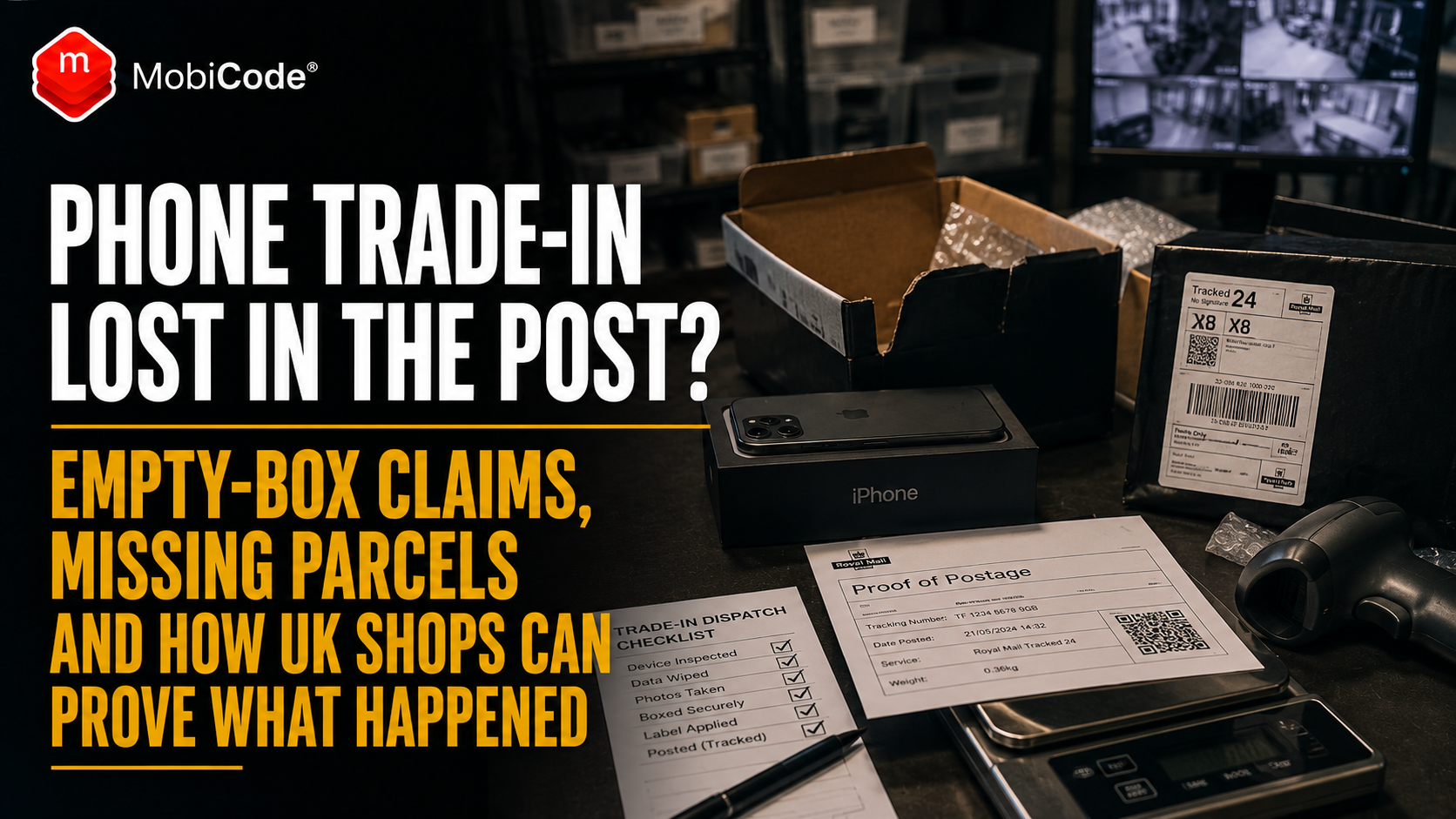
A phone trade-in can go wrong in a particularly difficult way: the sender says the handset was packed and posted, tracking shows that the parcel moved through the delivery network, but the receiving business says the box arrived empty—or that the phone was never received at all.
Sometimes the explanation is simple. The parcel may be delayed, damaged, delivered to the wrong part of a warehouse or linked to the wrong trade-in order. In other cases, the phone may have been removed while in transit.
However, deliberate fraud can also happen. A dishonest sender might post an empty box or substitute a low-value device. Equally, a dishonest recipient could receive the correct phone and falsely claim that it was missing.
The problem is that ordinary parcel tracking does not prove what was inside the package.
A delivery scan can show that a box reached an address. A proof-of-posting receipt can show that the carrier accepted a parcel. An IMEI record can identify the phone that was meant to be sent. Yet none of those records, by itself, proves that the same handset remained inside the same sealed parcel throughout the entire journey.
This guide explains how missing-phone and empty-box disputes happen, how UK phone shops and trade-in businesses should investigate them, and what evidence both senders and receivers should retain.
It also introduces the thinking behind MobiBlock, a MobiCode concept currently in development. MobiBlock has not yet launched and is not currently available. However, the idea addresses a clear gap in the market: creating a stronger digital chain of custody between the phone, the parcel and every important handover.
What is an empty-box phone trade-in claim?
An empty-box claim occurs when a parcel is delivered as part of a mobile phone trade-in, recycling or resale transaction, but the expected device is not found inside.
The dispute often sounds like this:
The sender: “I packed and posted the phone.”
The carrier: “The parcel was delivered.”
The receiver: “The phone was not inside.”
All three statements may reflect the evidence held by each party. Nevertheless, they do not establish where the handset disappeared.
Not every missing phone is the result of fraud
A phone shop should investigate the discrepancy before accusing the customer, courier, warehouse or employee of dishonesty.
A missing handset may be caused by:
- a genuinely lost parcel;
- delivery to the wrong address or loading bay;
- damage that allowed the phone to fall out;
- the parcel being opened during transit;
- a warehouse scanning error;
- the package being matched to the wrong order;
- the device being routed to another processing area;
- an incorrect tracking number;
- a delayed intake scan;
- a deliberate false claim by one of the parties.
For that reason, the business should initially describe the case as a parcel or device discrepancy. That language is accurate, neutral and less likely to alienate a genuine customer.
A fair investigation protects honest sellers. It also makes deliberate fraud easier to identify because the decision is based on evidence rather than assumption.
How phone trade-in parcel fraud can happen
1. The sender posts an empty box
A dishonest seller may create a trade-in order for a valuable phone, send an empty package and later use the tracking history as supposed proof that the handset was delivered.
The sender may also place something else inside the box to create a believable parcel weight, such as:
- a low-value object;
- a broken phone;
- an unrelated handset;
- a metal weight;
- packaging material;
- a device shell with no useful internal components.
Tracking can confirm that the parcel moved. It cannot confirm that the quoted phone was inside when the carrier accepted it.
2. The sender substitutes a different device
Some parcels contain a phone, but not the phone used to obtain the original valuation.
For example, a customer might declare a recent 256GB iPhone but send:
- an older model;
- a lower-storage version;
- a heavily damaged handset;
- a blocked phone;
- a counterfeit device;
- a phone with a different IMEI.
This is not technically an empty-box claim. However, it creates the same underlying challenge: proving which device was declared, which device was packed and which device arrived.
3. The phone is removed during transit
A genuine customer may pack the correct handset securely, only for the parcel to be opened or damaged after entering the delivery network.
Possible signs include:
- torn outer packaging;
- cuts along a seam;
- different tape from that used by the sender;
- a broken tamper-evident seal;
- a hole in the package;
- missing internal packaging;
- a large difference between dispatch and arrival weight;
- the parcel arriving inside replacement carrier packaging.
In this situation, the sender and receiving business may both be telling the truth.
4. The parcel reaches the building but not the correct team
A carrier may mark the parcel as delivered to a warehouse, reception desk or loading bay. However, that does not prove that the package reached the correct trade-in intake station.
Internally, it might be:
- placed in the wrong cage;
- added to another batch;
- scanned against a different customer order;
- opened before the tracking number is recorded;
- sent to returns or recycling;
- left in an unprocessed-parcel area;
- mixed with discarded packaging.
The customer may then receive an automatic “device not received” email even though the parcel entered the site.
5. The recipient falsely claims that the box was empty
Fraud can also occur on the receiving side.
A dishonest buyer, employee or receiving operation could obtain the phone and claim that:
- the package never arrived;
- the box arrived empty;
- a different device was inside;
- the phone was damaged beyond value;
- the declared IMEI was not received.
This is why receiving businesses need to preserve their own evidence. It is unreasonable to demand detailed proof from customers while retaining no reliable record of the parcel’s arrival and opening.
6. The sender makes an honest mistake
Not every inaccurate account is deliberately dishonest.
A customer may:
- use the wrong tracking number;
- send two parcels and confuse them;
- place the wrong family member’s phone in the box;
- use packaging from another trade-in;
- forget that someone else posted the parcel;
- mistake a delayed scan for a loss.
Good records can often resolve these cases quickly and without unnecessary escalation.
Why parcel tracking is not enough
Tracking is essential evidence, but it answers a limited set of questions.
It may show:
- when the shipping label was created;
- when the carrier accepted the parcel;
- which depots processed it;
- whether delivery was attempted;
- the recorded delivery time;
- the delivery address;
- a photograph or signature where available.
It does not necessarily show:
- which IMEI was inside the parcel;
- whether the phone was present when the parcel was posted;
- whether the contents changed during transit;
- the condition of the package at every handover;
- whether the receiver opened it under controlled conditions;
- whether the warehouse linked it to the correct order.
Proof of posting still matters
Although it does not prove the contents by itself, proof of posting remains a vital part of the evidence chain.
A receipt may confirm:
- the posting date;
- the carrier and service used;
- the tracking number;
- the destination postcode;
- the package weight where recorded;
- that the carrier accepted the parcel.
Royal Mail may require proof of posting and evidence of value for compensation claims. Evidence relating to the packaging and damage may also be required in partial-loss cases.
Customers should retain the receipt until the trade-in has been inspected, accepted and paid—not merely until tracking shows delivery.
Check who carries the risk during transit
Responsibility for the phone while it is travelling can depend on the trade-in company’s terms, who purchased the postage and which party has the contract with the carrier.
A prepaid label does not always produce the same legal or commercial position across every trade-in programme.
Before dispatch, customers and businesses should check:
- when risk transfers from the sender;
- who holds the carrier contract;
- who must submit a loss claim;
- the maximum compensation available;
- the required packaging method;
- whether the supplied label must be used;
- the deadline for reporting a loss or partial loss;
- which evidence the programme requires.
Trade-in businesses should make this information easy to find. Customers should not discover the transit-risk terms only after their phone has disappeared.
Record the phone before packing it
Before the handset enters the parcel, the sender should establish exactly which device is being sent.
Record:
- IMEI 1;
- IMEI 2 where applicable;
- serial number;
- make and model;
- storage capacity;
- colour;
- visible condition;
- trade-in order number;
- the account-lock status.
A customer can usually find the IMEI in the phone’s settings or by dialling *#06# on a supported handset.
For individual devices, MyMobiCheck can provide a device-check record linked to the IMEI used in the transaction.
Trade and higher-volume businesses can use MobiCHECK within a professional device-processing workflow.
However, the IMEI record proves only which device was documented. Additional evidence is needed to connect that device to the sealed package.
Should customers film themselves packing the phone?
A continuous packing video can be useful, particularly for high-value devices.
A helpful recording may show:
- the phone switched on;
- the IMEI or serial number;
- the handset’s visible condition;
- the device being placed into the packaging;
- the box being closed and sealed;
- the shipping label;
- the finished parcel.
The customer should avoid recording passwords, personal photographs, messages or unnecessary account information.
Even a continuous video has limitations. It may end before the parcel is handed to the carrier, meaning the package could theoretically be reopened afterwards.
For that reason, video works best when combined with:
- tamper-evident packaging;
- a unique seal number;
- a recorded parcel weight;
- proof of posting;
- tracked delivery;
- receiving-side evidence.
Use tamper-evident packaging
Standard parcel tape protects a package, but it may not reveal clearly whether somebody opened and resealed it.
Stronger options include:
- tamper-evident tape;
- numbered security seals;
- single-use security bags;
- unique seal references;
- internal packaging that stops the phone moving;
- plain outer packaging that does not advertise valuable electronics.
The seal number should be recorded against the trade-in order.
When the parcel arrives, receiving staff should confirm whether:
- the seal remains intact;
- the number matches the dispatch record;
- the package has cuts, holes or tears;
- different tape covers the original closure;
- the carrier placed the parcel in replacement packaging.
Tamper-evident packaging does not prevent every theft. However, it makes unauthorised opening more visible and strengthens later investigations.
Record the parcel weight at both ends
Weight can be one of the most useful pieces of evidence in an empty-box case.
Ideally, record the parcel’s weight:
- after packing;
- when the carrier accepts it;
- when the warehouse receives it unopened;
- after opening if a discrepancy exists.
Suppose a sealed phone parcel weighs 640g when accepted by the carrier but only 330g when received by the warehouse.
That difference does not identify the person responsible. Nevertheless, it strongly suggests that the parcel’s contents changed between the two recorded points.
By contrast, if the carrier recorded a weight of 330g at the start, the evidence may point towards a packing or dispatch problem.
Where weight affects high-value commercial decisions, businesses should use suitable, calibrated scales and record the measurement automatically where possible.
Choose postage that reflects the phone’s value
The compensation level should reflect the value of the device being sent.
A phone worth several hundred pounds should not travel under a service with minimal compensation unless the programme clearly accepts that arrangement and responsibility.
Before dispatch, check:
- the standard compensation limit;
- whether additional cover is available;
- whether mobile phones are covered;
- whether lithium batteries are permitted;
- whether a signature or photograph is captured;
- whether the supplied label must be used;
- who is entitled to submit the claim.
Delivery services, restrictions and compensation limits can change. Therefore, both businesses and customers should check the carrier’s current terms at the time of posting.
Do not advertise the contents on the package
The outer packaging should remain discreet.
Avoid writing:
- “iPhone trade-in”;
- “mobile phone enclosed”;
- the exact phone model;
- the trade-in value;
- unnecessary details identifying expensive electronics.
The package should still display any information required by the carrier, including applicable battery or routing labels.
The receiving business needs an equally strong process
The sender cannot create a complete chain of custody alone.
A professional warehouse or phone shop should record what happened from the moment the parcel arrives.
A strong intake workflow should:
- scan the tracking number immediately;
- record the date, time and receiving location;
- weigh the unopened parcel;
- inspect all sides for visible damage;
- photograph cuts, tears or replacement tape;
- record the security-seal number;
- link the package to the correct trade-in order;
- open it in a controlled area;
- record the received device’s IMEI;
- compare the contents with the customer declaration;
- route any discrepancy for immediate review.
This process reduces fraud, but it also prevents ordinary warehouse mistakes.
Should warehouses record parcel opening?
For high-value devices, continuous parcel-opening evidence can be useful.
A controlled recording may capture:
- the tracking label;
- the unopened parcel;
- every side of the packaging;
- the security seal;
- the recorded weight;
- the opening process;
- the contents being removed;
- the received IMEI and model.
However, recording needs to be designed properly.
The business should consider:
- employee and customer privacy;
- data-protection obligations;
- access controls;
- retention periods;
- camera coverage;
- how footage is indexed;
- how quickly it can be retrieved.
Hours of unindexed warehouse footage may have little practical value. The recording should be linked to a specific parcel, order or tracking reference.
Inspect the parcel before opening it
Some of the most useful evidence disappears as soon as staff cut the tape.
Before opening a suspicious package, record:
- the condition of the outer packaging;
- cuts, holes and punctures;
- different types of tape;
- carrier damage labels;
- wet or crushed areas;
- broken security seals;
- unexpected movement inside;
- the unopened arrival weight.
If the package looks compromised, move it away from the normal high-speed processing line.
Do not open it casually and attempt to reconstruct the evidence after the packaging has been discarded.
What should happen when a parcel arrives empty?
The business should immediately stop normal processing and preserve the evidence.
- Retain the full outer and inner packaging.
- Photograph every side of the parcel.
- Record the arrival weight.
- Record all tape and seal conditions.
- Preserve any opening footage.
- Save the complete tracking history.
- Review reception and loading-bay records.
- Check whether the parcel was rescanned internally.
- Search unprocessed and incorrectly routed stock.
- Contact the sender with neutral, factual questions.
The first customer message should not accuse them of sending an empty box.
Example wording: “We received the parcel linked to your trade-in order, but the device was not present when the package entered our inspection process. We have opened an investigation and need your proof of posting, packing evidence and any recorded parcel weight.”
This wording explains the problem without presenting an unproven conclusion as fact.
What evidence should the sender provide?
The business may ask the customer for:
- proof of posting;
- the tracking number;
- the posting date and location;
- the receipt showing weight where available;
- photographs of the phone;
- the IMEI and serial number;
- packing photographs or video;
- the trade-in confirmation;
- evidence of the phone’s value;
- details of anything unusual during handover.
Useful factual questions include:
- Who packed the phone?
- Which packaging was used?
- Was the parcel sealed before reaching the drop-off point?
- Did the carrier weigh it?
- Did anyone else handle it before posting?
- Was the device switched off?
- Was a security seal used?
Inconsistent answers may become relevant, but they should be considered alongside the physical and digital evidence.
What evidence should the receiver retain?
The receiving business should preserve:
- the delivery scan;
- the date and time of receipt;
- the delivery photograph where available;
- the unopened parcel weight;
- photographs of damage or tampering;
- the seal number;
- parcel-opening footage where used;
- internal warehouse scan history;
- the intake operator’s record;
- the retained packaging;
- carrier investigation references.
Both sides need evidence. A fair dispute process cannot depend entirely on the customer proving their innocence while the recipient produces no intake record.
Check for internal errors before alleging fraud
Before treating the sender as suspicious, investigate routine operational failures.
Check whether:
- the tracking number was linked to another order;
- the phone entered the wrong processing queue;
- the received IMEI was entered incorrectly;
- the parcel arrived inside a larger delivery container;
- the phone moved to data erasure before intake was completed;
- several packages were opened together;
- the packaging was discarded too quickly;
- an automated “not received” message fired early;
- another customer’s order received the wrong status.
A good fraud-prevention system should reduce false accusations as well as genuine losses.
Create a dedicated discrepancy workflow
Missing-device investigations should not remain inside a general customer-service inbox.
Useful case statuses include:
- Carrier delay: the parcel remains in transit.
- Delivered, awaiting intake: delivery is recorded but warehouse processing is incomplete.
- Damaged parcel: the packaging arrived visibly compromised.
- Partial loss: some declared contents are missing.
- Empty-box discrepancy: no device was found.
- Device substitution: the received IMEI differs from the declaration.
- Internal search: a warehouse routing error is suspected.
- Carrier claim: evidence has been submitted to the delivery provider.
- Suspected fraud: the available evidence suggests deliberate dishonesty.
- Resolved: the device was found or a final outcome was recorded.
Each case should have an owner, next action and review date.
The chain-of-custody problem
Mobile phones are particularly vulnerable to parcel disputes because they combine several difficult characteristics:
- high value;
- small physical size;
- easy resale;
- rapid depreciation;
- unique IMEI identifiers;
- personal data;
- lithium battery shipping restrictions;
- strong demand for current models.
Yet most trade-in delivery systems track only the outer parcel.
A stronger chain of custody would connect:
- the declared phone and IMEI;
- the device condition;
- the parcel identifier;
- the security seal;
- the dispatch weight;
- carrier acceptance;
- each material handover;
- the warehouse arrival weight;
- the package-opening record;
- the received device and IMEI.
The fewer gaps between those events, the easier it becomes to identify where a discrepancy occurred.
Introducing the MobiBlock concept
MobiCode is developing a concept called MobiBlock to explore this chain-of-custody problem.
MobiBlock has not launched and is not currently available. Its final functionality, release plans and commercial form have not yet been announced.
However, the concept is based on a straightforward need: phone shops and trade-in businesses require stronger evidence connecting a specific device to a specific package and a sequence of recorded handovers.
The intended direction is a shared, tamper-resistant device journey that could connect information such as:
- the declared IMEI and serial number;
- the trade-in or shipment reference;
- the parcel identifier;
- the security-seal reference;
- dispatch and arrival weights;
- dated handover events;
- parcel-condition evidence;
- warehouse intake;
- the received IMEI;
- the final discrepancy outcome.
The aim would not be to replace carriers, cameras, proof of posting or device checks.
Instead, the concept is intended to help connect those separate pieces of evidence into one clearer chain.
MobiBlock concept:
A future device chain-of-custody approach intended to connect the declared phone, the parcel and each important processing event. MobiBlock is currently a pre-launch concept and is not yet available as a product or service.
What existing MobiCode tools can record today
Current MobiCode tools can strengthen the device side of the evidence chain.
-
MyMobiCheck supports individual IMEI checks for consumers and occasional sellers.
See: MyMobiCheck -
MobiCHECK supports professional IMEI and device-status checks before a device moves further through the business.
See: MobiCHECK -
MobiONE helps connect IMEIs, checks, diagnostics, erasure and device-processing records.
See: MobiONE -
MobiCode TEST helps businesses record the functional condition of the handset received.
See: MobiCode TEST -
MobiWIPE supports controlled data erasure connected to the correct device record.
See: MobiWIPE
These tools help establish which phone entered the operational workflow and what happened after intake.
The remaining challenge—and the area behind the MobiBlock concept—is connecting that device evidence more clearly to the physical parcel journey before intake.
What customers should do when tracking says delivered
If tracking says the trade-in was delivered but the company says it has not been received, the customer should:
- save screenshots of the complete tracking history;
- find the proof-of-posting receipt;
- confirm the destination postcode;
- provide the trade-in reference and IMEI;
- contact the business in writing;
- request a physical warehouse search;
- ask the company to check loading-bay and reception records;
- ask who must open the carrier claim;
- retain all messages and evidence;
- use the formal complaints process if the issue remains unresolved.
A carrier delivery scan does not necessarily mean the trade-in team has opened or processed the package.
What customers should do after an empty-box allegation
If the company says the package arrived empty, ask for the evidence supporting that conclusion.
Useful questions include:
- What time did the parcel arrive?
- What did it weigh before opening?
- Was the packaging visibly damaged?
- Were photographs taken before opening?
- Was the seal intact?
- Was the opening recorded?
- Has the packaging been retained?
- Has the carrier been notified?
- What is the warehouse discrepancy reference?
The customer should provide their own proof of posting, weight evidence, IMEI and packing records.
Keep the discussion factual. The issue may involve carrier loss or warehouse error rather than deliberate dishonesty by the receiving company.
When to report suspected fraud
A knowingly false representation intended to obtain money or cause another party a loss may potentially amount to fraud under UK law.
However, an unresolved parcel dispute is not automatically evidence of a criminal offence.
Before escalating, the business should:
- preserve all available evidence;
- complete the internal warehouse search;
- review the carrier records;
- ask the sender for evidence;
- check the applicable trade-in terms;
- record every contact and decision;
- consider whether the case forms part of a repeated pattern.
Where the evidence supports suspected deliberate fraud, the business can use the appropriate UK reporting route.
Fraud reporting arrangements may differ across England, Wales, Northern Ireland and Scotland, so businesses should check the current official guidance.
Monitor patterns across multiple claims
One disputed parcel may never produce a completely certain answer. Repeated patterns can be more revealing.
Monitor:
- claims linked to the same sender;
- claims from the same posting location;
- weight discrepancies associated with one depot;
- empty packages received during the same shift;
- losses involving the same phone model;
- repeated failures in one type of packaging;
- disputes linked to one acquisition campaign;
- incorrect IMEI intake by the same workflow;
- missing devices handled by the same internal route.
Pattern analysis can identify:
- organised fraud attempts;
- carrier weak points;
- warehouse control failures;
- training problems;
- poor packaging design;
- automated system errors.
Do not allow fraud controls to punish genuine customers
Strong evidence controls should make fair decisions easier. They should not create an assumption that every seller is lying.
A good investigation process should:
- apply the same evidence standards consistently;
- give customers time to provide records;
- investigate internal errors;
- explain the next steps;
- avoid threatening or accusatory language;
- protect personal information;
- provide a review or complaints route;
- record the reason for the final outcome.
A genuine customer who has lost a valuable phone is already dealing with a stressful situation. Poor communication can cause lasting reputational damage even where the company ultimately resolves the claim correctly.
Phone trade-in parcel evidence checklist
Before dispatch
- Record the IMEI and serial number.
- Photograph the phone and its condition.
- Remove personal accounts correctly.
- Record the trade-in order number.
- Pack the device securely.
- Use tamper-evident packaging where possible.
- Record the seal reference.
- Record the packed parcel weight.
- Use the required tracked service.
- Keep the proof-of-posting receipt.
At receipt
- Scan the parcel immediately.
- Record its unopened weight.
- Inspect every side before opening.
- Record visible damage or tampering.
- Check the security-seal reference.
- Open the parcel in a controlled area.
- Record the received IMEI.
- Compare the device with the declaration.
- Retain the packaging if a discrepancy exists.
- Escalate the case before normal processing continues.

Common mistakes during missing-phone investigations
- Treating a delivery scan as proof of the contents.
- Assuming proof of posting proves that a phone was packed.
- Discarding empty or damaged packaging.
- Opening suspicious parcels without recording their condition.
- Failing to record dispatch and arrival weight.
- Checking the warehouse system but not searching the building.
- Accusing the sender before completing the investigation.
- Collecting customer evidence but retaining no receiving evidence.
- Allowing disputed parcels to continue through normal processing.
- Failing to connect tracking numbers with IMEIs.
- Missing carrier claim deadlines.
- Ignoring repeated patterns across several claims.
Commercial takeaway
When a phone trade-in is reported lost in the post, tracking alone cannot reveal where the handset disappeared.
The device may never have entered the package. It may have been substituted, removed during transit, delivered to the wrong warehouse area, processed incorrectly or falsely reported as missing.
Proof of posting, IMEI records, photographs, packing video, parcel weights and delivery tracking can all help. However, each record proves only one part of the journey.
The strongest process connects:
- the declared device;
- its IMEI and condition;
- the sealed parcel;
- dispatch weight;
- carrier handover;
- warehouse arrival;
- the opening event;
- the received device.
This need for a more connected device-and-parcel evidence chain is the thinking behind MobiBlock.
MobiBlock remains a pre-launch concept and is not yet available. However, the problem it is intended to address is already affecting phone shops, recyclers, trade-in programmes and customers across the used-device market.
A practical empty-box claim example
A customer accepts a £420 online trade-in offer for an iPhone. Before posting it, they record the IMEI, photograph the device and retain the Post Office receipt.
Three days later, tracking shows that the parcel was delivered to the trade-in warehouse. However, the customer receives an email stating that the box arrived without the phone.
The business pauses the trade-in and reviews the evidence.
The sender’s receipt records a parcel weight of 640g. The warehouse intake system shows that the parcel weighed 330g before it was opened. Photographs also show a torn side covered with carrier tape.
The evidence does not identify the person responsible. Nevertheless, it strongly indicates that the parcel lost part of its contents between carrier acceptance and warehouse receipt.
Because both parties retained useful records, the business can open a partial-loss investigation with the carrier instead of automatically treating the customer as dishonest.
Without the two weight records and intake photographs, the same case would be one unsupported statement against another.
Frequently asked questions
What should I do if my phone trade-in is lost in the post?
Save the full tracking history, proof of posting, parcel weight, IMEI, trade-in order and any packing evidence. Contact the trade-in business in writing and ask whether it or you must open the carrier claim.
What if tracking says delivered but the trade-in company says it was not received?
Ask the company to search its reception area, loading bay, unprocessed parcels, incorrectly matched orders and alternative processing queues. Delivery to the building does not always mean the trade-in team has processed the package.
Can somebody fake an empty-box phone trade-in claim?
Yes. A dishonest sender could post an empty parcel or substitute another object. A dishonest recipient could also receive a phone and falsely report it as missing. Businesses should investigate the evidence rather than assume which party is responsible.
Does proof of posting prove that the phone was inside?
No. It proves that the carrier accepted a parcel. A recorded weight, packing evidence, security seal and receiving-side records can provide stronger evidence about the contents.
Should I film myself packing a trade-in phone?
A continuous packing video may help, especially if it shows the IMEI, condition, packaging and final seal. However, it works best alongside parcel weight, proof of posting, tracking and receiving evidence.
How can phone shops reduce empty-box trade-in fraud?
Record declared IMEIs, link devices to parcel references, use tamper-evident seals, capture dispatch and arrival weights, inspect packages before opening and retain evidence when a discrepancy occurs.
What is MobiBlock?
MobiBlock is a MobiCode concept currently in development. It is intended to explore a stronger chain of custody connecting a device, its IMEI, its parcel and important handover events. It has not yet launched and is not currently available.
References and further reading
- Royal Mail: Compensation policy for loss
- Royal Mail: Compensation for damage and partial loss
- Royal Mail: Certificate and proof of posting
- Royal Mail: Packaging guidance
- Royal Mail: Lithium batteries and restricted items
- Apple Support: Prepare and send an iPhone for trade-in
- Google Store UK: Device trade-in terms
- Crown Prosecution Service: Fraud Act 2006 guidance
- Report Fraud: Reporting fraud and cybercrime
- Citizens Advice: Lost, damaged or delayed parcels
- MyMobiCheck
- MobiCHECK
- MobiONE
- MobiCode TEST
- MobiWIPE