

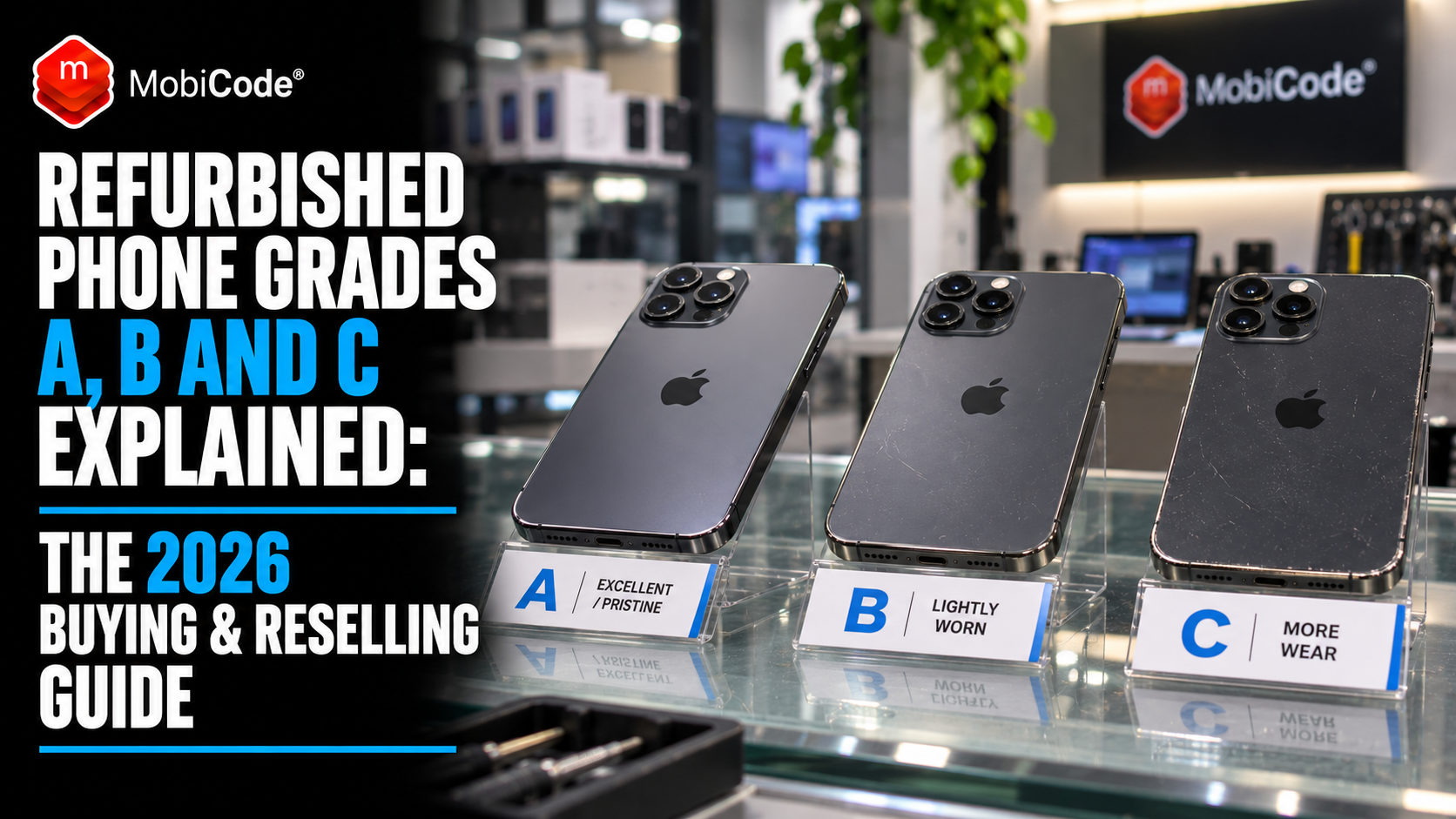
One supplier calls a refurbished iPhone Grade A. Another calls an almost identical phone Grade B. Both claim the handset works perfectly. So what do refurbished phone grades actually mean, and how can you tell whether you’re getting what you paid for?
It’s one of the biggest frustrations in the second-hand smartphone market. A phone can look almost new but have a tired battery. Another might have scratches across the back yet perform just as well as a more expensive model.
For consumers, confusing grading labels make it harder to compare prices. Meanwhile, mobile phone retailers, wholesalers and refurbishers face another problem: inconsistent grading can lead to overpaying for stock, customer complaints and unnecessary returns.
There’s also an important distinction: a phone’s cosmetic grade does not automatically tell you whether its hardware works correctly.
This guide explains refurbished phone Grades A, B and C, how UK retailers classify used handsets and what buyers should check beyond appearance.
We’ll also explain how professional businesses can build more consistent grading processes using diagnostics, device-status checks and MobiONE, MobiCode’s all-in-one device-processing software.
Quick answer: What do refurbished phone grades mean?
Grade A: Usually excellent or near-new cosmetic condition, with little or no visible wear.
Grade B: A used phone with light cosmetic marks or small scratches, but generally expected to work properly.
Grade C: A phone with more noticeable cosmetic wear. It should still function correctly when the retailer advertises it as a working refurbished device.
Important: The UK does not have one universal retailer grading scale. Each seller sets its own condition criteria, so always read the actual description and check the device’s functionality, battery and warranty.
What are refurbished phone grades?
Refurbished phone grades help retailers describe the condition of previously owned devices.
Most commonly, sellers use letters such as A, B and C. Others prefer descriptions including Pristine, Excellent, Very Good, Good and Fair.
Generally, those labels describe the handset’s appearance.
For example, a Grade A phone should have fewer visible scratches than a Grade C handset.
That difference does not automatically mean the Grade A phone has a better processor, stronger battery or more reliable camera.
In fact, the MoneySavingExpert refurbished-phone guide explains that retailers do not follow a universal grading system.
Consequently, the same handset could qualify for different grades at different businesses.
Why do retailers use different grading systems?
Retailers have different expectations about cosmetic condition, accessories and how they describe stock.
For example, one business may allow tiny marks on a Grade A handset. Another may reserve Grade A for devices in virtually immaculate condition.
Some businesses also consider whether the phone includes its original box and accessories.
Meanwhile, others grade cosmetic condition separately and list accessories as a different product attribute.
Therefore, comparing two Grade A listings without reading their descriptions can be misleading.
Grade A vs Grade B vs Grade C: what’s the difference?
Although standards vary, the following table describes the broad differences shoppers commonly encounter.
| Grade | Typical appearance | Best suited to |
|---|---|---|
| Grade A | Near-new appearance with minimal or no visible wear | Buyers who prioritise cosmetic condition |
| Grade B | Minor scratches, marks or signs of previous use | Buyers seeking a balance between condition and price |
| Grade C | Visible scratches, scuffs or heavier cosmetic wear | Buyers who prioritise value over appearance |
| Faulty / Spares | One or more significant functional defects | Repair businesses and parts buyers |
These descriptions are general guidance, not an official grading standard.
Importantly, a faulty phone should not enter ordinary working-condition stock simply because its case looks excellent.
Grade A: excellent cosmetic condition
A Grade A phone typically looks close to new.
For example, it may have an almost flawless display, a clean frame and very little evidence of previous ownership.
The exact requirements depend on the retailer. Some businesses require original packaging and accessories, while others focus mainly on the physical handset.
Therefore, buyers should never assume that Grade A automatically means a new battery, a factory-original screen or no previous repairs.
Grade B: light signs of use
Grade B phones generally show minor cosmetic wear.
You might notice small scratches on the frame or faint marks on the rear casing.
Nevertheless, the handset should still meet the retailer’s advertised functional condition.
For many buyers, Grade B can offer a useful compromise between appearance and price.
In fact, Which? has recommended considering Grade B or an equivalent condition as a good balance of performance and value.
Grade C: noticeable cosmetic wear
Grade C phones usually have more obvious signs of previous use.
The casing may show deeper scratches, small dents or other cosmetic damage.
Even so, a reputable retailer selling the handset as fully working should test its important functions.
Consequently, a Grade C phone can still offer good value if the buyer does not mind cosmetic imperfections.
Visible cracks, faulty buttons and broken displays require separate disclosure and should not disappear behind an ordinary cosmetic grade.
How do major UK retailers grade refurbished phones?
Real-world grading policies illustrate why customers should read the seller’s definitions.
For example, CeX uses a clear A, B and C system, while other retailers prefer labels such as Fair, Good, Excellent and Pristine.
How CeX grades used phones
According to CeX’s official grading guidance, the company uses the following categories:
- A — Mint: The device must be in mint or new condition, with the original box and required official accessories.
- B — Good: The handset must be in good condition and include essential accessories, but the original box is not required.
- C — Working: The device may have poor cosmetic condition, but it must still work and include essential accessories.
- F — Non-Working: A separate category for selected faulty phones, subject to the company’s acceptance rules.
CeX’s Grade A therefore includes specific packaging and accessory requirements that another retailer might not use.
This illustrates why a grade alone cannot tell the complete story.
Is Apple Certified Refurbished the same as Grade A?
No. Apple Certified Refurbished represents a separate refurbishment programme with its own published standards.
According to Apple’s official refurbished-product guidance, its certified refurbished products undergo functional testing and inspection.
Apple also says refurbished iOS devices receive a new battery and outer shell.
Furthermore, its certified refurbished products include Apple’s standard one-year limited warranty.
Therefore, an ordinary retailer’s Grade A listing does not automatically offer the same refurbishment process or benefits.
Does Grade A mean the battery is new?
No. This is one of the most important misunderstandings about refurbished phones.
A handset may look immaculate while its battery has already completed hundreds of charging cycles.
Likewise, a phone with visible scratches may have received a recent battery replacement.
Consequently, businesses should assess battery condition separately from cosmetic appearance.
What battery health should a refurbished phone have?
Different retailers apply different battery policies.
Some advertise a minimum remaining capacity, while others offer an optional new battery.
As a result, there is no universal battery-health percentage that every Grade A, B or C handset must meet.
Before purchasing, ask the retailer to explain its battery standard.
In addition, check whether the battery has undergone replacement and whether the handset displays any relevant service warnings.
Why this matters for phone wholesalers
Battery condition can affect the price a professional buyer should pay for a handset.
For example, a phone that requires a battery replacement may need additional parts, labour and testing before resale.
Buying a cosmetically excellent device without checking battery condition can therefore create an unexpected refurbishment cost.
For businesses purchasing hundreds of handsets, those costs can accumulate quickly.
Can a Grade A refurbished phone still have problems?
Yes. Cosmetic condition and functionality are different things.
A device may have an excellent-looking screen but unreliable touch response.
Similarly, a handset may look new while its microphone, charging connection or Bluetooth function does not work correctly.
For this reason, sellers should carry out proper functional testing before advertising a device as fully working.
What tests should retailers perform?
A professional inspection should cover the functions that matter to everyday use.
- Touchscreen response and display quality.
- Dead pixels and unusual colour problems.
- Physical buttons and switches.
- Microphones and speakers.
- Front and rear cameras.
- Charging and USB connectivity.
- Wi-Fi and Bluetooth connectivity.
- Relevant sensors and motion detection.
- Battery condition and charging behaviour.
- Activation-lock and relevant device-status checks.
Testing requirements vary by model and device type.
For example, a foldable phone may require additional hinge and display checks.
Consequently, businesses should adapt their workflows to the devices they handle.
Why refurbished phone grading matters more in 2026
The used-smartphone market continues to attract buyers who want to save money.
However, confidence remains a major barrier.
In August 2026, the GSMA published research about trust in refurbished smartphones.
It reported that almost half of surveyed consumers would consider a refurbished phone for their next device.
However, fewer than one in ten consumers actually buy refurbished phones in most markets covered by the research.
Consumers want proof that refurbished phones work
The GSMA also reported two particularly revealing findings:
Of consumers surveyed said quality assurance — proof that a refurbished phone works as promised — was important or very important.
Of surveyed consumers worried that a refurbished phone might break sooner than a new device.
These figures relate to the GSMA’s surveyed population, rather than every UK smartphone buyer.
Nevertheless, they show why clear grading and credible testing information matter.
For retailers, the commercial opportunity goes beyond offering a lower price.
Businesses also need to help customers understand what they are buying.
Better grading can help build trust
Imagine two retailers selling similar refurbished iPhones.
The first advertises the handset as Grade A with little explanation.
Meanwhile, the second explains the cosmetic standard, battery policy, functional checks and warranty.
Both may offer good phones, but the second business gives buyers more useful information before they purchase.
As a result, customers can make a better-informed decision and understand what condition to expect.
How to grade used phones professionally
For a professional refurbisher, grading should be a repeatable process.
Otherwise, two employees may assign different grades to the same phone.
For example, one employee may overlook scratches that another considers unacceptable for Grade A.
To avoid that inconsistency, businesses should define each grade and provide clear examples to staff.
Step 1: Identify the device correctly
Record the model, storage capacity, IMEI and other relevant device details.
Next, connect those details to the stock or purchase record.
This helps prevent confusion when several devices look almost identical.
Step 2: Check device status before processing
Before investing in refurbishment, investigate relevant commercial risks.
For example, a phone may have an outstanding finance record, a loss or theft report or an activation-lock issue.
These problems can affect whether a business should purchase or resell the device.
Consequently, a clean-looking handset should not automatically enter normal resale stock.
MobiCHECK helps professional buyers investigate available IMEI and device-status information.
Step 3: Run functional diagnostics
Next, test the important device functions.
For example, check the touchscreen, speakers, microphones, connectivity and sensors.
Record failures so staff can decide whether the device needs repair or belongs in a separate faulty-stock category.
Importantly, cosmetic grading should not hide a functional defect.
Step 4: Inspect cosmetic condition
Once the business understands the device’s functionality, staff can examine its appearance.
Look for scratches, dents, casing damage and screen marks.
For consistent results, use the same lighting conditions and inspection rules wherever practical.
In addition, provide reference photographs showing examples of each grade.
Step 5: Apply the business’s grading policy
Now decide whether the phone meets Grade A, B, C or another internal category.
The rules should remain consistent across employees and locations.
For example, if a particular type of screen scratch prevents Grade A, that rule should apply to every relevant handset.
Step 6: Record the result
Finally, save the grade alongside the device’s diagnostic results and stock record.
This gives the retailer a clearer history of how it assessed the handset.
It also helps managers investigate disagreements or unexpected grading patterns.
Why manual phone grading becomes difficult at scale
Grading a single phone is relatively straightforward.
However, the process changes when a business receives hundreds or thousands of devices every month.
Different employees may follow different testing routines.
Meanwhile, managers need to understand which devices have passed testing, which require repair and which are ready for resale.
Consequently, separate spreadsheets and informal notes can become difficult to manage.
Inconsistent grading can affect profit margins
Consider a wholesaler buying 100 used smartphones.
The supplier advertises every device as Grade A.
However, the buyer’s inspection finds that 20 handsets only meet the business’s Grade B standard.
If the wholesale value difference is £25 per handset, those discrepancies create a £500 difference in expected stock value.
Illustrative difference in expected stock value, not measured industry data.
Of course, the actual impact depends on the agreed supplier grading terms and the prices the buyer can achieve.
Nevertheless, the example shows why grading consistency matters for commercial transactions.
Testing errors create another cost
A business may also discover faults after the phone reaches a customer.
For example, a defective microphone might lead to a return, extra shipping and repair work.
Professional businesses therefore need both cosmetic grading and functional diagnostics.
Neither process should replace the other.
How MobiONE helps businesses grade phones consistently
MobiONE is MobiCode’s centralised mobile device-processing platform.
It combines device lookup, diagnostics, grading and secure data erasure in one PC-based workflow.
For professional phone retailers, refurbishers and recyclers, this helps reduce the need to move between disconnected tools.
Furthermore, MobiONE supports customisable workflow rules that help staff follow the same processing stages.
Guided diagnostics before grading
MobiONE includes guided hardware and functional testing.
For example, it supports checks covering:
- Physical buttons.
- LCD and touchscreen functionality.
- Pixel and colour issues.
- Speakers and microphones.
- Proximity and motion sensors.
- Wi-Fi, Bluetooth and USB connectivity.
MobiCode advertises guided handset testing in under two minutes, depending on the device and workflow.
Consequently, teams can work towards more consistent diagnostics without relying entirely on individual memory.
Custom grading within the workflow
MobiONE allows businesses to capture custom grading information directly during device processing.
For example, an operator can record the appropriate cosmetic grade after inspecting the handset.
This is not the same as automatically determining cosmetic condition with perfect accuracy.
Staff still need a clear grading policy and appropriate inspection procedures.
The benefit is that the business can connect the grading decision to the device’s wider processing record.
Smart Block and workflow rules
MobiONE also provides configurable Smart Block and Workflow rules.
For example, the system can highlight relevant blocklist or activation-lock issues that need attention.
As a result, businesses can identify certain high-risk devices before moving them through normal processing.
This helps create a more structured workflow, although staff must still investigate individual exceptions.
Multiple device connections
Some businesses process handsets in large batches.
MobiONE supports multiple simultaneous or independent device connections.
Therefore, teams can process compatible devices without treating every handset as a completely separate manual exercise.
The actual throughput depends on the equipment, device mix and chosen procedures.
Reporting across employees and locations
MobiONE provides reporting and oversight features for professional operations.
For example, managers can review activity across users and locations.
In addition, the platform supports custom barcode labels that help connect physical stock with processing records.
Consequently, businesses have a clearer way to monitor work and investigate inconsistent results.
Grading hundreds of used phones every month?
Cosmetic inspection, functional testing, device-status checks and data erasure all matter when preparing refurbished stock.
MobiONE connects these stages in one platform, helping businesses apply consistent processes across employees and locations.
Explore the available diagnostic, grading, workflow and reporting features, or speak to MobiCode about your processing volumes.
MobiONE vs MobiTEST: which should a phone business choose?
Both products help professional businesses test mobile devices.
However, they serve slightly different operational needs.
MobiTEST: guided device diagnostics
MobiTEST focuses on guided functional testing.
It helps staff check important hardware and software functions through customisable diagnostic workflows.
For example, a retailer may use MobiTEST to assess incoming devices before assigning a resale grade.
Therefore, it is worth considering when the main requirement is consistent testing.
MobiONE: a wider processing platform
MobiONE combines checking, diagnostics, grading and secure data erasure in a broader workflow.
Consequently, it may suit businesses that manage several stages of refurbishment or trade-in processing.
For example, a wholesaler receiving mixed used-phone batches may want to check device status, test functionality, record grades and prepare suitable devices for resale.
MobiONE helps connect those tasks.
Businesses should review their existing systems and processing needs before selecting a product.
How should wholesalers inspect a batch of used phones?
Buying one used smartphone and purchasing a pallet of 500 handsets involve different levels of commercial exposure.
For example, a wholesale batch might contain multiple models, storage capacities, cosmetic grades and battery conditions.
Professional buyers should therefore agree on clear inspection and acceptance criteria before completing large transactions.
Agree the grading standard before purchase
First, ask the supplier to provide its written Grade A, B and C definitions.
Then clarify whether those grades cover appearance only or also include functional and battery requirements.
For example, establish what happens when a handset has a defective microphone despite appearing cosmetically excellent.
Additionally, ask how the supplier treats locked devices, damaged screens and incomplete repairs.
Check the stock against the agreed description
Once the shipment arrives, compare the devices against the purchase agreement.
Verify the models, storage capacities and quantities.
Next, inspect the cosmetic condition using the agreed criteria.
Where a business uses sampling, it should define the sampling method and acceptable defect level in advance.
A sample cannot guarantee that every untested device in the batch matches the supplier’s description.
Separate functional faults from cosmetic downgrades
A Grade B phone with light scratches presents a different issue from a phone with a defective charging port.
Therefore, record cosmetic differences and functional problems separately.
For example, a handset may deserve a lower cosmetic grade while remaining suitable for normal resale.
By contrast, a phone with an unresolved functional defect may require repair or exclusion from working stock.
Record disputed units clearly
Finally, keep a record of devices that do not match the agreed criteria.
Include the relevant IMEI or stock identifier, condition notes and supporting evidence.
Consequently, the business can discuss discrepancies with the supplier using specific device records instead of general estimates.
Can better grading increase refurbished phone sales?
Accurate grading does not guarantee more sales.
However, it can improve the information that customers receive before purchasing.
For example, a listing that clearly explains cosmetic wear, battery policy and functional testing gives buyers a better basis for comparison.
Likewise, a consistent grading policy can help staff describe stock accurately across different sales channels.
Better product descriptions reduce uncertainty
Consider a customer choosing between two Grade B iPhones.
One listing simply states that the phone is in good condition.
The other explains that the handset has minor frame scratches, has passed specified functional tests and meets the retailer’s published battery standard.
This second listing gives the customer more relevant information.
Consequently, the buyer can judge whether the condition matches their expectations.
Consistent grading also supports repeat purchases
Trust matters when customers return to a business for another device.
Someone who buys a Grade B phone and receives the advertised condition has a clearer idea of what the retailer means by Grade B.
Inconsistent results, however, can undermine that confidence.
For this reason, businesses should treat grading as an ongoing quality-control process rather than simply a label attached before sale.
What does UK law say about refurbished phone descriptions?
Businesses selling used phones to consumers must still meet relevant consumer-protection requirements.
Under the Consumer Rights Act 2015, section 11, goods supplied by description must match that description.
Furthermore, section 9 requires goods to meet the applicable standard of satisfactory quality, taking account of their description, price and other relevant circumstances.
Therefore, calling a phone refurbished does not remove the retailer’s legal responsibilities.
Why honest grading descriptions matter
Imagine a retailer advertises a handset as Grade A and describes it as having no visible scratches.
If the customer receives a device with obvious screen damage, the description may not match the goods supplied.
Similarly, a business should not describe a phone as fully working if it knows that an important function has failed.
Consequently, accurate grading and functional testing support clearer listings and help businesses meet their obligations.
For further information, see the UK government’s guidance on statutory consumer rights.
How to choose the right grade when buying a refurbished phone
The best grade depends on your budget and expectations.
Someone who wants a phone that looks almost new may prefer Grade A.
By contrast, a buyer who uses a protective case and prioritises value may find Grade B or C more attractive.
Choose Grade A if appearance matters most
Grade A generally offers the best cosmetic condition.
Nevertheless, check the battery policy, warranty and functional testing before paying a premium.
Choose Grade B for a balance of price and condition
Grade B can be a sensible option when you are comfortable with minor signs of use.
Before buying, compare the retailer’s grade definitions and inspect the actual condition where possible.
Choose Grade C if you want greater savings
Grade C devices may offer attractive prices because of visible cosmetic wear.
Even so, make sure the handset still meets the advertised functional standard.
For example, a scratched casing and a faulty touchscreen are not equivalent issues.
Always compare more than the grade
Before buying, consider the handset’s:
- Model and storage capacity.
- Battery condition.
- Repair history.
- Network compatibility.
- Cosmetic appearance.
- Functional test results.
- Warranty and returns policy.
- Remaining software and security-update support.
Ultimately, the best refurbished phone is the one whose actual condition and price match your needs.
The future of refurbished phone grading
The GSMA’s 2026 research highlights the need for clearer information in the refurbished smartphone market.
Consumers want confidence that the devices they purchase will work as promised.
Meanwhile, businesses need reliable ways to assess stock and communicate its condition.
Therefore, more transparent grading and consistent diagnostics could become increasingly important.
Technology alone, however, cannot determine whether a refurbished phone offers good value.
Businesses still need clear policies, appropriate testing and honest descriptions.
Why connected device records matter
A retailer may want to understand which employee tested a handset, what results the device achieved and which cosmetic grade staff assigned.
Keeping those records together can make the process easier to manage.
In addition, managers can use the information to investigate recurring quality issues.
Consequently, a connected device-processing workflow can provide operational benefits beyond the initial grading decision.
The verdict: grading is only the beginning
Refurbished phone Grades A, B and C provide a useful starting point for comparing used handsets.
However, they do not follow one universal UK standard.
Consumers should therefore check what each retailer means by its grades and look beyond cosmetic condition.
Battery health, functional testing, repair history and warranty information all matter.
For professional phone businesses, consistency is particularly important.
A repeatable process helps staff assess stock, record results and avoid relying entirely on individual judgement.
MobiONE supports that process by connecting device checking, diagnostics, custom grading and secure erasure in one platform.
Ultimately, reliable grading comes from combining clear standards with accurate testing and appropriate operational controls.
Standardise your phone grading with MobiONE
Do you buy, refurbish, grade or resell used mobile phones?
MobiONE helps professional teams bring device checking, guided diagnostics, grading and secure data erasure into a connected workflow.
Whether you run an independent phone shop or manage a larger refurbishment operation, explore how MobiONE could support more consistent device processing.
MobiONE business features
- All-in-one device processing.
- Guided hardware and functional diagnostics.
- Custom grading information.
- Configurable Smart Block and Workflow rules.
- Activation-lock and blocklist detection.
- Multiple device connections.
- Secure device data erasure.
- Custom barcode labels.
- Reporting across users and locations.
- Integration of MobiCode’s wider checking, testing and erasure capabilities.
Speak to MobiCode about supported devices, workflow options, current pricing and the right setup for your business.
Check the device. Test its functions. Record the grade. Prepare stock with greater consistency.
Frequently asked questions about refurbished phone grades
Understanding Grade A, B and C
What does Grade A mean on a refurbished phone?
Grade A usually describes a used phone in excellent or near-new cosmetic condition. However, retailers set their own requirements, so the grade does not automatically guarantee a new battery, original screen or untouched repair history. Always check the seller’s description.
Is Grade B refurbished good?
Grade B can offer good value if you don’t mind minor scratches or other light cosmetic marks. A reputable retailer should still disclose functional problems separately. Before buying, check the battery condition, warranty and seller’s grading policy.
Is a Grade C refurbished iPhone worth buying?
A Grade C iPhone may offer attractive savings if you don’t mind visible cosmetic wear. Even so, make sure the device works as advertised. Check its battery, screen, cameras, charging connection and warranty before deciding whether the price represents good value.
Battery condition and choosing a grade
Does Grade A mean 100% battery health?
No. Grade A usually focuses on cosmetic condition. Battery standards vary between retailers. Some offer a minimum remaining capacity, while others provide replacement-battery options. Therefore, check the specific battery policy before purchasing.
Are refurbished phone grades standardised in the UK?
No universal retailer grading standard applies across the UK refurbished-phone market. Individual businesses define their own Grade A, B and C categories. Consequently, buyers should compare written condition criteria rather than relying entirely on the grade name.
What is the best refurbished phone grade to buy?
Grade A usually suits buyers who prioritise appearance. Grade B can offer a useful balance between price and condition. Meanwhile, Grade C may provide greater savings for buyers who accept visible cosmetic wear. Functionality, battery condition and warranty matter at every grade.
Professional grading and testing software
How do professional businesses grade used phones?
Professional businesses typically identify the device, investigate relevant status risks, test important functions and inspect its cosmetic condition. Staff then assign a grade under the company’s policy and record the result. Consistent procedures help reduce differences between employees.
What is mobile phone grading software?
Mobile phone grading software helps businesses record device-condition information as part of their processing workflow. For example, MobiONE combines device checks, guided diagnostics, custom grading and data erasure. Staff still need to inspect cosmetic condition and apply their business’s grading policy.
What is the difference between MobiONE and MobiTEST?
MobiTEST focuses on guided device diagnostics. MobiONE provides a broader device-processing platform that combines checking, diagnostics, grading and secure data erasure. The better option therefore depends on the business’s testing requirements and wider workflow needs.
Sources and further reading
Independent refurbished-phone buying guidance
MoneySavingExpert — Refurbished Phones: A Guide to Buying Second-Hand Phones
Independent UK guidance covering refurbished phone grades, battery health, pricing and consumer protections.
Which? — How to Buy a Refurbished or Used Mobile Phone
Independent buying advice explaining grading categories, used-device condition and value comparisons.
UK retailer grading standards
CeX UK — How Are Your Items Graded?
Official examples of Grade A, B, C and selected non-working device categories, including cosmetic condition and accessory requirements.
Apple — Why Apple Certified Refurbished?
Apple’s published refurbished-device testing, replacement-part, battery and warranty standards.
Refurbished smartphone market research
GSMA — Closing the Refurbished Smartphone Trust Gap, August 2026
Research on consumer confidence, quality assurance, inconsistent grading and opportunities to build trust in refurbished smartphones.
UK consumer protection
Consumer Rights Act 2015 — Section 11
UK legislation requiring goods supplied by description to match that description.
UK Government — Implied and Statutory Consumer Rights
Official guidance on goods being as described, of satisfactory quality and fit for purpose.
MobiCode professional device-processing software
All-in-one mobile device checking, functional testing, custom grading, workflow management and data-erasure capabilities.
Guided device diagnostics for professional mobile phone retailers, refurbishers and recyclers.
IMEI validation, blocklist checks and device-status due diligence for professional phone buyers.