

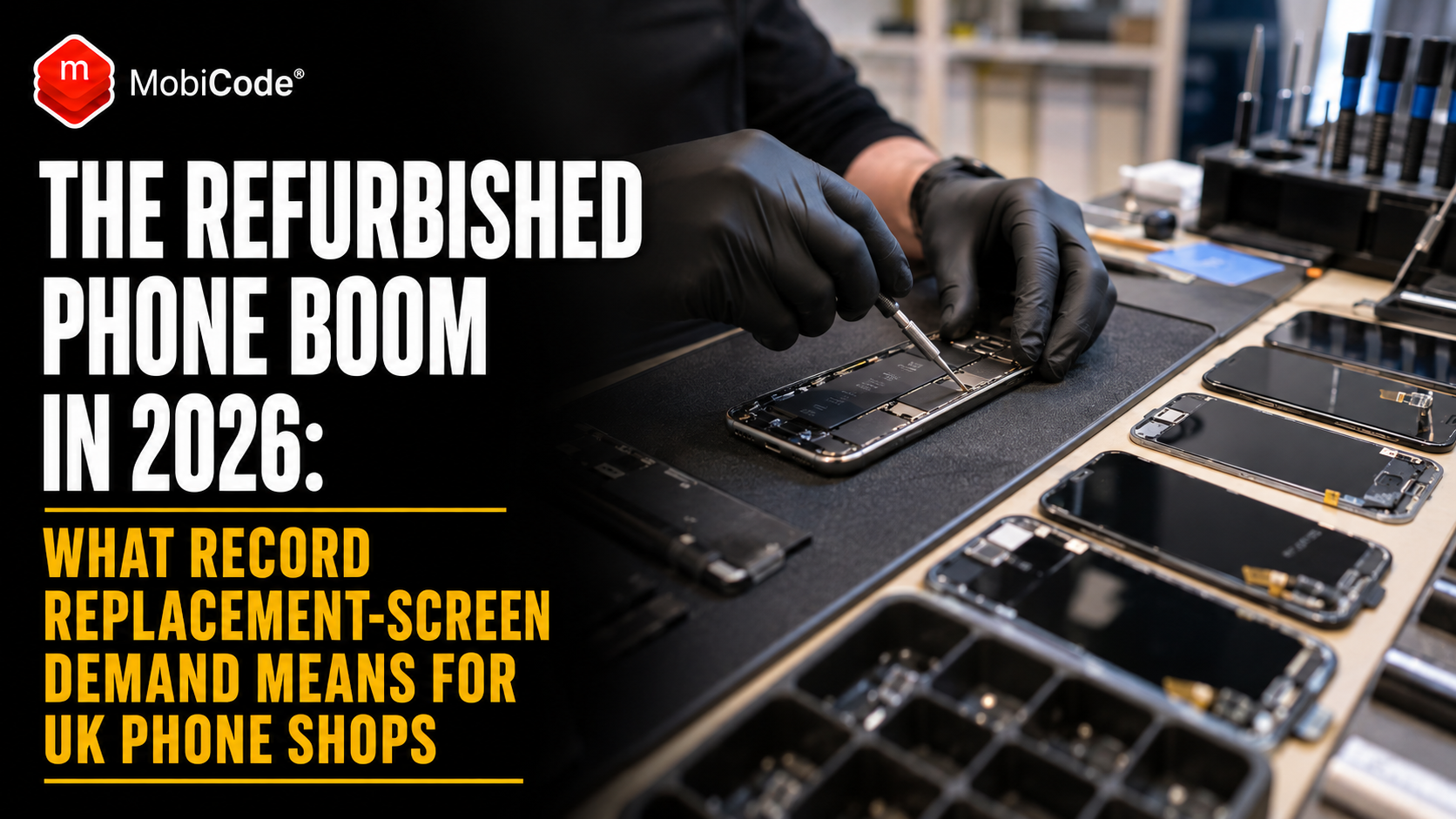
Something unusual happened in the smartphone supply chain during the first quarter of 2026. According to new Omdia research, display-panel shipments into the refurbished smartphone ecosystem reached 298 million units, up 20% year on year. By comparison, 289 million displays were shipped to new-smartphone manufacturers during the same quarter.
Crucially, that does not mean more refurbished phones were sold than new phones. Omdia’s refurbishment figure includes displays flowing into consumer repairs, professional refurbishment and the wider aftermarket. Nevertheless, it is a striking sign of how important repair and reuse have become to the smartphone industry.
For UK phone shops, recyclers, repair centres and refurbishers, the commercial message matters more than the headline itself. More devices are remaining economically useful for longer, replacement-part supply is expanding and consumers increasingly expect used phones to be properly tested rather than simply cleaned and resold.
At the same time, larger retailers and mobile networks are moving further into refurbished devices. As a result, independent shops are no longer competing only with other local traders. Increasingly, they face professional refurbishment offers built around diagnostics, warranties, battery standards and clear grading.
So where is the opportunity? More importantly, what does a UK phone business now need to get right?
What exactly happened in the refurbished smartphone market?
Omdia published its latest display-market findings on 5 August 2026. The research found that display panels supplied into the refurbished smartphone ecosystem increased by 20% year on year during Q1 2026, reaching 298 million units.
Meanwhile, panels supplied to manufacturers for new smartphones totalled 289 million.
Why are more screens moving into refurbishment?
Several forces are interacting. First, Omdia expects demand for displays used in new smartphones to decline during 2026. Rising component costs have also contributed to manufacturers reviewing production plans.
However, display factories cannot simply switch large amounts of capacity on and off without consequences. Therefore, panel suppliers are increasingly looking towards repair and refurbishment as another source of demand.
In effect, the aftermarket gives manufacturers another outlet for production capacity.
Do 298 million panels equal 298 million refurbished phones?
No. This distinction is important.
Omdia’s refurbishment ecosystem includes:
- consumer screen repairs;
- professional refurbishment;
- replacement parts;
- screens fitted to recycled devices;
- the wider smartphone aftermarket.
Consequently, the figure should not be quoted as refurbished-phone sales. Instead, it shows that significantly more screen inventory is flowing towards keeping existing phones usable.
OLED replacement screens are becoming more important
Importantly, the change is not limited to cheap LCD replacements. Omdia reports that OLED accounted for 7% of display shipments into the refurbished smartphone ecosystem during Q1 2026. A year earlier, the figure was only 2%.
As a result, that shift is particularly relevant to businesses processing newer premium phones.
Why OLED matters commercially
Flagship iPhones, Samsung Galaxy devices, Google Pixels and other premium smartphones increasingly use OLED displays. Therefore, greater aftermarket availability can make more damaged premium devices commercially repairable.
For example, a phone with a smashed display does not automatically need to become recycling stock if a suitable replacement can restore enough resale value.
However, easier access to replacement parts creates another challenge: businesses still need to understand the quality of the component being fitted.
More replacement screens do not automatically mean better refurbished phones
At the same time, supply growth creates opportunity, but it can also create inconsistency.
For instance, two visually identical refurbished iPhones could contain very different replacement displays. One might contain a genuine manufacturer replacement, while another could use an aftermarket OLED or a lower-cost panel.
Possible replacement-screen types
Depending on the device and repair history, a refurbished handset could contain:
- a genuine manufacturer replacement;
- a previously used genuine component;
- a high-quality aftermarket OLED;
- a lower-cost replacement panel;
- a poorly fitted screen;
- a display with hidden touch or brightness problems.
Consequently, simply recording “screen replaced” is not enough for a professional refurbishment workflow.
Testing becomes more important as the parts market expands
Afterwards, the handset should be checked carefully.
Useful tests include:
- touch response;
- multi-touch;
- brightness;
- colour consistency;
- dead pixels;
- screen burn;
- proximity sensing;
- automatic brightness;
- biometric functions;
- other model-specific features.
In other words, growing access to replacement screens makes diagnostics more valuable rather than less valuable.
Consumers are buying confidence, not just a cheaper phone
Over time, the used-phone market has matured considerably. Traditionally, the attraction of a refurbished phone was straightforward: it cost less than buying new.
Price still matters. However, established sellers increasingly compete on confidence as well.
What major UK sellers now promise
Vodafone’s current UK refurbished-phone offer provides a useful example. Its refurbished devices are promoted with features such as:
- a multi-point health check;
- data wiping;
- defined cosmetic grades;
- battery checks;
- repair and warranty support;
- testing across screens, cameras, connectivity, sensors and audio.
Importantly, major sellers do not necessarily promise that every part remains factory original. Instead, the commercial promise is increasingly that the handset has been checked, processed, graded and supported.
What this means for independent shops
Of course, an independent retailer may not have the marketing budget of a national network. Nevertheless, it can still compete on evidence.
For example:
“Refurbished iPhone 15, Grade A, tested, securely erased, battery checked, IMEI status verified and supplied with warranty.”
That description is far stronger than:
“Excellent condition. Fully working.”
The first description explains something about the process behind the device. As refurbishment becomes more mainstream, that process becomes increasingly valuable.
What the latest market data means for UK phone shops
The new display figures are global rather than UK-specific. Even so, several practical implications apply directly to British device businesses.
1. More damaged phones may be worth repairing
Greater aftermarket part availability can change repair economics. For instance, a handset that previously produced too little margin after a screen replacement may become viable if component costs fall or supply improves.
Therefore, shops should review repair-versus-recycle decisions regularly rather than relying on old price assumptions.
2. Premium refurbishment may become easier to scale
Higher OLED availability could improve access to suitable replacement displays for premium stock. As a result, businesses may be able to recover more value from damaged higher-end devices.
Nevertheless, the resale grade should still reflect the quality of the repair and the part fitted.
3. Testing standards become a competitive advantage
More replacement parts mean greater variation between refurbished phones. Consequently, buyers will increasingly want confidence that the handset works correctly after repair.
A consistent diagnostic process can therefore help separate professional refurbishment from basic resale.
Do not let cheaper replacement screens distort your buy prices
One temptation is to see lower component prices and immediately increase what you pay for damaged phones. However, the screen cost is only part of the calculation.
Calculate the entire refurbishment cost
In practice, a realistic buying decision should consider:
- purchase price;
- replacement parts;
- technician time;
- failed-repair risk;
- diagnostic time;
- battery replacement where required;
- shipping;
- marketplace fees;
- warranty reserve;
- expected return rate;
- final resale value.
Therefore, a £25 reduction in screen cost does not necessarily justify paying £25 more for the handset.
Think in expected resale value, not headline repair cost
Suppose a phone sells for £400 once fully processed. If the damaged handset costs £280 and the repair adds another £60, the apparent margin is £60.
However, that calculation ignores operating costs and risk.
What else can consume the margin?
In addition, the final profit may also need to absorb:
- testing labour;
- packaging;
- payment fees;
- warranty claims;
- customer returns;
- failed parts;
- listing fees;
- stock depreciation.
Consequently, buying discipline matters just as much as access to cheaper parts.
Repair quality needs to become part of grading
Many grading systems still concentrate almost entirely on cosmetics. For example, Grade A may mean almost perfect condition, while Grade B allows light wear and Grade C covers heavier cosmetic damage.
That approach is simple for consumers to understand. However, it does not describe the entire device.
Two Grade A phones may not be equivalent
For example, imagine two spotless devices. The first has its original display and a battery in good condition.
Meanwhile, the second has a replacement screen, a recently changed battery and previous camera repair.
Both may function perfectly. Nevertheless, their histories differ.
Record more than cosmetic condition
A stronger commercial record separates:
- cosmetic grade;
- functional result;
- battery condition;
- repair history;
- device-status result;
- data-erasure result.
As a result, the grade becomes part of a wider evidence trail rather than the only description of the phone.
The refurbished market is becoming a data problem as well as a repair problem
When a shop processes five phones each week, staff can remember a surprising amount. At 100, 500 or 5,000 devices, however, memory stops being a system.
Each handset creates multiple data points
In practice, a professional process may need to record:
- IMEI;
- serial number;
- model;
- storage;
- supplier;
- purchase price;
- status-check result;
- diagnostic result;
- battery condition;
- parts fitted;
- repair cost;
- cosmetic grade;
- wipe result;
- final routing decision.
As volumes rise, connecting those decisions becomes essential.
Status checking should happen before expensive refurbishment
For that reason, a shop should not spend £100 repairing a handset only to discover afterwards that the IMEI has an unresolved status problem.
Therefore, device due diligence should happen early.
Check the commercial risk first
Before repair, review:
- device identity;
- IMEI status;
- lost or stolen indicators;
- blocklist concerns;
- activation locks;
- other relevant resale risks.
MobiCHECK supports professional IMEI and device-status checks before businesses commit more money to a handset.
Diagnose the whole phone before ordering parts
A cracked display is highly visible. However, it may not be the only fault.
In addition, the same handset might also have a weak battery, damaged charging port, faulty microphone or broken camera.
Hidden faults can destroy repair economics
Possible additional problems include:
- battery degradation;
- charging faults;
- microphone problems;
- camera failures;
- Wi-Fi issues;
- broken NFC;
- sensor faults;
- biometric problems.
Consequently, diagnosing before repair can prevent businesses from spending money on a handset that will remain uneconomic.
MobiCode TEST helps teams run structured functional checks rather than relying entirely on manual inspection.
Retest after every major repair
Even so, a device passing diagnostics before repair does not guarantee that it still passes afterwards.
For example, replacing a display can potentially interact with touch response, proximity sensing, ambient-light behaviour or front-camera functions.
What should post-repair testing cover?
Depending on the repair, check:
- touch response;
- proximity sensing;
- ambient-light behaviour;
- front-camera functions;
- biometric systems;
- frame alignment.
Therefore, a professional workflow should include a post-repair test rather than assuming the job succeeded because the new screen lights up.
Before-and-after testing creates stronger evidence
Ideally, the device record should show:
- initial condition;
- faults identified;
- repair completed;
- parts used;
- post-repair diagnostic result;
- final grade.
Later, this information also becomes useful if a customer returns the phone.
Battery standards could become the next competitive battleground
Screens attract attention because damage is visible. However, batteries often determine whether the customer actually enjoys using the refurbished handset.
That is why major sellers increasingly talk about battery standards alongside cosmetic grades.
UK shops should define a battery rule
In practice, a retailer should decide what happens when a battery:
- meets the resale threshold;
- falls just below it;
- cannot provide reliable health data;
- shows unexpected shutdowns;
- has been replaced previously;
- needs replacement before warranty sale.
Without a defined policy, two members of staff can make different decisions about identical stock. Therefore, a clear battery standard improves both consistency and customer expectations.
Do not compete with national retailers on price alone
Large networks can buy components at scale and spread warranty costs across enormous customer bases. Consequently, an independent UK phone shop may struggle to win a pure price war.
Instead, smaller businesses can compete in other ways.
Areas where independent shops can stand out
- local service;
- fast repairs;
- clear grading;
- documented testing;
- honest repair disclosure;
- good warranties;
- trade-in convenience;
- knowledgeable staff.
As a result, process quality can become a sales tool rather than merely an internal operating cost.
A refurbished phone should have a story you can prove
For example, consider two devices that look almost identical to a customer.
Phone A
- excellent cosmetic condition;
- no test record;
- battery condition unknown;
- screen replaced by an unknown supplier;
- IMEI checked months ago;
- factory reset performed;
- no recorded wipe result.
Phone B
- IMEI checked at intake;
- initial diagnostics completed;
- screen fault recorded;
- replacement documented;
- post-repair diagnostics passed;
- battery assessed;
- device securely erased;
- grade recorded;
- warranty attached.
To the customer, both phones may look similar. Operationally, though, they are very different products.
Secure data erasure remains essential
The growth of refurbishment means more devices are moving between owners. As a result, data handling becomes even more important.
For instance, a used handset may contain:
- photographs;
- messages;
- email accounts;
- business documents;
- saved credentials;
- authentication apps;
- personal contact information.
Therefore, refurbishment should include a controlled erasure process before resale.
MobiWIPE supports certificated mobile data-erasure workflows for professional device processors.
Why a factory reset is a weak commercial record
A technician may know that they pressed “Erase All Content and Settings”. However, a business may later need to demonstrate what happened to a specific handset.
Recorded erasure evidence becomes particularly useful when:
- a corporate client asks for confirmation;
- a customer raises a privacy concern;
- an auditor reviews the workflow;
- a batch contains sensitive business devices;
- the phone moves through several processing stages.
Consequently, the refurbished-phone boom increases the value of traceability as well as repair skills.
The wider pre-owned market is attracting serious industry attention
Counterpoint Research published its latest Global Pre-Owned Smartphone Market Tracker on 17 August 2026. The report covers pre-owned and refurbished smartphone volumes, regional trends, average selling prices and the wider value chain.
Notably, Counterpoint identifies component shortages and right-to-repair policies among the forces influencing the market.
Who is watching the sector?
Specifically, the research is relevant to:
- carriers;
- national retailers;
- insurers;
- refurbishers;
- resellers;
- component companies.
In other words, pre-owned phones are no longer a peripheral part of the mobile sector.
European repair policy is moving in the same direction
At the same time, European repair policy is also encouraging longer product lives.
New EU right-to-repair consumer rules took effect in 2026. They strengthen repair rights for products including mobile phones and tablets, alongside requirements around repair information and parts.
These EU rules do not automatically become UK domestic law because the UK is outside the EU. However, they still matter commercially to British companies operating across European supply chains.
Why UK businesses should still care
In particular, the rules are relevant to companies that:
- sell into European markets;
- buy European stock;
- work with EU refurbishment partners;
- source parts through European supply chains;
- follow manufacturer repair programmes designed for several markets.
More broadly, they reinforce the same commercial direction: keeping devices in use for longer.
What models should UK refurbishers concentrate on?
Not every repairable phone deserves refurbishment. Instead, the best candidates normally combine strong second-hand demand with manageable repair costs.
Good refurbishment candidates often have:
- strong resale demand;
- good residual value;
- available parts;
- reasonable repair difficulty;
- remaining software support;
- manageable warranty risk.
Beware cheap phones with expensive labour
For example, a replacement part may cost only £20. Nevertheless, if the completed handset sells for £60, technician time and warranty exposure can remove the margin.
Therefore, refurbishment decisions should be model-specific rather than based only on whether the repair is technically possible.
Software support should influence buying decisions
Importantly, a phone can be physically perfect but commercially weak if its remaining software-support life is short.
Therefore, shops should consider not only today’s resale price but also how long the handset remains sensible for the next owner to use.
This matters most for older stock
Before investing in repair, ask:
- how old is the model?
- does it still receive security updates?
- how quickly is its value falling?
- will customers still want it in six months?
- is the repair cost proportionate to resale value?
Otherwise, cheaper replacement screens can tempt a business into repairing stock that should have been routed elsewhere.
Inventory speed matters as competition increases
A refurbished phone loses value while it sits on a shelf. Therefore, buying well is only half the job.
Measure the full processing journey
In practice, businesses should monitor the time between:
- device intake;
- status checking;
- diagnosis;
- repair approval;
- parts fitting;
- retesting;
- erasure;
- grading;
- listing;
- sale.
For example, a cheaper repair is less valuable if the phone loses £40 of market value while waiting three weeks to be processed.
Automation does not replace technicians
Repair remains a skilled job. However, not every part of the refurbishment workflow needs to depend on individual memory.
Standardise what can be standardised
For example, good candidates for consistent workflows include:
- IMEI capture;
- device lookup;
- functional tests;
- workflow alerts;
- grading questions;
- data-erasure records;
- final routing decisions.
Meanwhile, technicians can concentrate on tasks where judgement and physical skill matter most.
How MobiONE fits into higher-volume refurbishment
MobiONE is designed to help businesses standardise device processing at scale.
For example, it can bring together stages such as:
- device identification;
- inbound checks;
- automated and guided diagnostics;
- workflow rules;
- grading;
- secure erasure;
- final device routing.
For businesses increasing refurbishment volumes, this matters because growth often exposes inconsistencies that remain hidden at lower volumes.
The refurbishment workflow UK shops should aim for
Intake and identification
- Capture IMEI and serial number.
- Record supplier and purchase price.
- Confirm model, storage and configuration.
Due diligence before repair
- Review IMEI and device status.
- Check account and activation locks.
- Hold problematic devices before spending on repair.
Initial diagnostic testing
- Test screen and touch.
- Assess battery condition.
- Check cameras and audio.
- Review charging, connectivity and sensors.
Deciding whether to repair
- Estimate parts and labour.
- Calculate expected resale value.
- Include warranty and return risk.
- Repair only where the economics work.
Testing after the repair
- Repeat relevant functional tests.
- Record components fitted.
- Investigate new faults before release.
Secure data erasure
- Remove customer data.
- Record the erasure result.
- Retain evidence where required.
Grading and resale
- Apply a consistent cosmetic grade.
- Record battery and repair information.
- Describe the device accurately.
- Attach the appropriate warranty.
Five numbers every refurbishment business should track
Market growth is useful, but your own numbers matter more. Therefore, every refurbishment business should monitor a small set of commercial metrics consistently.
1. Average gross margin per handset
Track the realised margin after repair costs rather than only the difference between purchase and selling price.
2. Average repair cost
Separate screens, batteries, cameras and other repairs so that changes in component prices become visible.
3. Return rate
A higher apparent margin is not attractive if poor testing produces expensive returns later.
4. Processing time
Measure how long a handset spends between intake and resale readiness.
5. Repair success rate
Finally, track how often devices approved for repair actually become saleable stock.
Together, these measures tell you much more than the total number of devices processed.
Where phone shops can lose money during a refurbishment boom
Growing markets often encourage businesses to buy too aggressively. However, higher demand does not automatically make every handset profitable.
Common margin killers
- overpaying for damaged phones;
- buying poor-quality replacement parts;
- repairing models with weak resale demand;
- failing to retest after repair;
- using inconsistent grading;
- ignoring battery condition;
- holding stock for too long;
- underestimating warranty costs;
- checking IMEI status too late;
- keeping weak device records;
- assuming a factory reset is enough for data handling.
Therefore, the winners from a growing refurbishment market will not necessarily be the businesses processing the most phones.
Instead, they will be the businesses that process the right phones consistently and profitably.
How MobiCode supports professional refurbishment
In particular, MobiCode’s tools are designed around the stages that become more important as used-device volumes grow.
MobiCHECK
MobiCHECK supports IMEI and device-status due diligence before businesses invest further money in a handset.
See: MobiCHECK
MobiCode TEST
MobiCode TEST provides structured automated and interactive diagnostics to help identify functional faults.
See: MobiCode TEST
MobiWIPE
MobiWIPE supports certificated data-erasure workflows before devices move to another user.
See: MobiWIPE
MobiONE
MobiONE helps bring device lookup, diagnostics, grading, workflow rules and data erasure into a more consistent processing workflow.
See: MobiONE
Ultimately, the purpose is not simply to test more phones. Instead, the aim is to make the decision behind each handset more consistent, traceable and commercially useful.
What should UK phone shops do now?
Overall, the Omdia figures do not require every repair shop to redesign its business overnight. However, they provide a useful reason to review the economics and processes behind refurbishment.
Review replacement-screen suppliers
As availability increases, compare quality as carefully as price.
Recalculate damaged-device buy prices
Updated parts costs may make some repairs more attractive. Conversely, falling resale values may make other repairs less worthwhile.
Formalise diagnostic testing
Rather than relying on a technician to remember every check, build a repeatable test process.
Record parts and repair history
In turn, better repair records can improve grading, listings and later warranty investigations.
Define battery thresholds
As a result, a clear rule makes resale decisions more consistent across different staff members and branches.
Improve the evidence behind each device
Likewise, IMEI checks, diagnostics, repair records, grading and erasure results become more useful as processing volume rises.
Commercial takeaway
The most interesting thing about the latest refurbished phone market 2026 data is not simply that 298 million replacement displays were shipped into the refurbishment ecosystem.
Instead, the real significance lies in what that figure represents.
In practice, more smartphone hardware is being directed towards repair, refurbishment and reuse at the same time that demand for new-device components is weakening.
Meanwhile, OLED replacements are becoming a larger part of the aftermarket, and major retailers are placing increasingly sophisticated refurbished-phone offers in front of UK consumers.
For independent phone shops, that creates both opportunity and pressure. Cheaper or more available parts can make more damaged phones worth saving. However, greater supply also means more variation in repair quality and more competition for customer trust.
Therefore, the strongest refurbishment businesses will treat testing, device status, grading, repair records and secure erasure as part of the product they sell—not merely as jobs happening behind the counter.
A practical example: when cheaper OLED screens change the buying decision
A UK phone shop is offered ten premium smartphones with cracked OLED displays.
Six months earlier, the cost of suitable screens made the batch unattractive. The projected repair spend left too little margin once labour, returns and resale fees were included.
Now, however, the replacement-screen market has changed. The shop obtains new supplier pricing and discovers that the economics may work.
Check the batch before buying
First, staff capture every IMEI and review device status before money is committed.
Next, the phones go through initial diagnostics. Two have camera faults, one has a weak battery and another has a charging problem.
Consequently, the shop does not value all ten handsets as simple screen repairs.
Make the repair decision device by device
Six phones remain commercially attractive after the wider faults are considered.
Those devices receive replacement displays and then undergo a second diagnostic test.
During retesting, one handset fails touch testing and goes back to the technician rather than reaching a customer.
Finally, the remaining five devices pass, are securely erased, graded and listed for resale with accurate condition information.
In this example, cheaper screens created the opportunity. However, the margin came from identifying which phones were actually worth repairing.
That distinction becomes increasingly important as the refurbishment market grows.
Frequently asked questions
Market and replacement-screen questions
Is the refurbished phone market growing in 2026?
Yes, recent industry data points to strong activity across the refurbishment ecosystem. Omdia reported that display shipments into repair, refurbishment and aftermarket channels rose 20% year on year in Q1 2026 to 298 million units.
Were more refurbished phones sold than new phones in Q1 2026?
No. The comparison concerns display-panel shipments. Omdia’s refurbishment figure includes consumer repair, professional refurbishment and aftermarket replacement screens, so it should not be interpreted as final refurbished-phone sales.
Why are more replacement phone screens being produced?
Weaker new-smartphone production is encouraging panel suppliers to direct more manufacturing capacity towards repair, refurbishment and aftermarket demand. Consequently, replacement-screen availability is becoming increasingly important to the wider mobile supply chain.
Are OLED replacement screens becoming more common?
Yes. According to Omdia, OLED panels represented 7% of display shipments into the refurbished smartphone ecosystem in Q1 2026, compared with 2% a year earlier.
Testing and refurbishment questions
What should a phone shop test after replacing a screen?
Post-repair testing should cover touch and multi-touch, brightness, display quality, relevant sensors, cameras, biometric functions, audio, charging and connectivity. In addition, the exact checks should reflect the device model and repair completed.
How should a shop decide whether a damaged phone is worth refurbishing?
Compare expected resale value with purchase price, parts, labour, diagnostics, other faults, marketplace costs, warranty risk and stock depreciation. Therefore, the replacement-part price alone is not enough to make the decision.
Why do refurbishers need mobile phone diagnostics?
Diagnostics help identify faults before money is spent on repair and confirm that the handset still works after components are replaced. As a result, structured testing can support more consistent grading and stronger warranty records.
How does MobiCode support phone refurbishment businesses?
MobiCHECK supports device-status due diligence, MobiCode TEST provides structured diagnostics, MobiWIPE supports certificated data erasure and MobiONE helps connect device checks, testing, grading and processing workflows.
References and further reading
- Omdia: Weak smartphone demand drives record growth in display shipments to refurbished phone market — 5 August 2026
- Counterpoint Research: Global Pre-Owned Smartphone Market Tracker, 1H 2026 — 17 August 2026
- Which?: How to buy the best refurbished phone
- Vodafone UK: Refurbished phones and device testing
- European Commission: Right-to-repair consumer rules
- MobiCHECK
- MobiCode TEST
- MobiWIPE
- MobiONE