

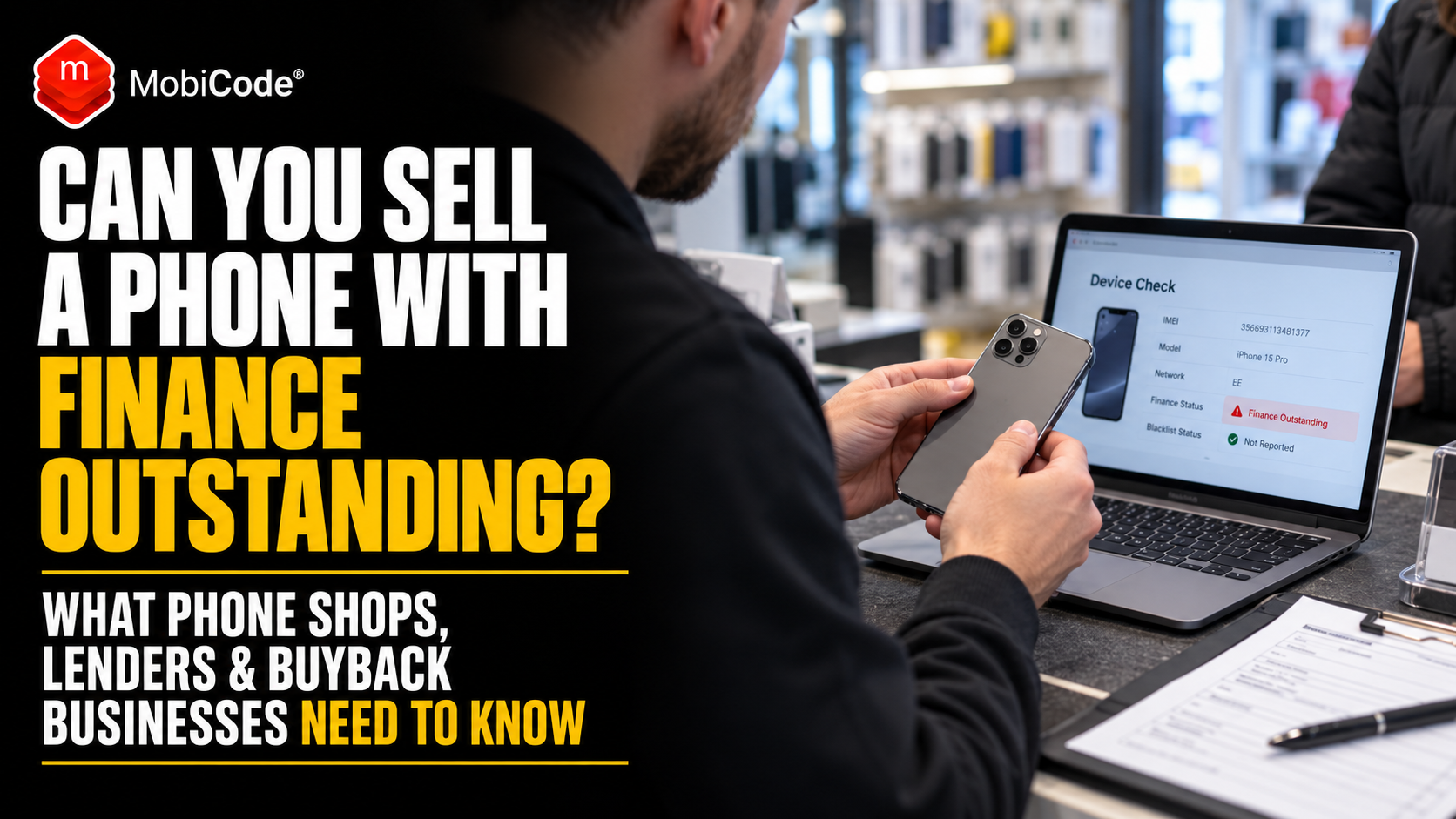
Can you sell a phone with finance outstanding? Sometimes — but there is no universal answer. It depends on the type of finance agreement, who legally owns the handset, the provider’s terms and whether the customer has the right to dispose of the device.
That uncertainty creates a real problem for lenders, phone shops, recyclers and trade-in companies. A handset can look completely legitimate while another business still has an active financial or contractual interest in it.
This guide explains how financed phones work, what professional buyers should check before accepting them and how MobiBLOCK and MobiCHECK can help make active device interests more visible across the second-hand market.
The short answer
Having a phone in your possession does not automatically prove that you are free to sell it. Some finance arrangements transfer ownership immediately while others do not. Businesses buying used phones should therefore investigate the device and relevant agreement status rather than assuming physical possession equals clear title.
Can you sell a phone that still has finance outstanding?
The answer depends on the agreement.
“Phone finance” can describe several very different arrangements.
A customer may have:
- a handset bundled with an airtime contract;
- a separate device-finance agreement;
- a personal loan used to purchase the phone;
- a hire-purchase agreement;
- a conditional-sale agreement;
- a rental or leasing arrangement;
- a business device supplied under an employer or fleet agreement.
Those arrangements do not all create the same ownership position.
That is why neither consumers nor professional buyers should assume that every “contract phone” works in the same way.
UK mobile contracts increasingly separate the phone from airtime
Ofcom’s 2026 pricing research highlights how modern mobile deals can separate the handset from the airtime service.
Some customers therefore have two distinct commitments:
- the mobile service contract; and
- the agreement used to pay for the handset.
Selling the phone does not automatically end either agreement.
Ofcom also notes that handset payment plans may run separately from airtime and, in some cases, continue for longer than a traditional 24-month mobile contract.
For businesses buying second-hand phones, that makes the device’s finance position a separate due-diligence question.
Ownership rules can differ dramatically between agreements
This is the point where simple online advice often becomes misleading.
Different finance structures create different rights.
Hire purchase and conditional sale
Citizens Advice explains that under hire purchase, the customer does not own the goods until they have paid for them in full.
While the agreement remains active, the customer normally cannot sell or dispose of the goods without the lender’s permission.
Conditional-sale agreements can work similarly, with ownership transferring only after the required payments have been made.
Device loans can work differently
Other mobile finance arrangements are structured as loans rather than hire purchase.
O2, for example, describes its Device Plan as a loan agreement used to spread the cost of a handset.
Its current guidance says customers can make early repayments and that they own the device outright once they have finished paying for the Device Plan.
However, customers should still check the exact terms of their own agreement rather than assume another provider works the same way.
Providers may impose additional ownership restrictions
EE Business provides a useful example of why contract terms matter.
Its current customer guidance states that EE legally owns devices it sells during the first six months of the contract and customers cannot sell or unlock the handset during that period.
The lesson for used-phone businesses is straightforward:
Why financed-phone resale creates a problem for lenders
A high-value smartphone remains useful and desirable even when the customer has not completed the agreement attached to it.
That creates an obvious risk.
A customer could potentially attempt to sell or trade the handset while another organisation still retains a financial or contractual interest.
The buyer may have no obvious way of knowing that from the device itself.
The phone may:
- look completely normal;
- turn on successfully;
- connect to a mobile network;
- pass hardware diagnostics;
- have no visible physical damage.
None of those facts tells a recycler or phone shop whether an active finance, rental or lease interest still exists.
The same problem affects phone shops and recyclers
Consider a buyback shop purchasing a recent flagship phone for several hundred pounds.
The seller has possession of the handset, knows the passcode and can remove their Apple or Google account.
From a purely physical perspective, the transaction looks normal.
However, if the device remains subject to an agreement that restricts resale or gives another business a continuing interest, the buyer may be taking on hidden commercial risk.
That is why professional due diligence should cover more than lost and stolen status.
Where MobiBLOCK fits
MobiBLOCK gives eligible businesses a way to create a device-level record when they retain a legitimate interest in a handset.
MobiBLOCK can be used to flag devices that remain under:
- finance agreements;
- rental agreements;
- lease agreements.
This gives the business another layer of protection beyond contracts, payment collection and customer communication.
A relevant device check further down the supply chain can then show that an active interest may still exist.
The commercial value
A finance provider should not have to rely solely on the hope that the next buyer knows an agreement exists. MobiBLOCK lets eligible organisations attach relevant finance, rental or lease information to the device itself.
Why the IMEI is useful for protecting financed devices
The IMEI identifies the cellular device itself.
Unlike a phone number or SIM card, it remains associated with the physical handset.
That makes it useful for managing device-level risk when a handset changes users, SIM cards or sales channels.
MobiBLOCK uses IMEI-based blocking and flagging to connect relevant device status to the handset.
MobiBLOCK can do more than flag finance
Finance is only one MobiBLOCK use case.
Eligible businesses can also use the service where appropriate for devices that become:
- stolen;
- lost;
- fraudulently retained;
- unreturned after rental;
- unreturned after leasing;
- subject to an evidenced marketplace dispute.
That makes the service relevant to a much wider group of businesses than traditional mobile networks.
Who should consider MobiBLOCK?
The strongest commercial use cases include:
- mobile phone finance providers;
- phone rental companies;
- device leasing businesses;
- mobile networks and MVNOs;
- marketplace smartphone sellers;
- electronics retailers;
- corporate device-fleet operators;
- loan-device providers;
- education providers issuing devices;
- businesses supplying high-value tablets and connected devices.
Finance providers: make the active interest visible
Finance businesses face a particular challenge because the handset may physically leave their control on day one.
The customer uses the device, changes SIM cards and carries it wherever they want.
If the agreement later becomes problematic, contractual rights remain important, but the business may also want a device-level status that helps communicate its continuing interest.
MobiBLOCK can flag that finance interest where appropriate.
This becomes valuable if the handset later reaches a recycler, trade-in business or second-hand retailer using MobiCHECK.
Rental companies: reduce the value of non-return
Rental models create an even clearer ownership issue.
The rental company owns the asset while the customer controls it physically.
Most customers return devices correctly.
However, some phones may become:
- lost;
- stolen;
- retained after the rental ends;
- resold without permission.
A modern flagship can retain substantial second-hand value, giving an unreturned device a resale market.
MobiBLOCK allows eligible rental businesses to flag or block the relevant handset where their evidence supports that action.
Leasing businesses face the same fundamental problem
A lease separates use from ownership.
The customer has possession, but the leasing business continues to retain an interest in the asset.
That is precisely the kind of arrangement where device-level flagging can complement the contractual recovery process.
How MobiCHECK closes the loop
MobiCHECK addresses the problem from the buyer’s side.
MobiBLOCK allows an eligible organisation with an interest in the device to create the relevant block or flag.
MobiCHECK allows another business to investigate device status before purchasing, trading or processing that handset.
Importantly, MobiCHECK can show devices that MobiBLOCK has blocked or flagged.
A finance, rental or leasing business records or acts on an appropriate at-risk device.
A recycler, retailer or buyback business sees relevant status before paying for the handset.
A practical financed-phone example
Imagine a customer acquires an expensive phone through a finance arrangement.
Several months later, the agreement is still active and the customer attempts to trade the handset into another business.
Without device-level finance visibility
The trade-in business may see only a functioning phone with an apparently normal seller.
If nothing in its due-diligence process reveals the active interest, it may buy the device.
With a MobiBLOCK finance flag
The finance provider can record the relevant interest where appropriate.
If the downstream business performs a MobiCHECK query, the flag can provide a reason to investigate before paying.
That is a much better point to resolve the problem than after the handset has already passed through several owners.
Why this matters as phone finance becomes more common
Handset prices remain high, particularly for flagship phones.
Ofcom’s 2026 pricing analysis found substantial differences between buying an iPhone outright and acquiring the same handset as part of some pay-monthly mobile packages.
Its analysis also shows how handset financing and airtime can operate as separate components.
That makes device finance an important part of the modern mobile market.
It also means more second-hand buyers may encounter devices whose contractual history is not obvious from their physical condition.
Phone shops should not try to interpret contracts themselves
A recycler or trade-in employee is not there to provide legal advice about a customer’s finance agreement.
Their job is simpler:
- identify the device;
- perform the required due diligence;
- recognise relevant warnings;
- follow the business’s internal policy;
- escalate exceptions rather than guessing.
If a relevant finance flag appears, staff can ask the seller to resolve the issue with the finance provider or provide whatever evidence the business requires.
What should a phone shop check before buying a financed handset?
A professional intake process should consider:
- IMEI validity;
- make and model verification;
- network blocklist status;
- lost or stolen reports;
- finance indicators;
- insurance-related records;
- Activation Lock or FRP;
- functional condition;
- physical grade;
- seller and transaction records.
Finance status and network blocking are different things
It is worth separating two MobiBLOCK functions.
A finance, rental or lease flag communicates that an organisation may still have an active interest in the handset.
An IMEI block restricts the device’s ability to connect to participating mobile networks.
Those are related but different controls.
Businesses should select the appropriate action based on the evidence, agreement and their internal policy.
What does IMEI blocking actually do?
When an appropriate IMEI block is applied, the handset can be prevented from connecting to participating mobile networks.
That makes the phone less useful and potentially less attractive for ordinary resale.
However, an IMEI block is not a universal kill switch.
It does not necessarily:
- stop the device using Wi-Fi;
- locate the handset;
- erase stored information;
- remove Apple Activation Lock;
- remove Android Factory Reset Protection.
Those functions solve different parts of the wider device-protection problem.
Why evidence matters before blocking a handset
Changing device status can affect whoever currently possesses the phone.
MobiBLOCK should therefore form part of a controlled business process.
Before taking action, organisations should confirm relevant evidence such as:
- the correct IMEI;
- the business’s ownership or financial interest;
- the relevant agreement;
- delivery or return evidence;
- customer communication;
- payment or account history where relevant;
- the organisation’s own internal policy.
MobiCode also emphasises retaining a written evidence trail around blocking and flagging decisions.
The evidence trail has value beyond the IMEI
A structured record can support:
- customer disputes;
- marketplace claims;
- insurance processes;
- internal reviews;
- police reports;
- legal escalation where necessary.
That is commercially important because asset protection is rarely about one button.
It is about being able to show why the business acted.
Device-level protection is becoming a wider industry priority
UK authorities have also been putting increased pressure on industry to reduce the resale value of problematic devices.
In March 2026, the Home Office told Parliament that it wanted to “break the business model” behind phone theft by reducing the value of stolen handsets.
The National Police Chiefs’ Council repeated that theme in October 2026, calling on manufacturers and industry to make stolen phones harder to reset and resell.
Those initiatives focus primarily on theft, but the principle is relevant more broadly:
How MobiBLOCK can improve the economics of device finance
Device finance involves calculated risk.
The business provides access to a valuable physical asset and receives payment over time.
Traditional controls focus on:
- credit checks;
- contracts;
- Direct Debit or recurring payments;
- debt collection;
- customer communication.
Those controls remain important.
MobiBLOCK adds another layer: the ability to act on or flag the physical device itself where the circumstances justify it.
The value proposition is not “block more phones”
The real objective should be to reduce avoidable loss.
If customers know that unreturned, fraudulently retained or agreement-linked devices can be flagged or blocked, that may also create a useful deterrent.
A strong process therefore creates value in three ways:
- prevention — customers know the device can remain visible;
- action — the business has another response when things go wrong;
- downstream visibility — another buyer may detect the relevant status through MobiCHECK.
What does one bad device actually cost?
The loss is rarely limited to the handset’s purchase price.
A problem device can also create:
- staff investigation time;
- customer-service work;
- marketplace disputes;
- recovery activity;
- legal costs;
- insurance administration;
- stock write-offs;
- fraud-team workload.
This is why asset-protection software should be evaluated against the cost of unresolved exceptions, not merely against the subscription or transaction price of the software.
A stronger finance and rental workflow
Record the device
Capture the IMEI and connect it to the customer, agreement and asset record.
Record the active interest
Where appropriate, use MobiBLOCK to flag an active finance, rental or lease interest.
Track the agreement
Keep the asset and agreement information connected throughout the customer lifecycle.
Investigate exceptions
Review payment, delivery, return and customer evidence before taking device-level action.
Block or update status where justified
Use the appropriate MobiBLOCK action once the business has established the facts and its right to act.
Preserve the evidence
Keep the agreement, customer communication and status history available for later review or escalation.
How should trade-in businesses respond to a finance flag?
A finance indicator should trigger investigation rather than guesswork.
The shop can follow its own policy, which may involve:
- asking the seller for clarification;
- requesting evidence that the relevant balance has been settled;
- asking the seller to contact the provider;
- escalating the transaction to a manager;
- declining the device until the issue is resolved.
The purpose of the flag is to reveal information that would otherwise remain invisible.
Why MobiBLOCK and MobiCHECK are more useful together
Neither product is trying to do the other’s job.
MobiBLOCK is for an organisation that already has a legitimate interest in the device.
MobiCHECK is for the business considering whether to acquire or process it.
Together, they create a simple principle:
Commercial takeaway
A contract protects the agreement. MobiBLOCK helps protect the device.
Finance, rental and leasing businesses already use contracts, credit controls and recovery processes. The weakness is that the physical handset can still move into another part of the market.
MobiBLOCK adds a device-level layer by allowing eligible businesses to flag active interests and act on appropriate stolen, lost, fraudulently retained or unreturned devices.
When another professional buyer checks the handset through MobiCHECK, that status can become visible before the next transaction takes place.
Protect financed, rented and leased devices with MobiBLOCK
MobiBLOCK is designed for organisations that carry financial or operational risk after a device leaves their immediate control.
Current capabilities include:
- IMEI-based device blocking;
- finance-interest flagging;
- rental and lease flags;
- support for stolen or lost devices;
- support for fraudulently retained or unreturned devices;
- written evidence trails;
- visibility through relevant MobiCHECK checks.
Does your business retain an interest in devices after they leave your hands?
MobiBLOCK can help finance providers, rental companies, leasing businesses and other eligible organisations protect device assets, flag active interests and respond when devices become stolen, retained or unreturned.
Already a MobiCode customer?
Request MobiBLOCK access through your existing account using the
Blocklist Access page →
Frequently asked questions
Can you sell a phone with finance outstanding?
It depends on the finance agreement. Some arrangements allow the customer to own the handset while repaying a loan, while hire purchase, conditional sale or provider-specific terms can restrict ownership or resale until certain conditions are met. Check the exact agreement before selling.
Does selling a phone cancel the finance agreement?
No. Selling or handing over the physical phone does not automatically cancel the separate finance or airtime agreement. The customer remains subject to the terms of the relevant contract unless the provider confirms otherwise.
How can a phone shop check whether a phone has finance outstanding?
Professional buyers can use commercial device-status services such as MobiCHECK to investigate relevant finance, insurance, network-block and lost or stolen indicators associated with the handset.
What does MobiBLOCK do for finance companies?
MobiBLOCK can allow an eligible finance provider to flag a device that remains subject to an active finance interest. Relevant MobiCHECK queries can then show that status to downstream businesses before purchase or processing.
Can rental companies use MobiBLOCK?
Yes. MobiBLOCK is designed for eligible rental and leasing businesses as well as finance providers. It can help them flag or block appropriate devices that become lost, stolen, retained after the agreement or otherwise unreturned.
How do MobiBLOCK and MobiCHECK work together?
MobiBLOCK helps an eligible organisation create or act on relevant device status. MobiCHECK helps another business investigate that status before buying, trading or processing the handset. MobiCHECK can show devices that MobiBLOCK has blocked or flagged.
Sources and further reading
-
Ofcom — Pricing and Consumer Engagement Trends in the UK Communications Sector, 2026
-
Ofcom — Choosing the right mobile package
-
O2 — Device Plan guidance
-
EE Business — Device ownership and contract guidance
-
Citizens Advice — Hire purchase and conditional sale
-
MoneyHelper — Hire purchase and conditional-sale ownership
-
UK Parliament — Reducing the value of stolen mobile phones
-
National Police Chiefs’ Council — Making stolen phones harder to resell, October 2026
-
MobiCode — MobiBLOCK device blocking and asset protection
-
MobiCode — MobiCHECK device-status due diligence