

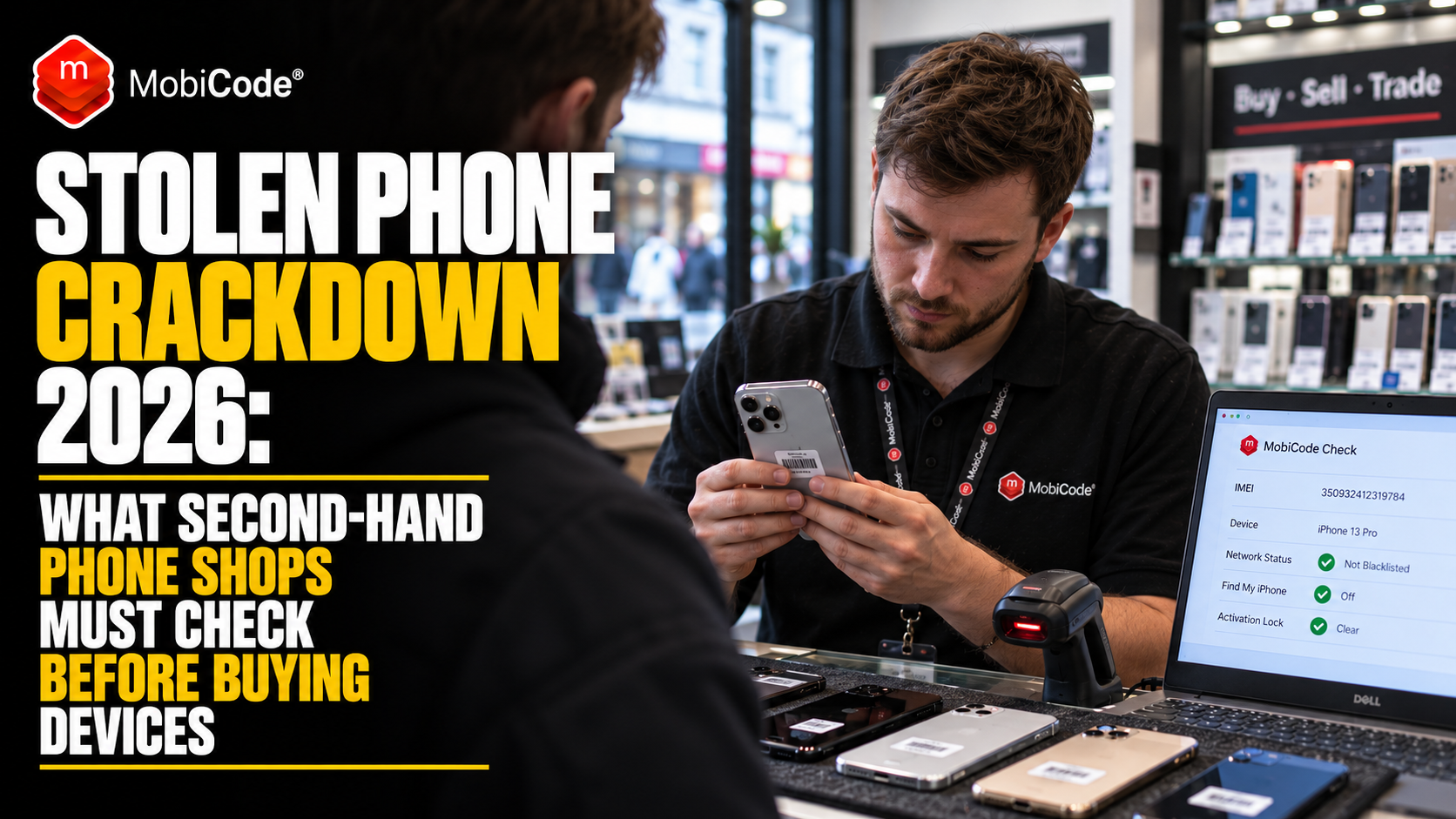
Second-hand phone shops are under more pressure than ever to know exactly what they are buying. In October 2026, the Metropolitan Police said it had arrested more than 700 people and seized hundreds of suspected stolen phones during its largest-ever crackdown on mobile phone theft.
The operation included more than 50 warrants, with police specifically confirming activity at second-hand phone shops suspected of handling stolen devices.
For legitimate retailers, recyclers, refurbishers and buyback operators, the message is clear: visual inspection alone is not enough. Businesses need consistent IMEI checks, device-status due diligence and a documented process before money changes hands.
The commercial takeaway
A phone can look genuine, function perfectly and still be commercially risky. The safest point to identify a stolen, blocked, financed or otherwise problematic handset is before the business pays for it.
Why stolen-phone checks matter more for phone shops in 2026
The mobile phone theft problem is not only about street crime.
The bigger commercial issue is what happens afterwards.
Stolen devices need a route back into value. That can involve private resale, organised handling, export or attempts to move phones into legitimate second-hand channels.
Police activity in London during 2026 has highlighted exactly that risk.
On 8 October, the Metropolitan Police said it had arrested more than 700 people in one month as part of its largest-ever crackdown on phone theft.
Officers also seized hundreds of suspected stolen devices and executed more than 50 warrants.
Importantly for the used-phone industry, the Met said some of those warrants were carried out at second-hand phone shops suspected of handling stolen devices.
That does not mean legitimate second-hand retailers are the problem.
It means strong intake controls are increasingly important for businesses that want to protect themselves from becoming part of the stolen-device supply chain by accident.
The organised market behind stolen phones is also getting clearer
The October crackdown followed another major Metropolitan Police investigation announced in September 2026.
In that case, three men were jailed for a combined 25 years after police uncovered what they described as the UK’s largest mobile phone smuggling network.
Detectives said the group had trafficked up to 40,000 stolen phones from the UK to China during 2024 and 2025.
Police estimated that those devices represented around 40% of all phones stolen in London during that period.
The case demonstrated that stolen smartphones can move through sophisticated networks rather than simply being sold by the person who originally stole them.
What does that mean for a legitimate phone shop?
It means the person standing at your counter may not be the only risk factor.
A handset could have changed hands several times before reaching your business.
The seller may not know the full history themselves.
That is why a professional buying decision needs to focus on the device as well as the person presenting it.
What should a phone shop check before buying a used device?
A strong intake process should answer several separate questions.
- Is the IMEI valid?
- Does the IMEI match the expected make and model?
- Has the device been reported lost or stolen?
- Is it network blocked?
- Is there a finance-related issue?
- Is there an insurance-related record?
- Does the phone have an activation lock?
- Does the hardware work correctly?
- Does the physical condition match the proposed value?
No single visual inspection can answer all of those questions.
1. Check the IMEI before payout
The IMEI is one of the most important identifiers in a used-phone transaction.
It identifies the physical cellular device rather than the SIM card.
That makes it central to professional device-status checking.
GSMA maintains a global Device Registry that includes a Block List of device identifiers associated with phones reported lost, stolen or otherwise unsuitable for network use.
GSMA also operates Device Check specifically so organisations including recyclers, insurers and other industry participants can investigate device status before purchase.
2. Confirm the IMEI belongs to the phone in front of you
Recording an IMEI is not enough if nobody verifies the device identity.
A professional check should help confirm the associated make and model.
If the returned device information does not match the handset being presented, the business has a reason to investigate further before proceeding.
That can help uncover simple customer mistakes, incorrect model selection or more serious identity concerns.
3. Check lost, stolen and network-blocked status
This is where MobiCHECK becomes directly relevant.
MobiCHECK is MobiCode’s live IMEI and device due-diligence service for businesses buying or processing used phones.
MobiCode says MobiCHECK checks device IMEIs live against several independent datasets, including the GSMA Global Blacklist Registry.
Relevant results can include whether a handset is:
- network blocked;
- reported lost or stolen;
- linked to finance;
- associated with an insurance claim.
For a phone shop or trade-in desk, the value is simple: staff can investigate those risks before the business commits money.
4. Do not assume a working phone is a safe phone
This distinction matters.
A phone can power on normally, connect to Wi-Fi and pass every hardware test while still carrying a commercial status problem.
Equally, a handset can have a clear IMEI result while containing a broken microphone, damaged camera or unreliable charging port.
Due diligence and diagnostics therefore solve different problems.
MobiTEST: does the phone actually work properly?
5. Check finance and insurance indicators
A lost or stolen report is not the only status issue that can affect resale.
Phones can also enter the used market while finance remains active or after an insurance-related event.
For a professional buyer, that matters because the handset may look completely normal.
MobiCHECK can surface relevant finance and insurance indicators alongside lost, stolen and network-block information.
Staff can then follow the business’s own policy before approving the purchase.
6. Watch for status changes after purchase
Another difficult issue is timing.
A phone may appear clear when first checked but acquire a relevant status later.
This can matter when devices remain in stock for days or weeks before resale.
MobiCode offers monitoring and watchlist functionality around MobiCHECK so businesses can keep visibility on devices of interest after the initial lookup.
That can help reduce the risk of discovering a status change only when the handset has already reached a customer.
7. Check Activation Lock and FRP separately
An IMEI status check does not replace account-lock checks.
Apple Activation Lock and Android Factory Reset Protection are separate controls.
A handset can have a clear network status and still be unusable for normal resale because the previous owner’s account remains attached.
Phone shops should resolve those issues while the seller is still present wherever possible.
8. Test the hardware after the device passes status checks
Once the phone passes commercial due diligence, functional testing becomes the next layer.
A proper check can cover:
- display and touchscreen;
- cameras;
- microphones;
- speakers;
- buttons;
- sensors;
- Wi-Fi;
- Bluetooth;
- charging;
- biometric features.
Where MobiTEST fits
MobiTEST provides a guided diagnostic workflow for mobile devices.
That helps businesses test phones consistently rather than relying on each employee to decide what to inspect.
A device that passes MobiCHECK but fails diagnostics may still be poor stock.
Why the order of checks matters
Shops often waste time by doing the expensive work before answering the basic commercial question.
Consider a handset that later turns out to carry a serious blocklist issue.
If staff have already cleaned it, tested every sensor, graded it and prepared it for resale, the business has invested processing time in a device it may never want to release into normal stock.
A more efficient sequence is:
What should happen when MobiCHECK returns a warning?
The software should support a business decision, not replace one blindly.
A professional shop should define clear rules for different outcomes.
Depending on the result, staff may:
- continue with the transaction;
- ask the seller for more information;
- request additional evidence;
- escalate the handset to a manager;
- decline the device;
- quarantine it for investigation.
The important point is consistency.
Two employees should not make completely different decisions from the same status result.
Why records matter when police scrutiny increases
Good due diligence is not only about identifying a problem.
It is also about being able to show what the business did.
If a handset later becomes the subject of a dispute or investigation, a device record can help establish:
- which IMEI staff checked;
- when they checked it;
- what result the business received;
- which staff member handled the transaction;
- what decision followed.
That creates a much stronger operational position than relying on memory.
MobiCHECK is particularly useful for multi-site phone shops
A single owner-operated store can often enforce good habits personally.
Multi-site operations face a harder challenge.
Different branches may have different staff experience, transaction volumes and interpretations of policy.
MobiCHECK gives those businesses a consistent device-status layer that can sit inside the intake process.
MobiCode also supports API integration for businesses that want status checking built directly into their own trade-in or retail systems.
A practical example: buying a recent flagship
Imagine a customer offers a recent high-value smartphone to a buyback desk.
The handset looks almost new.
It turns on normally and the customer has the box.
That is useful information, but it does not answer the important commercial questions.
Step 1: identify the handset
Capture the IMEI, model, serial and storage capacity.
Step 2: run live status due diligence
Use MobiCHECK to investigate relevant blocklist, lost, stolen, finance and insurance information.
Step 3: check account locks
Confirm the seller can remove any relevant Apple or Google account protections.
Step 4: test functionality
Run the appropriate hardware diagnostics.
Step 5: grade and value
Only once the shop understands the device status and condition should it finalise the commercial offer.
How MobiONE can make those checks harder to skip
MobiONE becomes relevant when a business wants to connect checking, diagnostics, grading and erasure into one wider workflow.
Instead of asking employees to remember every stage independently, a workflow can guide them through the required process and highlight exceptions.
That is particularly useful for recyclers, refurbishment hubs and retailers processing significant volumes.
Where MobiBLOCK fits on the other side of the transaction
MobiBLOCK solves the upstream side of the same device-status problem.
MobiCHECK helps a phone shop investigate a device before buying it.
MobiBLOCK helps an eligible organisation block or flag an at-risk device when theft, fraud, non-return or an active finance, rental or lease interest gives it a legitimate reason to act.
Importantly, MobiCHECK can show devices that MobiBLOCK has blocked or flagged.
That means one legitimate business protecting an asset can help another legitimate business avoid buying it later.
MobiCode’s closed-loop approach
MobiBLOCK: creates a relevant block or flag when an eligible organisation has reason to act.
MobiCHECK: helps the next buyer detect relevant status before paying for the handset.
What does GSMA say about stolen-device checking?
GSMA maintains the Device Registry and global Block List used to share device identifiers associated with lost, stolen or otherwise restricted phones.
GSMA also says its Device Check service allows recyclers, insurers, law enforcement and other stakeholders to check whether a device has been reported stolen before purchase.
That is important because IMEI-based due diligence is not a niche retail practice.
It forms part of the wider industry’s response to device theft and resale.
How much due diligence is enough?
There is no single check that removes every possible risk.
The goal is to build several sensible controls together.
A professional used-phone business should consider:
- device identity;
- live IMEI status;
- lost and stolen indicators;
- network block information;
- finance and insurance indicators;
- activation locks;
- hardware diagnostics;
- cosmetic grading;
- data erasure;
- transaction records.
The more valuable the phone, the more expensive a weak intake decision can become.
Commercial takeaway
Phone shops should be able to explain why they bought every device
The recent police crackdown shows why strong second-hand device controls matter.
A professional retailer should not rely on appearance, seller confidence or the fact that a handset switches on. The business needs current device-status information and a repeatable process for acting on it.
MobiCHECK gives phone shops, recyclers and refurbishers a practical way to bring live IMEI due diligence into that buying decision before risky devices enter stock.
Use MobiCHECK before used phones enter your stock
MobiCHECK is designed for businesses making regular decisions around used mobile devices.
Its current capabilities include:
- live IMEI checks;
- GSMA Global Blacklist Registry data;
- lost and stolen status indicators;
- network-block information;
- finance indicators;
- insurance-related information;
- device identity validation;
- make and model confirmation;
- watchlist and monitoring functionality;
- API integration for higher-volume workflows.
Buying used phones from the public or trade suppliers?
Talk to MobiCode about using MobiCHECK for live IMEI and device-status due diligence before devices enter your stock.
Frequently asked questions
How can a phone shop check whether a phone is stolen?
Professional phone shops can check the handset’s IMEI against relevant device-status data before purchase. Services such as MobiCHECK use multiple independent datasets, including GSMA blacklist data, to identify relevant lost, stolen and network-block indicators.
When should a phone shop check the IMEI?
The best time is before the shop pays for or accepts the device into normal stock. That allows the business to investigate relevant risks while it can still stop or escalate the transaction.
Does a clean IMEI check guarantee a phone is safe to buy?
No. IMEI due diligence is one part of the process. Shops should also check account locks, hardware functionality, physical condition and any other relevant commercial information before making a buying decision.
What does MobiCHECK check?
MobiCHECK provides live IMEI and device-status due diligence and can surface relevant information about lost, stolen or network-blocked devices, finance and insurance records, while also validating device identity.
Can MobiCHECK be used by multi-site phone shops?
Yes. MobiCHECK is designed for professional device buyers and can support repeated due-diligence decisions across retail, recycling and refurbishment operations. MobiCode also supports API-based integration for higher-volume workflows.
How do MobiCHECK and MobiBLOCK work together?
MobiBLOCK allows an eligible organisation to block or flag an appropriate at-risk device. MobiCHECK helps another business investigate relevant status before buying or processing that handset, and can show devices that MobiBLOCK has blocked or flagged.
Sources and further reading
- Metropolitan Police — Met seizes hundreds of stolen phones as thefts hit four-year low, 8 October 2026
- Metropolitan Police — Major phone theft investigation and sentencing, 25 September 2026
- GSMA — Mobile device theft and the Device Registry
- GSMA — IMEI Database and Device Registry
- MobiCode — MobiCHECK
- MobiCode — MobiONE
- MobiCode — MobiTEST
- MobiCode — MobiBLOCK