

IMEI checks for stolen phones remain a critical control for UK trade-in, buyback, repair, pawn and recycling businesses — even as police report progress in reducing phone theft.
The Metropolitan Police has intensified its response to mobile-phone theft in London, expanding specialist e-bike patrols, targeting hotspot areas and pursuing the organised networks that move stolen handsets beyond the street.
That is encouraging for victims. It does not mean the second-hand device market can relax. A stolen phone still needs a route back into value, and legitimate businesses buying devices have an important role in making that route harder.
The key point
A stolen handset only retains criminal value if somebody can reuse, move or monetise it. A live IMEI check before payout helps prevent a legitimate buy-desk from becoming part of that route by accident.
Phone theft is falling in London — but the market for stolen phones still matters
Recent Metropolitan Police figures show genuine progress against phone theft.
In August 2026, the Met announced that it had increased its specialist crime-fighting e-bike fleet from five bikes to 25. The force said the bikes allow officers to pursue offenders through traffic, narrow streets and areas that conventional vehicles struggle to reach.
At the same time, the Met reported that mobile-phone theft had fallen by more than 13,000 offences across London over the previous year.
Enforcement has continued.
In September, an operation in Westminster targeting thieves using e-bikes and mopeds had resulted in 187 arrests and 157 vehicles seized. The Met reported that officers were using both hotspot patrols and tracking data from stolen phones to identify and pursue offenders.
Then, on 25 September, three men were jailed for a combined 25 years following a Met investigation into what the force described as the UK’s largest mobile-phone smuggling network.
Detectives said the group was responsible for trafficking up to 40,000 stolen phones from the UK to China during 2024 and 2025.
That case is particularly important for businesses in the used-device sector because it demonstrates that phone theft is not only a street-crime problem.
It is also a supply-chain problem.
Stolen phones still need an exit
A handset stolen on a London street has little criminal value if nobody can turn it back into money.
Police investigations show that some devices move through organised handlers and international export routes. Others may enter the wider second-hand device economy.
That does not mean legitimate trade-in shops, recyclers or repair businesses are responsible for phone theft.
Quite the opposite.
Established businesses have an opportunity to become part of the barrier between theft and resale.
Every trade-in desk, pawn counter, repair business that buys devices, recycler and buyback operation makes commercial decisions about whether to purchase individual handsets.
The critical question is whether those decisions use live device-status information before money changes hands.
Why appearance alone tells a buy-desk very little
A stolen or otherwise problematic handset can look completely normal.
The screen may be immaculate. The cameras may work. The seller may know the passcode and demonstrate the device confidently.
None of those things establishes whether the phone is commercially safe to buy.
Physical condition, functional condition and device status answer different questions.
| Check | Question it answers |
|---|---|
| Cosmetic inspection | What physical condition is the phone in? |
| Functional diagnostics | Does the handset work correctly? |
| IMEI / device-status check | Is there a status or ownership-related reason to stop and investigate before buying it? |
What can go wrong if the IMEI check happens too late?
Timing matters.
A device-status check performed after a business has already paid the seller has far less preventative value than one performed before the transaction.
Once cash leaves the till or a bank transfer is approved, the business already carries the commercial exposure.
Without an appropriate live check at intake, a buyer may risk:
- paying for a handset already reported lost or stolen;
- buying a network-blocked device;
- taking in a phone carrying finance or insurance-related status;
- spending staff time testing and grading stock that should have been investigated earlier;
- dealing with a later insurer, police or ownership query;
- suffering avoidable post-purchase losses;
- damaging customer confidence in the buying channel.
What does a good UK buy-desk workflow look like?
The exact process will differ between a national trade-in chain and an independent repair-and-buyback business.
However, the basic control sequence is simple.
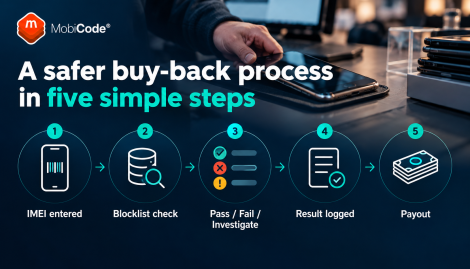
Step 1
Capture the correct IMEI
Identify the handset and connect its IMEI to the customer and transaction before any payout takes place.
Step 2
Run the live device-status check
Check the handset against the relevant blocklist and due-diligence datasets available to the business.
Step 3
Give staff a clear decision
Translate the result into a simple operational outcome: proceed, stop or investigate further.
Step 4
Record the result
Keep the relevant result against the transaction so the business can later show which device it checked, when it checked it and what information was available at the time.
Step 5
Only then grade, process and pay
Once the handset clears the relevant due-diligence stage, continue with diagnostics, grading, data erasure where required and the final purchase decision.
The other side of the equation: what happens when a phone is stolen?
Checking devices at the point of purchase addresses only one side of the problem.
The other side is making sure an organisation with a legitimate interest in a stolen, lost or fraudulently retained handset can act on the device itself.
That is where MobiBLOCK fits.
MobiBLOCK helps eligible businesses block at-risk mobile devices and flag active finance, rental or lease interests.
Instead of relying only on a courier investigation, marketplace dispute, customer recovery process or insurance claim, the business can add a device-level response based on the handset’s IMEI.
MobiBLOCK turns the device into part of the response
Consider a business device that is stolen or a high-value handset that is fraudulently retained.
The organisation may still pursue its normal recovery, insurance or investigation process.
MobiBLOCK adds another layer by allowing an appropriate device to be blocked or flagged where the evidence supports that action.
That matters because reducing the usefulness and resale appeal of a stolen handset attacks the economics behind the theft.
MobiBLOCK and MobiCHECK close the loop
MobiBLOCK and MobiCHECK address opposite sides of the same device-status problem.
Act
MobiBLOCK
Helps an eligible organisation block or flag a device when theft, fraud, non-return or an active agreement creates a legitimate reason to act.
Check
MobiCHECK
Helps another organisation investigate relevant device-status information before buying, trading or processing the handset.
Importantly, MobiCHECK can show devices that MobiBLOCK has blocked or flagged.
That means information created when one organisation protects an at-risk asset can later help another organisation avoid making a poor purchasing decision.
Where MobiCHECK fits at the buy-desk
MobiCHECK is MobiCode’s live device due-diligence service for organisations purchasing and processing pre-owned phones.
MobiCHECK checks device IMEIs against multiple independent datasets, including the GSMA Global Blacklist Registry.
Relevant results can include information about whether a handset is network blocked, reported lost or stolen, under finance or associated with an insurance claim.
For a trade-in or buyback operation, the commercial value is straightforward: staff can investigate relevant device status before the business commits money.
Real-time information matters
Used-device status can change.
For that reason, businesses need current information rather than relying on a check performed days or weeks earlier.
MobiCHECK is designed to provide live lookup information at the point where the buying decision is being made.
Why MobiONE matters when hundreds of staff make buying decisions
Running a device check is useful.
Making sure every relevant device follows the same process is better.
MobiONE is MobiCode’s wider device-processing platform, combining device lookup, due diligence, diagnostics, grading and secure data erasure in a more connected workflow.
Its configurable workflow controls can flag or stop devices when issues such as blocklist status or activation locks appear.
That can be particularly useful for larger retailers, recycling groups and multi-site businesses.
Why workflow control matters
A written policy saying “check every IMEI before purchase” only works if staff follow it consistently.
Real retail environments create pressure.
Queues form. Experienced staff take shortcuts. New employees interpret processes differently. Familiar customers may appear lower risk.
Workflow controls reduce dependence on memory and individual judgement by making important checks part of the operating process itself.
Check first, then test and wipe
Once a handset clears the relevant device-status checks, the business still needs to establish its physical and functional condition.
MobiTEST provides guided diagnostics across areas including hardware, screen, audio, sensors and connectivity.
If the device will move into reuse or resale, previous-user data also needs appropriate handling.
MobiWIPE supports professional mobile-device data erasure.
The order matters.
A business should ideally identify serious status risk before spending additional labour testing, grading and preparing the device.
The strongest controls work before a stolen handset reaches the counter
MobiBLOCK also creates an opportunity to act earlier in the lifecycle.
Businesses that sell, rent, lease, finance or otherwise retain an interest in mobile devices can record the correct IMEI before a problem occurs.
If a handset later becomes stolen, lost, fraudulently retained or unreturned, the organisation already knows which physical device is involved.
That allows any appropriate blocking or flagging action to form part of a documented process rather than an improvised response after the event.
Evidence matters before blocking or flagging
Device status can materially affect the person using a handset.
Therefore, businesses should confirm the facts before taking action.
Relevant records may include:
- the correct IMEI;
- ownership or financial-interest records;
- the original transaction or agreement;
- delivery or return evidence;
- customer communications;
- the organisation’s internal policy.
A practical example: stolen handset to attempted resale
Imagine a business-owned smartphone is stolen.
The company has already recorded the handset’s IMEI against its asset record.
Stage 1: the business confirms the device and evidence
Staff verify the correct IMEI and the circumstances surrounding the loss.
Stage 2: the organisation takes appropriate device action
Where justified, the organisation uses MobiBLOCK to block or flag the handset and keeps a record of why that action was taken.
Stage 3: the phone enters the second-hand market
The handset eventually reaches a legitimate trade-in or buyback business.
To the colleague at the counter, it may look like an ordinary used smartphone.
Stage 4: the buy-desk checks before paying
The business checks the IMEI using MobiCHECK.
Relevant status information tells the buyer that the device requires investigation rather than an immediate payout.
Stage 5: the exit route closes
Instead of converting the handset into easy cash, the transaction stops.
That is the wider value of linking blocking and checking.
The business protecting the original asset and the business considering purchasing it do not need to be the same organisation for device-status information to be useful.
IMEI checks also create a better audit trail
A professional buying process should not end with a green or red result on a screen.
Businesses should also be able to reconstruct what happened later.
If an insurer, investigator, customer or internal compliance team raises a question, useful records include:
- the device IMEI;
- the date and time of the check;
- the transaction reference;
- the status information available at the time;
- the staff member or location handling the purchase;
- the decision that followed.
That provides a stronger operational record than relying on somebody later remembering what happened at the counter.
Why this matters to more than national retailers
Strong device due diligence is not only relevant to large high-street chains.
The same principles apply anywhere a business buys valuable mobile devices.
That includes:
- trade-in operators;
- independent phone shops;
- repair businesses that buy used devices;
- pawn and second-hand retailers;
- recyclers;
- refurbishers;
- wholesale buyers;
- device rental and leasing businesses;
- finance providers and insurers.
The higher the device value and transaction volume, the more expensive inconsistent intake controls can become.
The wider theft response depends on removing the financial incentive
Policing remains the most visible part of the fight against street phone theft.
The Met’s specialist e-bike patrols, hotspot operations and investigations into organised handling networks show how much enforcement activity now takes place both at street level and further down the criminal supply chain.
But policing is only one part of the equation.
The less easily a stolen handset can return to legitimate-looking value, the weaker the incentive to steal it in the first place.
Manufacturers, networks, insurers, device owners, marketplaces and second-hand buyers all occupy different parts of that system.
IMEI blocking and live device-status checks connect two of the most important points:
act when a phone becomes compromised, and check before somebody buys it again.
Make stolen phones harder to monetise at both ends of the chain
Falling phone-theft figures are good news, but they do not remove the need for device-level controls.
MobiBLOCK helps eligible organisations act when a valuable handset becomes stolen, lost, fraudulently retained or unreturned.
MobiCHECK helps the next buyer investigate relevant device status before money changes hands.
MobiONE can then make those checks part of a wider, repeatable processing workflow. Together, the aim is simple: make it harder for a compromised handset to disappear into the legitimate second-hand market unnoticed.
Build live IMEI checks into your device workflow
If your organisation buys, sells, rents, leases, finances or processes mobile devices, MobiCode can help you strengthen both sides of the device-protection process.
Explore MobiBLOCK for blocking, flagging and business device asset protection.
Explore MobiCHECK for live IMEI and device-status due diligence.
Explore MobiONE for connected checking, diagnostics, grading and data erasure.
Review your current device-protection process
Talk to MobiCode about live IMEI checks at intake, MobiBLOCK asset protection and building consistent device controls into your wider processing workflow.
Frequently asked questions
IMEI checks and stolen phones
Why should a buy-desk check an IMEI before paying for a phone?
Checking before payout allows the business to investigate relevant device-status information before it commits money to the purchase. A handset can appear physically and functionally sound while still carrying status information that requires further investigation.
Can a stolen phone look completely normal?
Yes. Cosmetic condition and basic functionality do not reveal every device-status issue. That is why professional buyers should treat physical testing and IMEI due diligence as separate stages.
MobiBLOCK, MobiCHECK and MobiONE
What does MobiBLOCK do?
MobiBLOCK helps eligible businesses block or flag mobile devices when theft, loss, fraudulent retention, non-return or an active finance, rental or lease interest creates a legitimate reason to take device-level action.
What does MobiCHECK do?
MobiCHECK provides live IMEI and device-status due diligence. It checks device identifiers against multiple independent datasets, including the GSMA Global Blacklist Registry, to support informed buying decisions.
How do MobiBLOCK and MobiCHECK work together?
MobiBLOCK helps an eligible organisation act on an at-risk device, while MobiCHECK helps another organisation investigate relevant status before buying or processing that handset. MobiCHECK can show devices that MobiBLOCK has blocked or flagged.
Where does MobiONE fit?
MobiONE supports a wider device-processing workflow by combining due diligence, diagnostics, grading, workflow controls and secure data erasure. It can help businesses make important checks more consistent across operators and locations.