

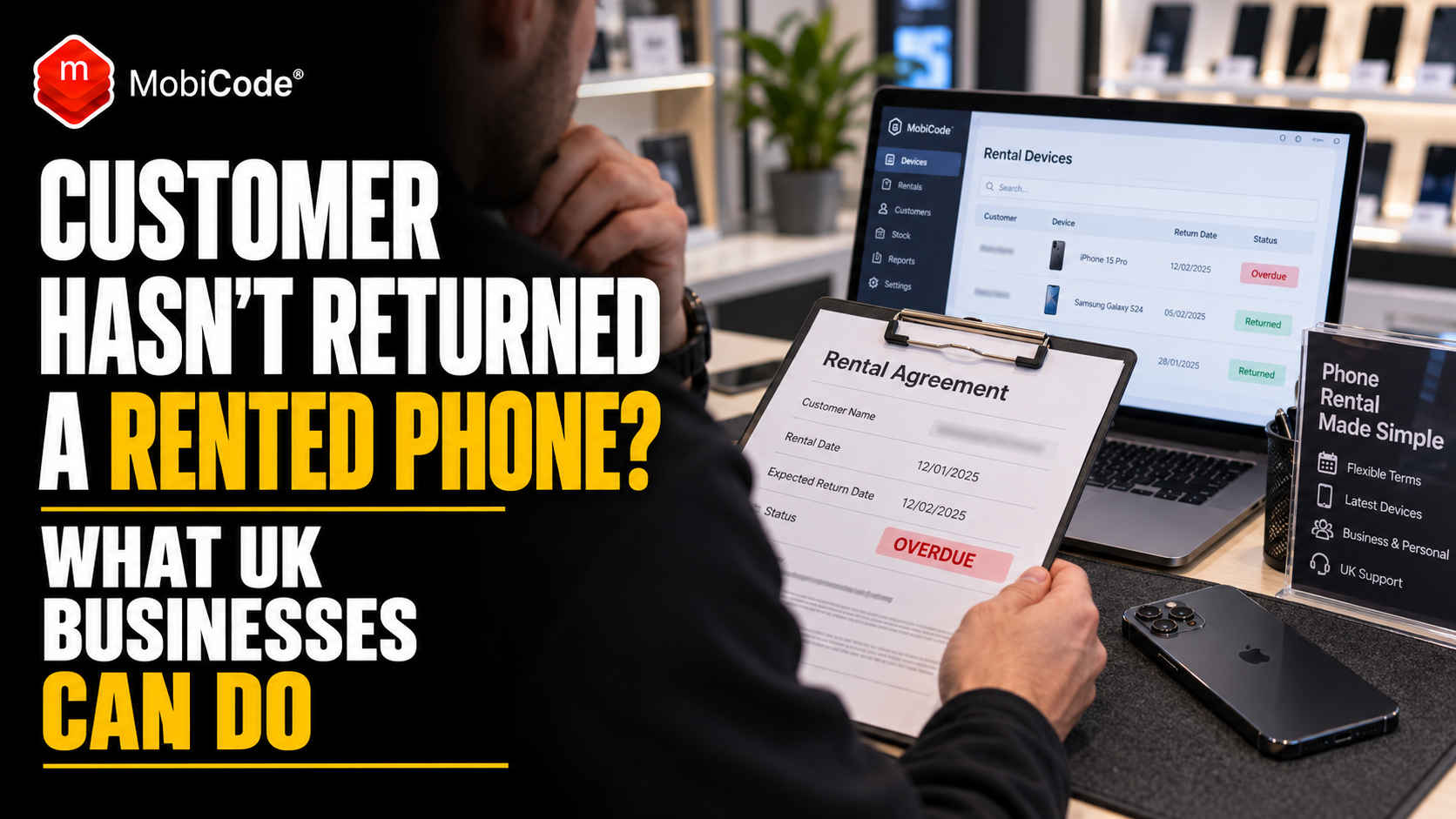
An unreturned phone is usually still worth more than the money owed — and that is exactly why it rarely comes back on its own.
When a customer keeps a rented, leased or loaned handset, you are left chasing two things at once: the balance, and the device.
Chasing payment is the obvious response. It is also the slowest, and it does nothing about the handset itself, which is quietly being used, sold or passed on while the invoices go unanswered.
This guide covers what UK rental, leasing and loan-device businesses can actually do about an unreturned phone: the practical steps, what each one achieves, and where recording an interest against the device changes the outcome.
Why an unreturned phone is different from an unpaid invoice
A late invoice is a debt. An unreturned handset is a debt and an asset sitting in somebody else’s pocket.
That matters because the asset keeps its value while you chase the debt. A premium handset retains substantial second-hand value for years, and a resale market exists that does not ask many questions.
Why an unreturned phone stays unreturned
If the handset is worth more than the outstanding balance, the customer has a financial reason not to return it. Every week that passes without consequence confirms that keeping it was the right decision.
Anything that reduces the device’s value to whoever holds it therefore changes that calculation directly.
Step one: write, clearly, with a deadline
Before anything else, send a written demand. Not a reminder — a demand.
It should state:
- which device, including the IMEI and model;
- the agreement it was supplied under;
- that the device remains your property or subject to your financial interest;
- a specific return deadline, with a date;
- what happens after that deadline.
Why the IMEI belongs in the letter
Naming the IMEI removes any later argument about which handset is being discussed. It also signals that you hold a record capable of following the device, which is often the part that produces a response.
Step two: decide what you are trying to achieve
There are only three realistic outcomes, and they need different actions.
1. You want the device back
Recovery is most likely in the first few weeks, while the customer still regards the matter as unresolved rather than closed.
2. You want to be paid for it
If the agreement covers non-return charges, pursuing the balance may be more practical than pursuing the handset.
3. You want it to stop being worth anything
Where neither of the above is realistic, the remaining objective is to ensure the handset cannot quietly become somebody else’s profit.
Most businesses default to option two because it is familiar. Option three is often the one that changes behaviour.
Step three: record your interest against the IMEI
This is the step most rental and leasing businesses skip, and it is the one that works on the device rather than the paperwork.
MobiBLOCK allows a business to record an ownership or financial interest against a device’s IMEI from 10p per device. The marker is there when a participating business next checks that handset.
What that actually does
It does not recover the phone on its own. What it does is place your claim where the next buyer, recycler or trade counter will see it, rather than leaving it in your own order system where nobody else can.
A handset carrying a recorded interest is harder to sell through legitimate trade channels. For a customer intending to sell it, that is the difference between an easy transaction and an awkward one.
Mark on dispatch, not on dispute
The strongest version of this is not reactive. Recording an interest when a device goes out — rather than when it fails to come back — means the marker already exists on the day the customer decides to keep it.
At 10p a device, that is affordable across an entire fleet, and it removes the scramble to act after the fact.
Step four: consider blocking, where it is appropriate
Blocking is a stronger step than flagging, and it is not right for every case.
Through MobiBLOCK, an eligible lost or stolen handset can be submitted for blocking across participating UK mobile networks for £1 per device. A blocked handset cannot connect to those networks, which removes most of its practical value.
When blocking fits
- the device is genuinely lost or stolen rather than simply overdue;
- the customer has stopped responding entirely;
- recovery is no longer realistic;
- you have a written record of the demand and the deadline.
When it does not
- the customer is in contact and the matter may yet resolve;
- there is a genuine dispute about who is entitled to the device;
- the handset may still come back.
Where the matter is resolved, removal is free. That matters: it means acting early does not commit you to a permanent outcome if the device turns up.
Why a written record matters more than people expect
Whatever route you take, the evidence trail is what makes it defensible later.
Keep:
- the signed agreement;
- the dispatch record with the IMEI;
- the written demand and its deadline;
- any response, or the absence of one;
- a dated record of any marker or block submitted.
Insurers, marketplaces and courts all ask the same question: what did you do, and when. A dated record answers it. A recollection does not.
Stopping the next unreturned phone, not just this one
Most rental businesses handle unreturned devices one at a time, as exceptions. The businesses that lose least treat it as a process.
A practical fleet routine
- Record the IMEI at dispatch, against the customer and the agreement.
- Mark the device with your interest at the same moment.
- Set a review date tied to the agreement’s end.
- Send the written demand on a fixed timetable, not when somebody remembers.
- Escalate or block according to a rule you set in advance, not case by case.
- Remove the marker when the device returns or the balance is settled.
The point of a routine is that it does not depend on anyone feeling strongly about a particular customer.
What about devices under finance or lease?
The same logic applies where a lender retains a financial interest until an agreement ends.
If a customer sells a financed handset early, the buyer or recycler usually has no way of knowing the finance still applies. Flagging the device makes that interest visible at the point somebody checks it, which is the only moment it can realistically change the outcome.
Checking devices you take in
The reverse problem is worth stating, because rental businesses buy stock as well as lend it.
A handset offered to you may already carry somebody else’s interest. MobiCHECK supports professional IMEI and device-status due diligence, with indicators relating to network blocking, lost or stolen status, finance, insurance and device identity, depending on available datasets.
Checking before paying is considerably cheaper than discovering afterwards that the device was never the seller’s to sell.
Common mistakes
Waiting too long
The chance of recovery falls sharply after the first month. Acting at day 30 is a different proposition from acting at day 180.
Threatening what you will not do
Letters promising police action or criminal prosecution rarely result in either, and they undermine the next letter.
Treating it as a payment problem only
Chasing the balance while ignoring the handset leaves the asset working for someone else throughout.
Having no record of the IMEI
Without it, you cannot flag, block, check or identify the device. Capturing the IMEI at dispatch is a two-second step that makes every later option possible.
What it costs to flag or block an unreturned phone
MobiBLOCK pricing is per device:
| Action | Cost |
|---|---|
| Record an interest against the IMEI | from 10p per device |
| Block an eligible lost or stolen handset | £1 per eligible device |
| Removal, once resolved | free |
Against the value of a single unreturned handset, the cost of marking a fleet is close to a rounding error. That is the whole argument.
Protecting a rental or leased device fleet
MobiBLOCK lets you record an interest against every handset you send out, and block an eligible device if it is never returned. Removal is free once the matter is resolved.
Ask MobiCode about MobiBLOCK
Existing customer? Request access
Frequently asked questions
What can a business do if a customer will not return a rented phone?
Send a written demand naming the IMEI and setting a deadline, record your ownership or financial interest against the device’s IMEI, and decide whether to pursue recovery, pursue payment, or reduce the handset’s resale value. Recording an interest costs from 10p per device through MobiBLOCK, and blocking an eligible lost or stolen handset on participating UK mobile networks costs £1.
Can you block a phone that has not been returned?
An eligible lost or stolen handset can be submitted for blocking across participating UK mobile networks. Blocking suits cases where recovery is no longer realistic and the customer has stopped responding. Where a device is simply overdue and the customer is still in contact, recording an interest is usually the more proportionate step.
How much does it cost to block or flag a device?
Recording an interest against a device’s IMEI starts from 10p per device. Submitting an eligible lost or stolen handset for blocking costs £1 per device. Removal is free once the matter is resolved.
Should we mark devices before they go missing?
Marking at the point of dispatch is stronger than marking after a dispute, because the record already exists when the customer decides whether to return the handset. At 10p per device it is affordable across a whole fleet, and removal is free.
What if the device comes back after we have flagged it?
Removal is free once the matter is resolved, so acting early does not commit you to a permanent outcome.
How do we know a device we are buying is not someone else’s?
MobiCHECK supports professional IMEI and device-status due diligence before you pay, with indicators relating to network blocking, lost or stolen status, finance, insurance and device identity, depending on available datasets.