

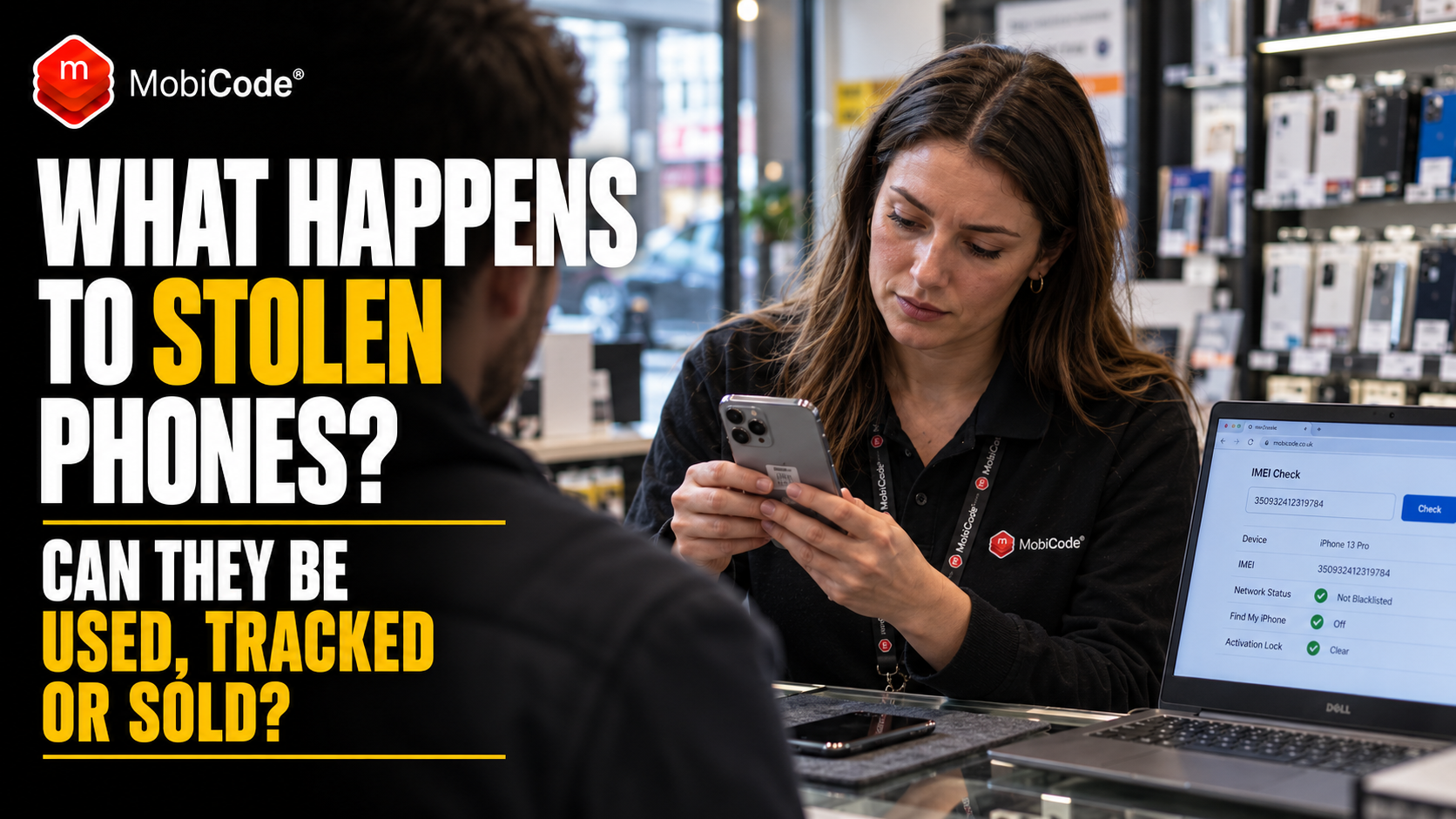
What happens to stolen phones after they disappear? Some are quickly resold, some are stripped for parts and others move through organised supply chains into overseas markets. Modern security features make that harder, but a stolen handset can still retain significant value.
The scale of that secondary market became unusually clear in September 2026, when the Metropolitan Police said an investigation had uncovered a network responsible for trafficking up to 40,000 stolen phones from the UK to China during 2024 and 2025.
Understanding what happens next explains why technologies such as Find My, Find Hub, Activation Lock, IMEI blocking and professional device-status checks all solve different parts of the same problem.
The short answer
A stolen phone does not simply become useless the moment it disappears. Depending on its security settings and device status, somebody may try to resell it, export it, break it for parts or bypass its protections. Tracking, activation locks and IMEI blocking make those routes progressively harder.
What actually happens to stolen phones?
There is no single route.
A phone taken from somebody’s hand may change hands several times before its final destination becomes clear.
At the simplest level, a thief may try to sell it quickly to another person.
More organised operations can look very different.
In September 2026, the Metropolitan Police said three men had been jailed for a combined 25 years after an investigation into what it described as the UK’s largest mobile-phone smuggling network.
Detectives said the group had trafficked up to 40,000 stolen phones from the UK to China during 2024 and 2025. Police estimated that the devices represented around 40% of the phones stolen in London over the same period.
The investigation exposed a much wider chain running from street theft through handlers and ultimately to international export.
That provides an important answer to the question of why modern smartphones continue to be stolen despite increasingly sophisticated security.
The phone does not necessarily need to remain useful to the original thief to retain value.
Why are stolen phones still valuable?
Modern flagship phones can cost well over £1,000.
Even when security features prevent straightforward reuse, the physical handset still contains valuable components.
Depending on the device and what protections are active, criminals may attempt to:
- resell the complete handset;
- move it into another geographic market;
- sell it to an unsuspecting buyer;
- strip it for valuable components;
- use social engineering to obtain account credentials;
- take advantage of the device before the owner locks or reports it.
That is why fighting phone theft requires more than one technical control.
Can a stolen phone still be used?
Sometimes, but it depends heavily on what happened before and after the theft.
A thief who obtains an unlocked phone can present a much greater immediate risk than somebody who takes a securely locked handset.
Device manufacturers have therefore spent considerable effort making stolen phones harder to unlock, reset and reactivate.
Can a stolen iPhone be used?
Apple’s Find My system includes Activation Lock.
Once Find My is enabled, Activation Lock links the device to the owner’s Apple Account. Apple says the feature continues to protect the device even if it is remotely erased.
That means simply wiping an iPhone does not necessarily turn it into a clean handset that somebody else can activate.
Owners can also use Find My to put the device into Lost Mode, which locks the handset and can display contact information for its return.
Apple’s Stolen Device Protection adds another layer
The problem becomes more serious when a thief has also seen or obtained the owner’s passcode.
Apple’s Stolen Device Protection was designed specifically for that scenario.
When enabled, sensitive actions can require Face ID or Touch ID with no passcode fallback. Changes to especially important account settings may also trigger a security delay before another biometric authentication is required.
Apple says this is intended to give the owner more time to mark a stolen phone as lost and secure the Apple Account.
What happens to a stolen Android phone?
Android has also moved significantly beyond a simple screen lock.
Google’s current theft-protection system includes features such as Theft Detection Lock, Offline Device Lock, Failed Authentication Lock, Remote Lock and Find Hub.
During 2026, Google expanded these protections further.
In the UK, Google has been extending automatic theft protections to eligible devices running Android 10 and later, while Android 17 adds further safeguards when a handset is marked as lost.
Theft Detection Lock
Theft Detection Lock can use device signals to recognise behaviour associated with a phone being physically snatched and automatically lock the screen.
Offline Device Lock
A thief may attempt to disconnect the phone from the internet to stop remote tracking.
Offline Device Lock is intended to respond to that behaviour by automatically locking the handset after it has spent a period offline.
Find Hub
Google’s Find Hub allows an owner to locate, secure or erase a lost Android device remotely.
Supported devices can also use Google’s crowdsourced Find Hub network to help locate phones when they are offline.
On certain models, including supported Pixel devices, location functionality can continue for a period after the handset has been switched off.
Can a stolen phone be tracked after it is switched off?
In some circumstances, yes.
Modern device-finding systems no longer depend entirely on the handset maintaining a normal mobile-data connection.
Apple’s Find My network and Google’s Find Hub network use nearby participating devices to help locate compatible offline hardware.
Support varies by model, configuration and battery state, so owners should not assume every switched-off phone will remain trackable indefinitely.
The important point is that switching off a phone no longer guarantees that it immediately disappears from device-finding networks.
What is an IMEI and why does it matter when a phone is stolen?
Every cellular handset has an International Mobile Equipment Identity, usually known as its IMEI.
The IMEI identifies the physical mobile device rather than the SIM card or mobile subscription.
That distinction is important after theft.
A thief can remove one SIM card and insert another.
Changing the SIM does not change the handset’s IMEI.
What happens when a stolen phone’s IMEI is blocked?
Mobile operators can use IMEI information to deny network service to handsets reported as lost or stolen.
The GSMA operates the Device Registry, a central system that allows participating organisations and network operators to share relevant block-list information.
According to the GSMA, the aim is to make stolen devices transported between markets more difficult to connect to participating mobile networks.
Does changing the SIM remove an IMEI block?
No.
The SIM identifies the subscriber account.
The IMEI identifies the handset.
Therefore, inserting another SIM does not normally remove a network restriction applied against the device’s IMEI.
This is one reason IMEI-based controls are useful in the fight against stolen-phone resale.
Can an IMEI-blocked phone still use Wi-Fi?
Usually, yes.
An IMEI block primarily concerns access to participating cellular networks.
It does not automatically disable every function inside the handset.
A blocked smartphone may still be capable of connecting to Wi-Fi and using some applications if the device itself is otherwise accessible.
That is why IMEI blocking, account security, activation locks, remote locking and data erasure should be understood as separate layers rather than interchangeable protections.
Can stolen phones simply be sold abroad?
International movement is one route stolen devices can take.
The September 2026 Met investigation provides a particularly striking example, with police describing tens of thousands of stolen UK handsets being trafficked to China.
Moving a device to another country, however, does not automatically guarantee that its status disappears.
The GSMA Device Registry exists partly so participating operators can exchange information about devices reported lost or stolen across network and national boundaries.
The effectiveness of that system depends on participation and implementation in the destination market.
Why do thieves sometimes want the phone’s passcode?
The physical handset is only part of the value.
An unlocked phone may provide access to email, messages, stored passwords, payment applications and other accounts.
That can create a second layer of criminal opportunity beyond the resale value of the handset itself.
It is one reason both Apple and Google have introduced increasingly aggressive theft protections around sensitive account changes.
What should you do immediately if your phone is stolen?
Speed matters because the first few minutes can determine how much access an offender has.
1. Use the manufacturer’s finding service
For an iPhone, use Find My.
For Android, use Find Hub.
Mark the handset as lost or secure it as soon as possible.
2. Do not put yourself in danger trying to recover it
A live location can be useful evidence, but it does not mean you should confront the person who has the phone.
Give relevant information to the police where appropriate.
3. Contact your mobile network
Tell the network the handset has been stolen and ask what steps are required to suspend the service and report the device.
4. Protect your important accounts
If there is any chance the thief knows the passcode or accessed the handset while it was unlocked, review your email, banking, payment and social accounts quickly.
5. Report the theft
Police reports may also be required for insurance claims and can help law enforcement identify theft patterns.
6. Be careful before removing the device from your account
Apple specifically advises customers with Theft and Loss coverage not to remove a stolen iPhone from Find My or their Apple Account before the claim has been approved.
Removing account protections too early can also make a device easier for somebody else to reactivate.
So why are phone thefts still happening?
Because the economics have not disappeared.
Smartphones remain small, portable and extremely valuable.
London alone recorded more than 117,000 stolen mobile phones in 2024 in Metropolitan Police data released the following year.
More recent figures point in a more encouraging direction. In September 2026, the Met said theft of personal items and mobile phones had fallen by 15.6% during 2026.
That is real progress, but the recent smuggling investigation demonstrates why the problem cannot be understood purely in terms of individual street thieves.
There is value further down the chain.
Stopping phone theft means attacking the resale value
The GSMA’s own position is straightforward: when lost or stolen devices become less useful, they become less attractive targets for theft.
That requires several layers working together:
- strong device authentication;
- tracking and Lost Mode;
- activation locks;
- network IMEI blocking;
- accurate stolen-device records;
- checks before second-hand businesses buy devices;
- controls that make stolen devices harder to turn back into cash.
Where MobiBLOCK fits for businesses
Consumers who lose a personal phone should use their network, device manufacturer’s security tools and the appropriate reporting routes.
Businesses can face a different problem.
A company may own hundreds or thousands of devices that it sells, rents, leases, finances or deploys to staff and customers.
When one of those devices becomes stolen, fraudulently retained or simply never returned, the organisation may continue carrying the financial risk.
MobiBLOCK is MobiCode’s business service for that situation.
It gives eligible organisations a route to block or flag appropriate devices using their IMEI and maintain a clearer evidence trail around the action taken.
Blocking stolen business devices
Where the evidence supports the action, MobiBLOCK can help a business block a stolen, lost or fraudulently retained device.
The objective is simple: make the physical handset less attractive to use or resell.
Flagging finance, rental and lease interests
Theft is not the only reason a handset may enter the second-hand market when another organisation still has an interest in it.
A financed phone may be sold early. A rented device may not be returned. A leased handset may be passed to somebody else.
MobiBLOCK can also flag those active interests so the status becomes visible to appropriate downstream checks.
MobiBLOCK is a business service
MobiBLOCK is designed for organisations with a legitimate financial or operational interest in a device. It is not a consumer replacement for reporting a stolen handset to your mobile network or using Find My or Find Hub.
How MobiBLOCK and MobiCHECK work together
Blocking a device is only one side of the problem.
The other is preventing another legitimate business from unknowingly buying it.
MobiCHECK helps retailers, recyclers, refurbishers and other device buyers investigate relevant IMEI and device-status information before purchasing or processing a handset.
MobiCHECK can show devices that MobiBLOCK has blocked or flagged.
That creates a useful chain:
An eligible organisation blocks or flags an at-risk handset.
A downstream business checks the IMEI before buying or processing it.
In practical terms, the aim is to stop a compromised handset from moving invisibly from one transaction into the next.
What should a business check before buying a used phone?
A phone’s appearance cannot tell a buyer whether it was previously stolen or carries another commercial risk.
The GSMA itself identifies recyclers, insurers and other industry participants as users of stolen-device status information before purchase.
Professional buyers should therefore treat device status and physical condition as separate questions.
Device status
MobiCHECK can help identify relevant blocklist, loss, theft, finance and insurance information.
Functional condition
MobiTEST provides guided diagnostics for areas such as screens, buttons, microphones, speakers, sensors and connectivity.
Data security
MobiWIPE supports controlled mobile-device data erasure before reuse or resale.
Processing at scale
MobiONE brings device checks, diagnostics, grading and erasure into a wider processing workflow and can flag blocklist and activation-lock issues during processing.
Can technology ever make phone theft disappear?
Probably not entirely.
Criminal behaviour changes as security changes.
Better locks encourage attempts at social engineering. Improved domestic blocklists can encourage cross-border trafficking. Stronger device security can increase the attraction of individual components.
But that does not make the technology ineffective.
Every additional barrier raises the cost, risk or difficulty of converting a stolen handset into money.
Taken together, device tracking, authentication, activation locks, IMEI blocking and second-hand-market due diligence can make the stolen-phone economy substantially less attractive.
The bigger picture
A stolen phone is only valuable if there is still a route to profit from it
Modern smartphones are much harder to steal and reuse than they once were, but the September 2026 Met investigation shows how organised networks can continue to find value further down the supply chain.
Tracking and account protections help the owner. IMEI blocking attacks network usefulness. Professional device checks help legitimate buyers avoid compromised stock.
For businesses with their own device assets, MobiBLOCK adds another layer by giving eligible organisations a practical route to block or flag an at-risk handset and make that status available further down the device lifecycle.
Protecting mobile devices across their lifecycle
MobiCode provides device-status, testing, erasure and asset-protection software for organisations handling mobile devices.
Block or flag appropriate stolen, lost, unreturned or otherwise at-risk business devices.
Live IMEI and device-status due diligence before buying or processing used devices.
Bring device checks, diagnostics, grading and secure erasure into a connected workflow.
Need to protect devices your business owns or manages?
Talk to MobiCode about MobiBLOCK and building device blocking, flagging and status checks into your wider asset-protection workflow.
Frequently asked questions
What happens to most stolen phones?
There is no single route. Stolen phones may be resold, passed through handlers, exported to another market or broken for components. A recent Metropolitan Police investigation found a network responsible for trafficking up to 40,000 stolen UK phones to China during 2024 and 2025.
Can a stolen phone still be used?
It depends on the device, its lock state and which security measures are active. Activation locks, account protections and IMEI blocks can substantially reduce a stolen phone’s usefulness, but they address different parts of the problem.
Can changing the SIM bypass an IMEI block?
Normally no. The SIM identifies the mobile subscription, while the IMEI identifies the physical handset. An IMEI-based network restriction therefore follows the device rather than a particular SIM card.
Can an IMEI-blocked phone still use Wi-Fi?
An IMEI block targets cellular-network access on participating networks and does not automatically disable every function in the handset. Wi-Fi may therefore continue to work.
Can a stolen phone be tracked when it is switched off?
Some modern devices can remain discoverable through offline finding networks for a period after losing their normal connection or, on supported hardware, after being switched off. Capability varies by model and configuration.
What is MobiBLOCK?
MobiBLOCK is MobiCode’s business device-protection service. It helps eligible organisations block or flag appropriate stolen, lost, fraudulently retained or unreturned devices and can also flag active finance, rental or lease interests.
How do MobiBLOCK and MobiCHECK work together?
MobiBLOCK allows an eligible organisation to act on an at-risk device, while MobiCHECK helps another business investigate relevant status before buying or processing that handset. MobiCHECK can show devices that MobiBLOCK has blocked or flagged.
Sources and further reading
- Metropolitan Police — major mobile-phone smuggling investigation and sentencing, 25 September 2026.
- Metropolitan Police — Westminster anti-theft operation, 10 September 2026.
- GSMA — Mobile Devices: Theft and GSMA Device Registry.
- Apple Support — Stolen Device Protection for iPhone.
- Apple Support — Find My, Lost Mode and Activation Lock.
- Google Security Blog — Android theft-protection updates, 2026.
- Google Android Help — Find Hub and Theft Protection.
- MobiCode — MobiBLOCK device blocking and asset protection.
- MobiCode — MobiCHECK device-status due diligence.