

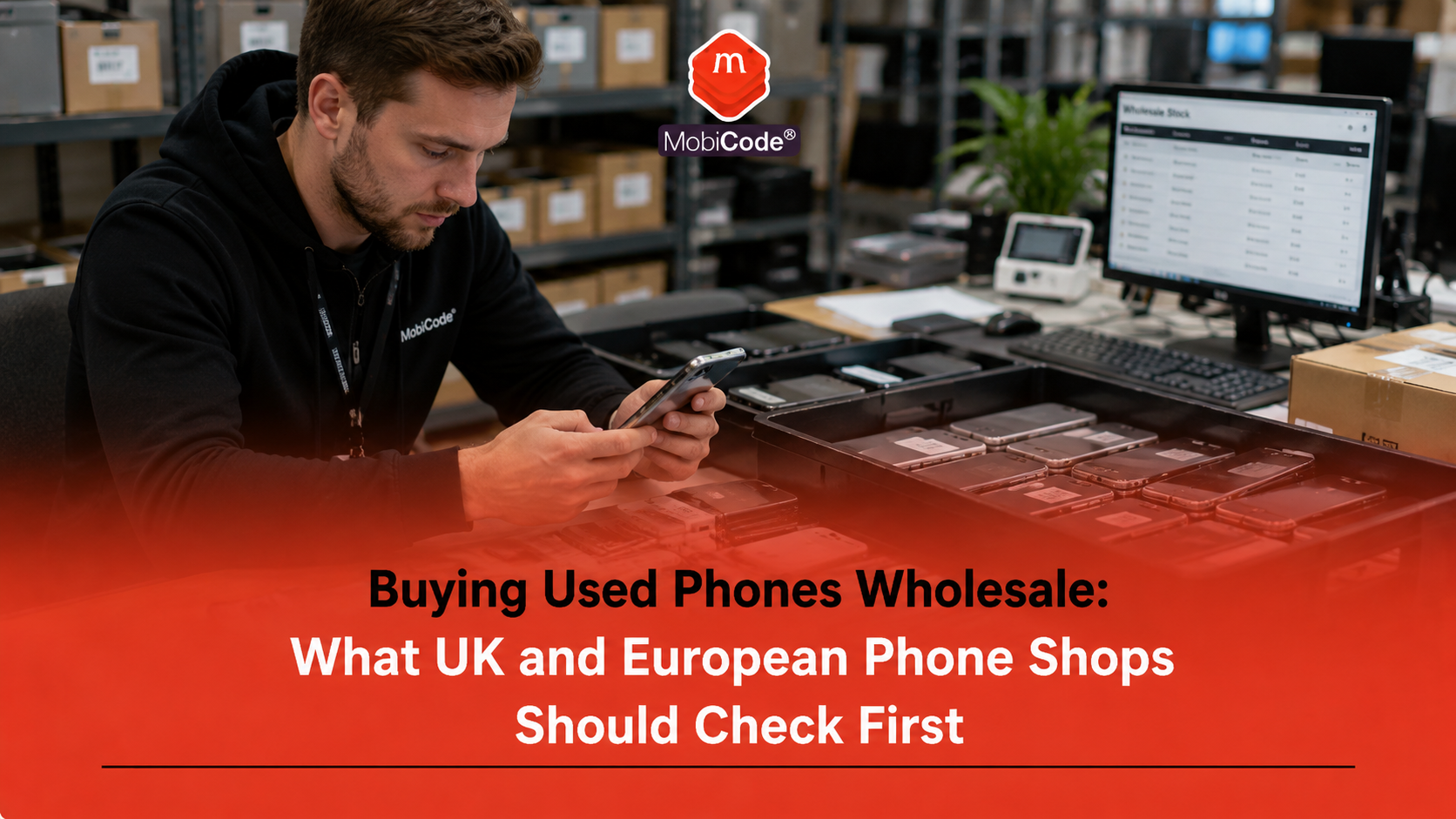
Why phone shops buy used phones wholesale
Phone shops buy used phones wholesale because they need reliable stock. Customer trade-ins can help, but they may not produce enough volume or the right models. Wholesale buying can fill that gap. A shop may buy wholesale stock to:
- increase second-hand phone inventory;
- support repair-and-resell work;
- sell tested devices in-store;
- list devices on marketplaces;
- create refurbished stock lines;
- source parts devices;
- serve business customers;
- increase accessory and warranty sales.
However, wholesale buying adds risk because the shop may receive dozens, hundreds or thousands of devices at once. Therefore, every batch needs a structured check before the business relies on the margin.
The real risk is not the price, it is the unknowns
A cheap wholesale batch may look attractive at first. Yet the real cost depends on what happens after intake. A batch becomes less profitable when devices have:
- incorrect model or storage information;
- blacklist or lost/stolen indicators;
- network lock issues;
- Google FRP or Apple Activation Lock;
- MDM or Remote Management prompts;
- weak batteries;
- faulty screens, cameras, microphones or charging ports;
- poor cosmetic grading;
- unclear data-erasure history;
- low resale demand.
Because of this, the best wholesale buyers do not chase the lowest headline price. Instead, they check whether the stock can actually move through a profitable route.
Know what type of wholesale stock you are buying
Not all used-phone batches are the same. Different stock sources carry different risks and opportunities. Common batch types include:
- customer trade-in stock: phones collected from consumers through retail trade-in programmes;
- repair shop stock: devices that may need screens, batteries, ports or parts;
- carrier or retailer returns: devices returned after upgrade, cancellation or fault review;
- insurance stock: phones linked to replacement or claims processes;
- corporate refresh stock: old company phones from staff upgrade programmes;
- ITAD stock: devices from business asset disposal channels;
- parts stock: phones unsuitable for normal resale but useful for components;
- recycling stock: low-value devices that may still contain recoverable value.
Each source needs a different buying rule. For example, corporate stock may need MDM review, while repair stock needs stronger fault and parts-cost checks.
Ask the supplier better questions
Before paying for a wholesale batch, ask questions that reveal how well the supplier understands the stock. Useful supplier questions include:
- Where did the phones come from?
- Are the IMEIs available before purchase?
- Has the batch been checked for blacklist indicators?
- Are any devices network locked?
- Have account locks, FRP and MDM been checked?
- Has each device been tested?
- What grading standard has been used?
- Are batteries tested or estimated?
- Has data been erased?
- What returns or dispute process applies?
- Can the supplier provide a manifest?
A serious supplier should understand these questions. If the answers are vague, the batch may need a lower offer or a stronger inspection process.
Always request a device manifest
A manifest is a list of devices in the batch. It helps the buyer compare what was promised with what arrived. A useful manifest should include:
- IMEI number;
- IMEI 2 where relevant;
- serial number;
- make and model;
- storage size;
- colour;
- grade;
- lock status where known;
- test status where known;
- fault notes;
- batch or supplier reference.
Without a manifest, staff may waste time matching devices manually. In addition, disputes become harder because the shop cannot easily prove what the supplier said it was selling. MobiONE helps link checks, tests, wipe results and device records into one operational workflow.
- Connected device processing: MobiONE
Run IMEI and blacklist checks before pricing the batch
IMEI checks matter because a phone’s identity and status can decide whether it should move into normal resale, review, return or rejection. The GSMA Device Check service explains that users can query a device’s electronic serial number, such as an IMEI, to see whether it has been flagged on the GSMA Block List. If a device has been reported lost or stolen, the result can show a red status with a reason such as lost or stolen. For a phone shop, this is not a small detail. One risky device can create a dispute. A full batch with status problems can damage cash flow. MobiCHECK helps businesses check device IMEI numbers against relevant datasets, including the GSMA Global Blacklist Registry.
- IMEI and device status checks: MobiCHECK
- Trade mobile blacklist support: MobiCode Blacklist
- Used-device due diligence: MobiCode CHECK
Check network lock status
Network lock status affects resale value. An unlocked phone usually has a wider buyer pool because it can work with more than one compatible mobile network. In the UK, Ofcom banned mobile companies from selling locked handsets from 17 December 2021. Even so, wholesale buyers still handle older phones, imported devices, mixed European stock and second-hand batches with uncertain histories. Before buying a batch, check whether devices are:
- unlocked;
- locked to a specific network;
- unclear and needing SIM testing;
- eligible for unlock review;
- unsuitable for normal resale until resolved.
MobiUNLOCK supports professional unlocking workflows where teams need to handle network restrictions.
- Network unlocking workflows: MobiUNLOCK
Check account locks, FRP and MDM
A wholesale batch can look profitable until setup screens reveal account-lock problems. These issues often appear after reset or during setup, not during a quick visual inspection. Check for:
- Apple Activation Lock;
- Google account verification;
- Android Factory Reset Protection;
- MDM or Remote Management prompts;
- work profiles on Android;
- business-management restrictions;
- unknown previous-owner credentials.
This matters especially for corporate refresh stock, ITAD stock and mixed Android batches. If a device cannot complete setup cleanly, it should not enter normal resale stock.
Test the phones before you trust the grade
Supplier grades can help, but they do not replace testing. Different suppliers may use different grading rules. Moreover, some grades focus on cosmetic condition and miss functional faults. A wholesale buyer should test:
- screen and touch response;
- battery health or performance;
- front and rear cameras;
- speaker and microphone;
- charging port;
- buttons and vibration;
- Wi-Fi and Bluetooth;
- NFC where supported;
- SIM detection and signal;
- sensors where relevant.
MobiCode TEST helps businesses run structured diagnostics before resale.
- Mobile phone diagnostics: MobiCode TEST
As a result, the shop can compare supplier grade with actual condition and adjust pricing decisions more fairly.
Do not ignore battery condition
Battery issues can quietly destroy used-phone margin. A device may look excellent but still need a battery replacement before resale. Before buying wholesale, consider:
- battery health;
- charging behaviour;
- unexpected shutdowns;
- swelling or heat;
- replacement cost;
- buyer expectations for that model;
- warranty or returns exposure.
A shop with repair capability may still buy weak-battery stock if the price makes sense. However, the cost should be included before the offer, not discovered after the batch arrives.
Data erasure must link to each device
Wholesale buyers should not assume that previous owners or suppliers erased every device properly. A phone may look reset but still need a clearer process before resale. The National Cyber Security Centre advises people to erase personal data before selling, donating or trading in second-hand devices. For phone shops and refurbishers, that advice becomes an operational requirement. A good wholesale workflow should record:
- which device was erased;
- which IMEI or serial number links to the erase;
- when the erase happened;
- who processed the device;
- what result appeared;
- what route the phone took afterwards.
MobiWIPE supports controlled data-erasure workflows before phones move to resale, reuse or recycling.
- Secure data erasure: MobiWIPE
Understand VAT and margin before buying stock
VAT treatment can affect profit on second-hand phone sales. Therefore, phone shops should understand the rules before buying large wholesale batches. In the UK, GOV.UK explains that VAT margin schemes tax the difference between what a business paid for an item and what it sold it for, rather than the full selling price, where the scheme applies. The European Commission also lists a VAT special scheme for taxable dealers in second-hand goods where output VAT applies to the profit margin. However, margin-scheme rules depend on the country, supplier, purchase paperwork and whether the stock qualifies. As a result, phone shops should speak to an accountant or tax adviser before scaling cross-border or high-volume used-phone sales. From an operational point of view, the lesson is simple: keep strong purchase records, sales records and device records.
Calculate the real margin before you pay
The headline batch price rarely shows the real margin. A shop needs to calculate the likely resale value after repairs, fees, returns and dead stock. A simple margin check should include:
- purchase price per device;
- expected resale price;
- repair cost;
- battery replacement cost;
- accessory or packaging cost;
- marketplace fees;
- payment fees;
- VAT or margin-scheme treatment;
- shipping and handling;
- expected return rate;
- devices that may fail checks.
For example, a batch may look profitable at £90 per phone. However, if 20% need repair, 10% fail setup checks and several batteries need replacing, the real margin may be much lower.
Use sample checks before buying larger batches
When working with a new supplier, start carefully. A small sample or trial batch can reveal whether the supplier’s descriptions match reality. Check whether:
- the manifest matches the devices;
- grades match the actual condition;
- IMEI and status results are clear;
- fault notes are accurate;
- devices complete setup cleanly;
- tests match the supplier’s claims;
- returns and disputes are handled fairly.
If the sample performs well, the buyer can increase volume with more confidence. If not, the sample may prevent a larger and more expensive mistake.

Where wholesale phone buyers lose money
Most losses come from hidden problems rather than the purchase price alone. Common loss points include:
- overpaying for mixed-grade stock;
- accepting weak supplier descriptions;
- missing blacklist indicators;
- buying account-locked devices;
- finding MDM issues after reset;
- underestimating battery replacement cost;
- missing screen or camera faults;
- selling phones with poor erase records;
- choosing the wrong resale route;
- holding slow-moving stock for too long.
Because of this, a strong buying process can matter more than a slightly cheaper supplier.
Build a workflow for every batch
A wholesale buying workflow should turn a box of phones into clear stock categories. Use this route:
- Receive the batch and match it against the manifest.
- Capture IMEI, serial, make, model, storage and colour.
- Run device-status and blacklist checks.
- Check network lock, account lock, FRP and MDM risk.
- Test functions and battery condition.
- Erase data and record the result.
- Apply a consistent grade.
- Estimate repair cost where needed.
- Route each device to resale, repair, parts, wholesale or recycling.
- Track profit, returns and supplier quality over time.
MobiONE helps connect these steps into one operational workflow.
How MobiCode supports wholesale used-phone buyers
MobiCode supports phone shops, refurbishers, recyclers and trade-in teams that need to check, test, wipe and route used-phone stock more consistently.
- MobiONE: helps link checks, tests, wipe results and device records in one operational workflow. See: MobiONE
- MobiCHECK: helps teams check IMEI and device status before buying, processing or reselling stock. See: MobiCHECK
- MobiCode TEST: helps teams run structured diagnostics before resale. See: MobiCode TEST
- MobiWIPE: supports controlled data-erasure workflows before devices move to resale, reuse or recycling. See: MobiWIPE
- MobiUNLOCK: supports unlocking workflows where teams need to handle network restrictions. See: MobiUNLOCK
- MobiCode CHECK: supports broader used-device due diligence before phones move further through the business. See: MobiCode CHECK
Together, these tools help buyers move from “cheap stock” thinking to evidence-based stock decisions.
Common mistakes when buying used phones wholesale
Wholesale buying goes wrong when shops trust the batch before checking the batch. Common mistakes include:
- buying without a manifest;
- checking only a small number of IMEIs;
- trusting supplier grades without testing;
- forgetting FRP, MDM and account-lock checks;
- underestimating repair costs;
- ignoring battery condition;
- not recording data-erasure results;
- failing to track supplier quality over time.
A better process does not remove every risk. However, it helps the shop identify risk before the stock becomes expensive.
Commercial takeaway: buying used phones wholesale
Buying used phones wholesale can help phone shops, repair stores, refurbishers and resellers grow faster. However, wholesale stock only creates profit when the buyer controls risk. Before paying for a batch, check the manifest, IMEIs, blacklist status, network lock position, account-lock risk, MDM status, battery condition, functional tests, erasure position, grading and likely resale route. MobiCode helps used-phone buyers make stronger stock decisions by connecting device checks, diagnostics, data erasure, unlocking support and workflow records.
A practical example for a UK phone shop
A phone shop considers buying 120 used iPhones and Android phones from a new wholesale supplier. The headline price looks attractive, and the supplier describes the batch as “mostly Grade B”. Before paying for a larger order, the shop asks for a manifest and checks a sample. Staff capture the IMEIs, run status checks, test functions, check battery condition, review account-lock risk and compare actual condition with the supplier grade. The sample reveals that several Android phones have FRP risk, some iPhones need batteries and a few devices do not match the expected storage size. As a result, the shop renegotiates the price and changes the resale route for part of the batch. Instead of discovering the problem after buying, the shop protects margin before cash leaves the business.
FAQ: buying used phones wholesale
Is buying used phones wholesale profitable?
Buying used phones wholesale can be profitable if the buyer checks device status, lock issues, faults, battery condition, data-erasure position, repair cost and resale route before paying.
What should phone shops check before buying wholesale phones?
Phone shops should check the manifest, IMEIs, blacklist indicators, network locks, account locks, FRP, MDM, functional condition, battery health, grades and expected resale value.
Should I buy used phones wholesale without IMEI numbers?
Buying without IMEI numbers increases risk. A stronger supplier should provide a manifest so the buyer can check device identity and status before committing to a batch.
Why do wholesale phone batches lose money?
Wholesale batches often lose money because of hidden faults, weak batteries, poor grading, locked devices, blacklist indicators, data-erasure issues, repair costs or slow resale demand.
Do VAT margin schemes matter for used phone sellers?
Yes, VAT margin rules can affect profit and records for second-hand phone sellers. However, the rules depend on the country, stock source and paperwork, so shops should take tax advice.
How does MobiCode help businesses buying used phones wholesale?
MobiCode helps wholesale phone buyers with IMEI checks, device-status checks, diagnostics, data erasure, unlocking support and connected workflow records.
References and Further Reading
- GOV.UK: VAT margin schemes
- European Commission: VAT special schemes
- NCSC: Buying and selling second-hand devices
- GSMA Device Check: GSMA Block List FAQs
- Ofcom: Mobile companies banned from selling locked handsets
- MobiONE
- MobiCHECK
- MobiCode TEST
- MobiWIPE
- MobiUNLOCK
- MobiCode CHECK
- MobiCode Blacklist
- MobiCode for Recyclers