

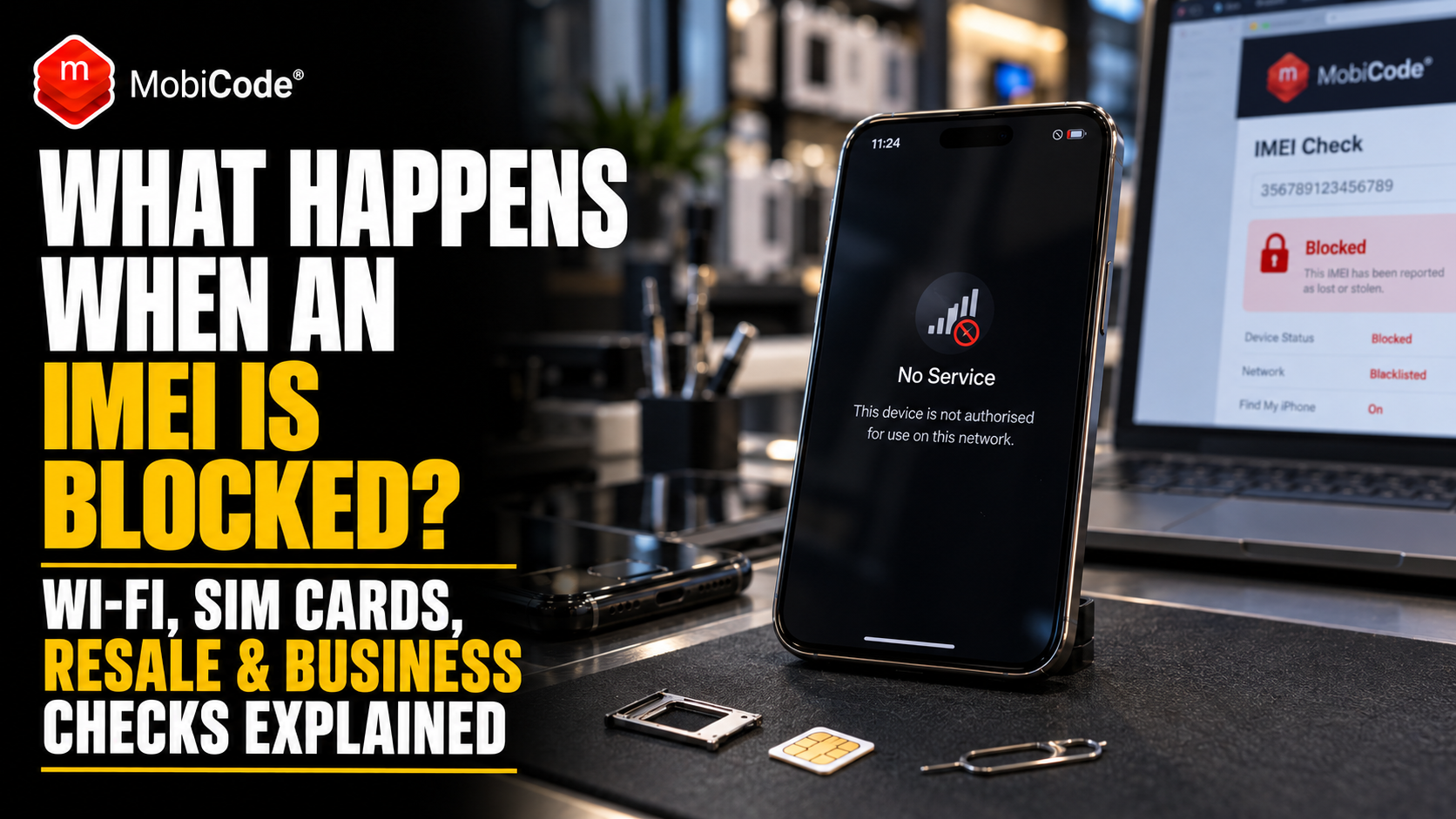
When a mobile network blocks an IMEI, participating networks can refuse cellular service to that device. Changing the SIM normally does not solve the problem because the block relates to the handset’s IMEI rather than the mobile subscription.
However, an IMEI block does not remotely destroy or completely disable a phone. Wi-Fi may still work, the block does not automatically erase data stored on the handset, and block-list coverage can vary between mobile networks and countries.
For consumers, that distinction explains why a phone can appear perfectly functional yet fail to connect to a mobile network. For retailers, recyclers, refurbishers, rental companies and finance providers, it shows why device status matters just as much as physical condition.
First: what exactly is an IMEI?
IMEI stands for International Mobile Equipment Identity. GSMA describes it as the electronic identifier used to identify cellular devices on mobile networks.
In simple terms, the SIM identifies the subscription while the IMEI identifies the device.
That distinction matters because a mobile network can take action against the handset itself rather than only cancelling the customer’s SIM or mobile plan.
What does “IMEI blocked” actually mean?
GSMA describes network blocking, also called cellular-access blocking, as a mobile network operator preventing a device from using its network because of the handset’s IMEI status.
Operators and approved organisations can share relevant device-status information through systems such as the GSMA Device Registry. Therefore, a device reported by one participant may also lose service on other participating networks.
The network rejects the device identifier. It is not simply cancelling the particular SIM that happened to be inside the phone when somebody reported it.
What stops working when an IMEI is blocked?
The main effect involves cellular network access.
Depending on the network and the status information it uses, a blocked handset may fail to register normally on the mobile network. Consequently, functions that rely on that cellular connection can stop working.
A network applying the block may refuse ordinary cellular calls from the device.
Normal mobile-network messaging may also stop working.
The handset may no longer receive normal cellular data service.
Can an IMEI-blocked phone still use Wi-Fi?
Yes, potentially.
Network-level IMEI blocking controls access to participating cellular networks. It does not automatically disable the phone’s Wi-Fi radio.
This is why an IMEI-blocked handset should not automatically be described as completely “dead”. It may still open apps, connect to Wi-Fi, use its camera and perform other local functions.
Will another SIM work in an IMEI-blocked phone?
Changing the SIM does not normally remove an IMEI block.
The reason is straightforward: the SIM and IMEI identify different things.
A new SIM gives the user a different subscription identity, but the handset still presents the same IMEI to the mobile network. If that network checks the IMEI against applicable block-list information, it can still refuse service.
Does a factory reset remove an IMEI block?
No, not normally.
A factory reset removes user settings and data from the handset. It does not normally alter network-side status attached to the device’s IMEI.
Therefore, resetting a blocked phone, deleting its apps or setting it up with another account does not resolve the underlying block-list status.
Does IMEI blocking erase the phone’s data?
No. IMEI blocking and secure data erasure solve different problems.
Blocking concerns the handset’s ability to use cellular networks. It does not itself delete photographs, messages, documents, saved accounts or other information stored on the device.
Businesses handling recovered, returned or recycled devices therefore need a separate data-erasure process. MobiCode’s MobiWIPE supports professional mobile-device data-erasure workflows.
Can an IMEI-blocked phone work in another country?
Possibly. The answer depends on the networks involved.
The GSMA Device Registry allows participating operators and authorised organisations to share block-list information internationally. This helps networks identify a device that another participant has reported.
However, operators and countries do not all implement block-list information in exactly the same way. Consequently, businesses should not describe an IMEI block as a guaranteed worldwide disablement of every cellular network.
Why are phones added to device block lists?
Lost and stolen phones are the most familiar examples, but device-status systems can support other approved circumstances too.
GSMA documentation describes block-list information relating to devices associated with situations such as loss, theft, fraud or other circumstances that make the device unsuitable for normal cellular-network use.
MobiBLOCK supports device-protection workflows for eligible businesses by helping them block at-risk devices and flag active finance, rental or lease interests.
Is a finance or rental flag the same as an IMEI block?
Not necessarily.
A block aims to restrict cellular-network use. By contrast, a finance, rental or lease flag can communicate that another organisation still has a financial or contractual interest in the device.
Restrict network use
The relevant network can restrict cellular service when the device status justifies blocking.
Communicate an active interest
A flag can help a downstream buyer or processor see that finance, rental or lease obligations may still exist.
Why does this matter when buying a used phone?
A device can look immaculate and pass every physical test while still carrying a serious status problem.
A recycler, refurbisher or retailer might confirm that the screen, cameras, microphones, battery and buttons all work perfectly. None of those checks reveals whether somebody has reported the IMEI or whether another organisation has flagged an interest in the handset.
Functional testing: Does the device work?
Device-status checking: Is there a commercial, ownership or network reason to investigate before buying it?
Professional device intake should consider both.
How can businesses check whether an IMEI is blocked?
GSMA Device Check allows eligible organisations to investigate whether a device carries relevant GSMA Block List status. GSMA identifies organisations such as device traders, retailers, insurance companies, repair centres and recyclers as users of device-status information.
Within the MobiCode ecosystem, MobiCHECK supports professional device-status due diligence.
How MobiBLOCK adds to that process
The MobiBLOCK product page explains that MobiCHECK can show devices that MobiBLOCK has blocked or flagged.
Therefore, status information created at one point in the device lifecycle can inform a later purchasing, trade-in or processing decision.
What if the IMEI status is wrong?
A buyer should not ignore device-status information simply because a seller says the result is an error.
GSMA advises consumers who believe block-list information is incorrect to contact their wireless provider. Commercial users should work with the organisation responsible for the relevant device record.
Therefore, a professional buyer should resolve the issue with the appropriate organisation rather than assuming the status will disappear later.
Can a recovered phone be unblocked?
Yes, device status can change when the underlying circumstances change.
For example, somebody may later recover a handset that they previously reported as lost. The organisation or network responsible for the relevant record can then follow the appropriate process to update its status.
That is another reason accurate records matter. Businesses need to know not only why they took an action but also when and why they should later change the device status.
Why IMEI blocking matters to rental and leasing companies
Rental and leasing companies face a particular problem: the business owns or retains an interest in the asset while somebody else physically possesses it.
If a customer fails to return a high-value handset, the device can still hold substantial second-hand value. Contractual recovery remains important, but the business may also want a device-level response.
MobiBLOCK gives eligible organisations a route to block or flag relevant devices as part of a controlled asset-protection workflow.
Why IMEI status matters to finance providers
A financed handset may enter the second-hand market before the underlying agreement has ended.
The next trader or recycler may see a fully functioning device without knowing that another organisation retains a financial interest.
By flagging that interest through MobiBLOCK, the business can make relevant status information visible to downstream checks rather than allowing the issue to travel invisibly with the handset.
Why IMEI status matters to recyclers and refurbishers
Device businesses routinely make purchasing decisions on relatively tight margins. A blocked or disputed handset can turn apparently profitable stock into a commercial problem.
GSMA specifically recognises device traders, retailers, repair centres and recyclers as organisations that use device-status information.
Therefore, IMEI due diligence belongs near the start of an inbound-device workflow — ideally before the business pays full value, invests in refurbishment or resells the handset.
MobiBLOCK and MobiCHECK: act versus check
The easiest way to understand the two services is to view them from opposite sides of the device transaction.
MobiBLOCK
Helps an eligible organisation block or flag an at-risk device when theft, loss, non-return, fraud or an active agreement creates a legitimate reason to act.
MobiCHECK
Helps another organisation investigate device status before buying, accepting, recycling or processing the handset.
A practical example: the phone works, but the IMEI does not
Imagine a refurbisher receives a recent flagship smartphone from a trader.
The screen looks excellent. The cameras work, battery health appears good, Wi-Fi connects immediately and the device passes functional testing.
However, a known-good SIM cannot establish normal mobile service.
Changing the SIM does not solve it
Staff insert another known-good SIM, but the problem remains. That makes a subscription-specific issue less likely.
The business checks the device status
An IMEI lookup then shows a relevant device-status warning.
The refurbisher now knows that this may not simply be a faulty SIM or ordinary connectivity problem. The handset needs further status investigation before the business invests more money or puts it into saleable stock.
Commercial takeaway
A working phone is not automatically a safe phone to buy
An IMEI block is fundamentally a device-status issue. The handset may still turn on, pass diagnostics and work over Wi-Fi while participating mobile networks refuse cellular access.
That is why retailers, recyclers and refurbishers need device-status due diligence as well as functional testing.
Meanwhile, organisations that own, rent, lease or finance devices need a controlled way to act when those assets become stolen, disputed, unreturned or improperly resold. That is where MobiBLOCK fits into the wider MobiCode device-protection workflow.
Get started with MobiBLOCK
MobiBLOCK is designed for businesses that need device blocking, finance or rental flagging and stronger mobile-asset protection.
Already a MobiCode customer?
Request MobiBLOCK through the dedicated Blocklist Access page in your existing account.
New to MobiCode?
Speak to the MobiCode team about how MobiBLOCK could fit your device-protection workflow.
Frequently asked questions
Blocked IMEI basics
What happens when an IMEI is blocked?
Participating mobile networks can refuse cellular service to the handset based on its IMEI status. Calls, SMS and mobile data may therefore become unavailable on networks that apply the block.
Can an IMEI-blocked phone still use Wi-Fi?
Yes, potentially. Network IMEI blocking restricts cellular access and does not automatically disable Wi-Fi or every other function inside the handset.
Will another SIM work in an IMEI-blocked phone?
Changing the SIM does not normally remove an IMEI block because the block relates to the device identifier rather than the subscription.
Does a factory reset remove an IMEI block?
No. A factory reset removes user data and settings but does not normally alter network-side block-list status attached to the handset’s IMEI.
Network and status questions
Does IMEI blocking delete data?
No. Device blocking and secure data erasure are separate processes.
Can an IMEI-blocked phone work abroad?
It depends on whether the relevant network receives and applies the block-list information. International sharing exists between participating organisations, but coverage is not identical everywhere.
Can an IMEI block be removed if the phone is recovered?
The relevant organisation can update device status when a legitimate lost or stolen report has been resolved.
How do existing MobiCode customers request MobiBLOCK?
Existing customers can request access directly through the Blocklist Access page in MobiCode Server.