

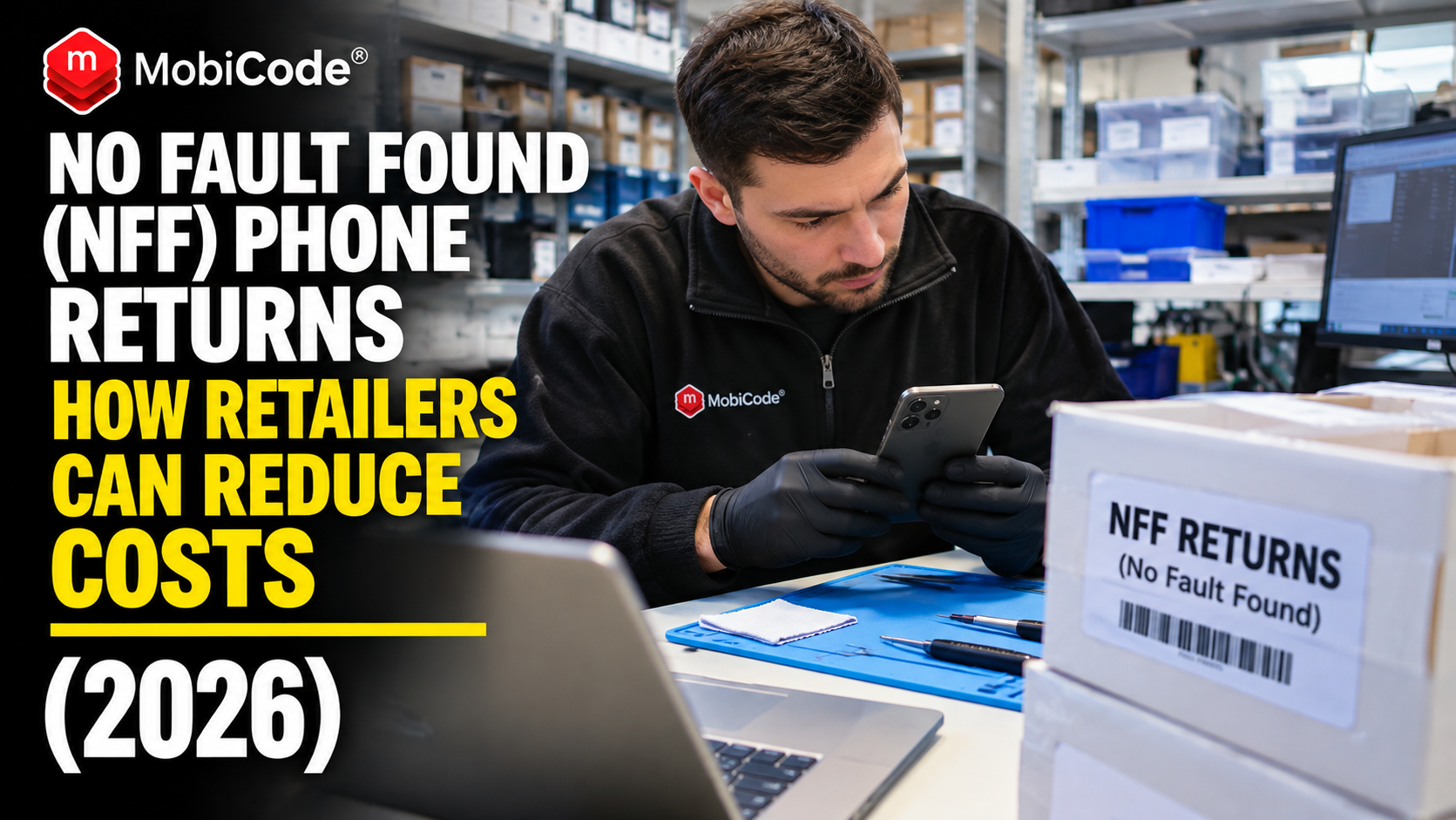
No fault found (NFF) returns are a frustrating and potentially expensive problem for mobile phone retailers, repair centres and refurbishment businesses. A customer reports that their iPhone keeps switching off, the handset is returned for inspection, and your technician discovers that everything appears to work perfectly. What happens next?
The business has already paid for return shipping, customer support and technician time. Meanwhile, the handset may be unavailable for resale while the investigation takes place.
Even worse, the same device could return to the workshop several weeks later with exactly the same complaint.
For businesses processing hundreds or thousands of smartphones, these incidents can consume valuable resources and reduce profitability.
However, a no fault found result does not necessarily mean the customer was mistaken. Intermittent hardware failures, software problems, accessories and environmental conditions can all make a genuine fault difficult to reproduce.
This guide explains how professional phone businesses can investigate NFF returns, improve warranty testing, reduce avoidable processing costs and introduce more consistent diagnostic procedures.
We’ll also explore how MobiTEST, MobiCode’s professional mobile phone diagnostic software, can help retailers and repair centres standardise testing, document results and retest devices more efficiently.
Quick answer: What does no fault found mean?
No fault found, commonly abbreviated to NFF, describes a situation where a returned device undergoes testing but the reported problem cannot be identified or reproduced during the investigation.
For mobile phone businesses, common causes include intermittent hardware faults, software issues, incompatible accessories, environmental conditions and differences between the customer’s usage and the workshop’s testing process.
To manage NFF returns more effectively:
- Record the customer’s exact fault description.
- Verify the returned handset’s IMEI and original sales record.
- Review previous diagnostic reports.
- Run consistent functional tests.
- Investigate the conditions under which the problem occurs.
- Retest relevant functions where necessary.
- Document the outcome and any testing limitations.
- Monitor repeat returns and recurring failure patterns.
Important: A no fault found result is not proof that a handset has never experienced a fault.
What is no fault found in mobile phone repairs?
A no fault found result occurs when a technician cannot identify the reported defect during an inspection or diagnostic procedure.
The term is widely used in electronics repair, warranty management, product servicing and reverse logistics.
For example, a customer returns a refurbished Samsung Galaxy because its touchscreen occasionally stops responding. During a workshop inspection, the technician runs several tests without experiencing the same problem.
The device may receive an NFF classification because the reported behaviour could not be reproduced.
However, this classification describes the outcome of the investigation, not necessarily the complete condition of the handset.
No fault found vs no trouble found
Different repair organisations use different terminology for similar outcomes.
| Abbreviation | Meaning | Typical interpretation |
|---|---|---|
| NFF | No Fault Found | No fault identified during the investigation |
| NTF | No Trouble Found | Reported issue not observed during testing |
| CND | Cannot Duplicate | Technician cannot reproduce the reported behaviour |
| TNI | Trouble Not Identified | Cause of the reported problem remains unidentified |
Definitions can vary between organisations. Therefore, repair businesses should establish consistent internal classifications so employees understand exactly what each outcome means.
Why no fault found does not mean fault-free
Some electronic defects occur only under particular conditions.
For instance, a smartphone may experience problems when its battery reaches a low charge level, when a particular application runs or when it connects to a specific accessory.
A short workshop test may not recreate those circumstances.
Research published in the journal Microelectronics Reliability discusses the relationship between intermittent electronic failures and NFF outcomes.
The practical lesson for phone businesses is straightforward: passing a diagnostic test provides useful evidence, but it does not guarantee that every possible intermittent problem has been eliminated.
Why no fault found returns cost mobile phone businesses money
A returned phone generates operational costs even when a technician cannot identify a defective component.
For retailers working with relatively small margins on each handset, those expenses can quickly become significant.
Return shipping and reverse logistics
Postal retailers may need to arrange collection, receive the handset, verify its identity and eventually send it back to the customer.
Each stage requires staff time and potentially additional delivery costs.
Unlike an ordinary sale, these activities may generate no additional revenue.
Technician and customer-service time
Someone must review the original complaint, test the handset, investigate the reported behaviour and communicate the outcome.
Even if no repair takes place, the business still incurs labour costs.
Those costs become particularly important when the workshop has a backlog of profitable repair jobs waiting for attention.
Inventory depreciation
Smartphones frequently lose resale value as newer models enter the market.
A handset that spends several weeks in a returns or investigation queue may be worth less when it becomes available for resale.
Furthermore, a previously sold device may need additional preparation before being listed again.
Repeat returns and customer dissatisfaction
Returning a handset without resolving the customer’s reported problem can create further costs if the issue recurs.
The retailer may face another investigation, additional postage and a more complicated customer-service interaction.
Consequently, reducing unnecessary repeat processing should be a priority for professional warranty operations.
How much could no fault found returns cost your business?
Consider a refurbishment business selling 2,000 smartphones each month.
For illustration, assume that 5% of devices are returned and that 30% of those returns result in an NFF classification.
These assumptions are hypothetical rather than measured industry averages.
Illustrative monthly NFF processing costs
| Business metric | Illustrative figure |
|---|---|
| Monthly phone sales | 2,000 |
| Return rate | 5% |
| Monthly returns | 100 |
| Proportion classified as NFF | 30% |
| Monthly NFF cases | 30 |
| Average direct processing cost | £35 |
| Monthly NFF processing cost | £1,050 |
| Annual NFF processing cost | £12,600 |
This example excludes potential refunds, inventory depreciation, lost sales opportunities and wider reputational costs.
What happens if avoidable NFF cases fall?
Suppose better fault identification, customer support and pre-sale quality control genuinely reduce avoidable return cases in this hypothetical business.
| Reduction in NFF processing volume | Monthly saving | Annual saving |
|---|---|---|
| 10% | £105 | £1,260 |
| 20% | £210 | £2,520 |
| 30% | £315 | £3,780 |
| 50% | £525 | £6,300 |
These figures assume that avoided cases eliminate the stated direct processing costs. They do not include the cost of implementing new systems or procedures.
They are not measured MobiTEST savings or a guaranteed software return on investment.
Nevertheless, they show why businesses should investigate avoidable return costs rather than focusing exclusively on sales growth.
Seven common causes of no fault found phone returns
Understanding why reported issues disappear during workshop testing is essential for improving warranty management.
1. Intermittent charging problems
A customer may report that their phone occasionally stops charging.
However, the handset works normally when connected to the workshop’s charging equipment.
The original issue could involve a damaged cable, incompatible adapter, debris, a worn connection or another intermittent fault.
Apple’s iPhone charging guidance identifies several possible causes of charging difficulties.
Technicians should investigate the circumstances of the reported problem, including the accessories involved, rather than relying on a single successful connection.
2. Battery problems at particular charge levels
A handset may perform normally when fully charged but experience unexpected shutdowns at lower battery levels.
Apple explains that battery ageing, charge level and temperature can influence an iPhone’s ability to deliver sufficient peak power.
See Apple’s battery and performance guidance.
Therefore, a workshop charging every incoming device before inspection may not recreate the customer’s original experience.
3. Software and application conflicts
Not every smartphone performance problem originates from defective hardware.
Operating-system problems, application behaviour and configuration differences may contribute to unexpected crashes, freezing or excessive battery consumption.
A technician testing a device in a clean environment may not experience the same behaviour.
Where appropriate, investigate software-related causes before replacing hardware unnecessarily.
4. Temperature-related behaviour
Smartphones can behave differently in unusually warm or cold environments.
For example, charging restrictions may occur when a handset’s temperature falls outside its supported operating conditions.
Apple explains these protective behaviours in its device temperature guidance.
However, technicians should never deliberately expose a phone or battery to unsafe temperatures simply to recreate a complaint.
5. Mobile network and connectivity issues
A customer may experience poor call quality, dropped connections or unreliable mobile data in a particular location.
The handset might behave normally when tested elsewhere.
Investigate whether the issue relates to network coverage, account provisioning, settings, SIM compatibility or defective hardware.
A successful Wi-Fi test alone does not establish that every cellular function works correctly.
6. Incomplete post-repair testing
A technician may successfully replace a screen but fail to test related functions afterwards.
For instance, the display could work normally while another feature behaves unexpectedly.
When the device returns, a more comprehensive diagnostic investigation may be necessary.
Consistent post-repair testing can help identify outstanding problems before the customer receives the handset.
7. Inaccurate fault descriptions
Descriptions such as “phone broken”, “battery bad” or “screen faulty” provide limited diagnostic information.
Without additional details, technicians may test functions that have little relevance to the actual complaint.
Better intake questions can make the investigation more focused and useful.
How to investigate a no fault found warranty return
A structured return merchandise authorisation (RMA) process helps businesses handle customer complaints consistently.
The objective is to distinguish confirmed faults, unresolved issues and other return reasons without making assumptions about the customer.
Step 1: Record the original complaint accurately
Ask the customer to describe what happens rather than asking them to diagnose the component.
Useful questions include:
- When did the problem first appear?
- How frequently does it occur?
- Does it happen during calls, charging or application use?
- What battery level is the phone usually at?
- Does the problem occur with particular accessories?
- Have any software updates or repairs recently taken place?
- Does restarting the handset temporarily resolve the problem?
Where appropriate, customers may provide screenshots or recordings without exposing unnecessary personal information.
Step 2: Verify that the returned phone is the correct device
Match the handset’s IMEI and relevant identifiers with the original sale or repair record.
This helps establish that the business is investigating the correct device.
If identifiers differ, investigate the discrepancy fairly before drawing conclusions.
MobiCHECK can additionally help professional businesses investigate available device-status information when relevant to the return.
Step 3: Review original diagnostic information
Retrieve the tests carried out before the original sale or repair.
For example, if the complaint concerns a microphone, check whether the original processing record includes a microphone test.
A previous successful result provides a useful baseline, although it does not establish that the component could not have developed a problem later.
Step 4: Complete a consistent functional test
Run the appropriate diagnostic workflow across the accessible functions.
Include relevant hardware, audio, screen, sensor and connectivity tests.
MobiTEST helps professional businesses standardise these checks through configurable guided procedures.
Step 5: Investigate the reported symptom separately
A general diagnostic pass may not recreate a specific intermittent complaint.
Therefore, perform additional manufacturer-appropriate checks relevant to the reported problem.
Record the test conditions, duration and results where they are material to the investigation.
Step 6: Retest when necessary
If the business performs an authorised repair or adjustment, repeat the relevant diagnostics.
Where the fault remains unresolved, consider further technical investigation rather than automatically returning the handset as fully functional.
Step 7: Record an appropriate final outcome
Use an outcome that accurately reflects the available evidence.
Options might include confirmed hardware fault, confirmed software issue, accessory-related problem, no fault reproduced or further investigation required.
Finally, determine the customer’s appropriate remedy under the applicable legal rights and warranty terms.
Processing warranty returns across your repair business?
MobiTEST helps retailers and refurbishment centres establish repeatable diagnostic workflows, print device test reports and repeat selected checks when further investigation is required.
Give technicians a consistent testing process rather than relying entirely on individual experience and handwritten notes.
Free no fault found inspection report template
A consistent inspection report helps technicians record what they actually investigated and which questions remain unanswered.
Businesses can adapt the following template to their internal repair-management systems.
Mobile Phone Warranty Investigation Report
RMA reference: [Reference]
Original order reference: [Order number]
Device make and model: [Model]
IMEI / serial number: [Identifier]
Date received: [Date]
Technician: [Operator reference]
Customer-reported fault
[Describe the reported behaviour, frequency and circumstances.]
Initial inspection
[Record relevant physical condition, known repairs and any limitations affecting testing.]
Diagnostic investigation
[List the functions tested, relevant conditions, results and diagnostic report reference.]
Additional symptom-specific checks
[Document additional investigation carried out to reproduce the customer’s complaint.]
Investigation outcome
- ☐ Confirmed hardware fault
- ☐ Confirmed software problem
- ☐ Accessory or configuration issue identified
- ☐ Reported fault not reproduced
- ☐ Testing incomplete or further investigation required
- ☐ Other documented outcome
Recommended next action
[Repair, replacement, refund assessment, further investigation or another appropriate outcome.]
Testing limitations
[Record functions or conditions that could not be assessed.]
Final review: [Authorised reviewer and date]
This template is a general operational example rather than an official MobiTEST report format.
For businesses processing larger volumes, professional diagnostic reports can supplement these records with more structured functional test information.
How MobiTEST helps reduce avoidable warranty processing costs
MobiTEST is MobiCode’s PC-based mobile phone diagnostic platform designed for professional device-processing businesses.
Its guided workflows help teams perform comparable tests and record results across different handsets, users and processing locations.
Standardise pre-sale and warranty diagnostics
One technician may carry out a comprehensive inspection while another focuses only on obvious symptoms.
MobiTEST allows businesses to configure testing workflows around their operational requirements.
This can help establish more consistent diagnostic standards before devices are sold and when they return for investigation.
Repeat relevant tests without restarting every process
MobiTEST supports partial and complete workflow retesting.
For example, after addressing a reported audio problem, a technician can repeat the relevant checks and document the result.
This is particularly useful for workflows involving multiple stages of investigation, repair and quality control.
Print professional diagnostic reports
MobiTEST provides printable reports containing test results.
These records give teams a clearer reference when reviewing a returned handset or investigating the outcome of previous work.
However, a report should always be interpreted within the scope of the tests performed.
Improve testing throughput
MobiCode advertises guided handset testing in under two minutes for its supported workflow.
The platform also supports multiple device connections, allowing suitable handsets to be processed concurrently or independently.
Actual processing times depend on the devices and tests selected. An intermittent fault may require a substantially longer investigation.
Review diagnostic performance across locations
MobiTEST includes management reporting across business users and locations.
For example, a refurbishment company can compare processing activity across its teams and investigate whether additional training or workflow changes are necessary.
The aim is to support more consistent technical standards as the business grows.
What diagnostic tests should a mobile phone returns centre perform?
A professional returns operation needs both a standard baseline inspection and additional tests relevant to each complaint.
| Reported symptom | Initial diagnostic focus | Additional considerations |
|---|---|---|
| Intermittent touchscreen | Display and touch response | Affected screen area, frequency and previous repairs |
| Poor call audio | Microphone and speaker tests | Network conditions and audio routing |
| Charging interruptions | USB connectivity and appropriate charging checks | Cable, adapter, connector condition and temperature |
| Screen stays on during calls | Proximity sensor | Accessories, display repairs and relevant settings |
| Bluetooth disconnects | Bluetooth functionality | Accessory compatibility and connection conditions |
| Unexpected shutdowns | Available battery and power information | Charge level, software behaviour and specialist assessment |
This table illustrates a general investigation framework. Additional checks may require manufacturer tools or specialist equipment beyond the standard MobiTEST workflow.
No fault found returns and UK consumer rights
Retailers must handle warranty investigations fairly and in accordance with consumer protection law.
A diagnostic pass does not automatically remove the customer’s statutory rights.
What happens within the first 30 days?
Under the Consumer Rights Act 2015, consumers generally have a short-term right to reject goods that fail to meet the applicable statutory standards within the relevant 30-day period.
Businesses should assess the reported issue and the available evidence rather than relying exclusively on an internal NFF label.
What happens within the first six months?
For relevant repair, replacement and subsequent remedies, a lack of conformity appearing within six months is generally presumed to have existed at delivery unless the trader establishes otherwise or the presumption is incompatible with the circumstances.
After six months, consumers may need to demonstrate that the problem relates to an underlying defect present when the goods were supplied.
Read GOV.UK’s guidance on returns and refunds and the Consumer Rights Act 2015 for the applicable requirements.
Can a retailer refuse a refund because no fault was found?
Not automatically.
The appropriate outcome depends on the evidence, timing, applicable statutory rights and circumstances of the sale.
Distance-selling cancellation rights may also apply independently of whether the handset has a fault.
Consequently, retailers should not treat an NFF result as a universal reason to refuse refunds, repairs or replacements.
Professional test reports can support a fair investigation, but they do not replace legal obligations.
How to calculate your no fault found return rate
Businesses cannot manage warranty-processing performance effectively without consistent measurements.
Start by defining which return cases qualify for an NFF classification.
NFF rate = NFF cases ÷ completed diagnostic return cases × 100
Use a consistent population of completed investigations when comparing periods.
For example, if a workshop completes 200 diagnostic return investigations and 40 receive an NFF classification, the NFF rate is 20%.
However, the percentage alone does not explain why the cases occurred.
Track these six additional warranty metrics
| Metric | Why it matters |
|---|---|
| Repeat return rate | Highlights devices or complaints requiring repeated attention |
| Average investigation cost | Measures the financial burden of warranty processing |
| Average turnaround time | Identifies delays and workshop bottlenecks |
| Post-repair failure rate | Supports investigation of repair quality |
| Diagnostic completion rate | Shows whether required checks are being performed |
| Returns by model and supplier | Helps identify recurring product and sourcing issues |
A falling NFF rate is not necessarily an improvement if technicians simply classify more cases as confirmed faults without sufficient evidence.
Measure customer outcomes, investigation quality and repeat returns alongside the headline percentage.
How to calculate the return on investment from diagnostic software
When purchasing professional mobile phone testing software, businesses should compare the cost of the proposed system with measurable operational improvements.
For instance, a workshop may want to reduce routine test handling time without removing necessary quality checks.
Illustrative technician time savings
Suppose a refurbishment operation processes 1,000 smartphones each month.
If an improved workflow genuinely saves three minutes of active technician time per handset, the total monthly reduction is 3,000 minutes, or 50 hours.
50 hours × £20 = £1,000
Illustrative monthly labour capacity value at an assumed £20 hourly employment cost.
That represents £12,000 of annual labour capacity before software costs and implementation expenses.
It does not necessarily mean the business will reduce its payroll by that amount. Instead, the released time could allow technicians to process additional devices or investigate more complex faults.
These assumptions are illustrative and should not be interpreted as verified MobiTEST performance results.
What should businesses measure during a software trial?
- Active technician time per device.
- Number of completed tests per working hour.
- Completeness and consistency of diagnostic records.
- Time required to train new operators.
- Time spent investigating repeat returns.
- Percentage of devices requiring additional manual processing.
Compare equivalent handsets and testing requirements before and after implementation.
This provides a more reliable basis for a purchasing decision than comparing advertised test speeds alone.
MobiTEST vs MobiONE for refurbishment and warranty processing
The most appropriate software depends on the wider services your business provides.
| Business requirement | MobiTEST | MobiONE |
|---|---|---|
| Guided functional diagnostics | Core focus | Included |
| Configurable workflows | Supported | Supported |
| Device grading | Supported | Supported |
| Relevant device-status checks | Integrated checks | Included in wider workflow |
| Secure data-erasure workflow | Not its primary focus | Included |
When to choose MobiTEST
Businesses primarily looking for repeatable diagnostics, repair testing and documented functional checks should explore MobiTEST.
When to choose MobiONE
MobiONE offers a broader device-processing workflow for businesses that also purchase, grade, erase and prepare smartphones for resale.
For example, a refurbishment centre receiving both new trade-in stock and previously sold warranty returns may benefit from evaluating a wider processing platform.
No fault found classification checklist for repair centres
Before closing an investigation as NFF, review the following questions.
Customer information
- ☐ Has the customer’s specific complaint been recorded?
- ☐ Are the circumstances and frequency of the problem understood?
- ☐ Has the customer’s supporting evidence been considered?
Device identification and diagnostics
- ☐ Does the returned IMEI match the relevant transaction?
- ☐ Have previous test reports been reviewed?
- ☐ Have suitable functional diagnostics been completed?
- ☐ Have symptom-specific checks been performed?
- ☐ Have relevant testing limitations been recorded?
Final investigation outcome
- ☐ Does the classification accurately reflect the evidence?
- ☐ Does the device require further investigation?
- ☐ Have relevant consumer rights been considered?
- ☐ Has the customer received a clear explanation?
- ☐ Can the outcome be reviewed if the problem returns?
Final verdict: better diagnostics lead to better warranty decisions
No fault found returns are not simply an inconvenience for mobile phone businesses.
They can consume technician capacity, generate unnecessary shipping expenses and contribute to repeated customer complaints.
However, the solution is not to dismiss faults more quickly or reject more warranty claims.
Instead, businesses should improve fault descriptions, standardise testing, investigate intermittent behaviour and retain useful device-level evidence.
For retailers and refurbishers handling larger device volumes, professional diagnostic software can help make those processes more consistent.
MobiTEST provides configurable guided tests, retesting, reporting and multi-device processing features that can support professional quality-control and warranty investigation workflows.
By combining appropriate diagnostics with fair customer-service procedures, mobile phone businesses can better understand device failures, manage processing costs and identify opportunities to improve repair quality.
Improve your mobile phone diagnostics with MobiTEST
Are avoidable warranty returns, inconsistent testing and repeat repairs consuming valuable technician time?
MobiTEST is designed for professional mobile phone retailers, repair centres, wholesalers and refurbishment businesses that need reliable, repeatable diagnostic workflows.
Why choose MobiTEST?
- Configurable guided diagnostic workflows.
- Hardware, screen, audio, sensor and connectivity testing.
- Rapid routine handset testing on supported devices.
- Partial or complete diagnostic retesting.
- Printable reports containing test results.
- Simultaneous device connections.
- Custom grading and barcode labels.
- Management reporting across users and locations.
Whether you process 100 devices a month or operate a large refurbishment facility, speak to MobiCode about your current testing procedures and business requirements.
Enquire About Business Testing
Test consistently. Investigate accurately. Protect your margins.
Frequently asked questions about no fault found phone returns
Understanding NFF outcomes
What does no fault found mean in phone repairs?
No fault found means a technician could not identify or reproduce the reported problem during testing. It does not necessarily establish that the handset has never experienced a fault, especially where the issue is intermittent or depends on particular operating conditions.
What causes no fault found returns?
Possible causes include intermittent hardware failures, software conflicts, accessory problems, network conditions, battery behaviour and incomplete fault descriptions. Inconsistent or insufficient testing may also contribute to unresolved investigations.
Can a phone pass diagnostics and still have a fault?
Yes. Diagnostic tests assess particular functions under defined conditions. An intermittent problem may not appear during a short inspection, which is why additional symptom-specific testing and appropriate follow-up can be necessary.
Reducing mobile phone warranty costs
How can retailers reduce avoidable NFF returns?
Retailers can improve pre-sale diagnostics, collect more detailed fault descriptions, establish consistent investigation procedures and provide appropriate customer support. Monitoring recurring complaints and supplier patterns can also help identify underlying quality problems.
How do you calculate the no fault found rate?
Divide the number of cases classified as NFF by the total number of comparable completed diagnostic return investigations, then multiply by 100. Use consistent definitions and measure repeat returns alongside this percentage.
Can a phone retailer refuse a warranty claim if no fault is found?
An NFF result does not automatically justify rejecting a warranty claim or statutory remedy. The retailer should consider the evidence, applicable consumer rights, contractual terms and circumstances of the complaint before deciding the appropriate outcome.
Professional mobile phone diagnostic software
What software do professional mobile phone repair centres use?
Repair centres may use diagnostic testing software, repair-management systems, manufacturer tools and stock-management platforms. MobiTEST provides guided functional diagnostics, retesting, configurable workflows and reporting for professional mobile device businesses.
Can MobiTEST help investigate no fault found returns?
MobiTEST can support NFF investigations through consistent guided testing, repeat diagnostics and documented test results. However, intermittent or specialist faults may require additional investigation beyond the standard diagnostic workflow.
Can MobiTEST produce diagnostic reports?
Yes. MobiTEST provides printable reports containing diagnostic test results. These records can support internal quality control, device processing and the investigation of warranty returns.
What is the difference between MobiTEST and MobiONE?
MobiTEST primarily focuses on professional device diagnostics, testing workflows, grading and reporting. MobiONE provides a broader processing platform that also incorporates secure data-erasure workflows. Businesses should select the solution that fits their processing volumes and operational requirements.
Sources and further reading
Electronic reliability and intermittent faults
Microelectronics Reliability — No-Fault-Found and Intermittent Failures in Electronic Products
Research discussing difficulties identifying intermittent defects and their relationship with NFF outcomes.
Manufacturer troubleshooting guidance
Apple Support — If Your iPhone Won’t Charge
Official troubleshooting guidance covering charging equipment and potential charging problems.
Apple Support — iPhone Battery and Performance
Explains battery ageing, peak performance and unexpected shutdown behaviour.
Apple Support — If Your iPhone or iPad Gets Too Hot or Too Cold
Information about device temperature, protective operating restrictions and charging behaviour.
UK consumer rights and warranty returns
GOV.UK — Accepting Returns and Giving Refunds
Official retailer guidance on returns, refunds, faulty goods and relevant consumer protections.
Consumer Rights Act 2015 — Section 19
Legislation concerning consumer rights and remedies when goods fail to conform to a contract.
MobiCode professional testing solutions
Professional mobile phone diagnostics, guided workflows, retesting, multiple-device connections and reporting.
Integrated device checking, diagnostics, grading and secure data-erasure workflows.
Professional device-history and IMEI-status checking.