

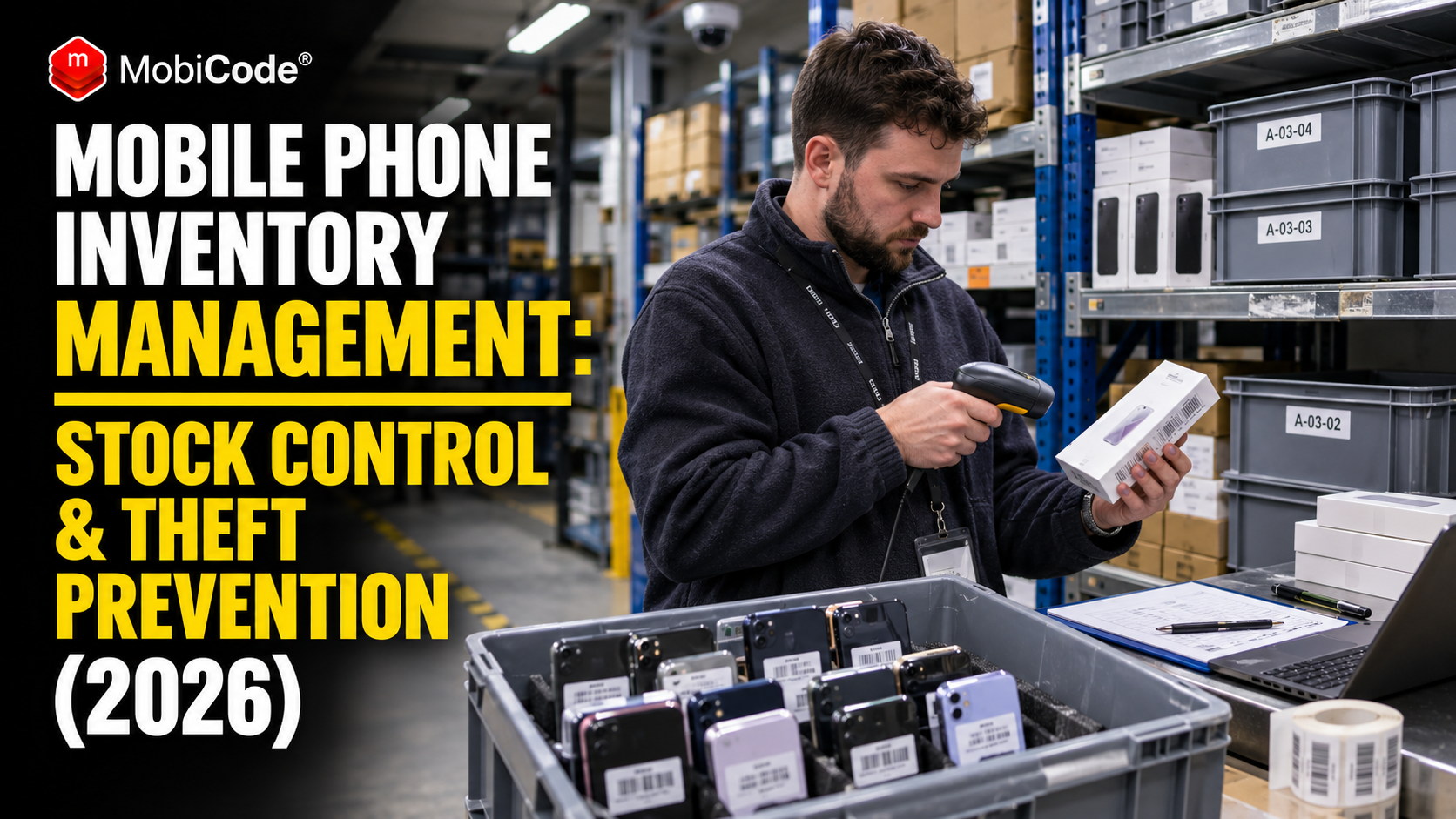
Mobile phone inventory management is about more than knowing how many smartphones are sitting on a shelf. If your business holds £100,000 worth of iPhones, Samsung Galaxy devices and other mobile technology, can you account for every individual handset, identify missing stock and establish whether a device has been traded elsewhere without your authorisation?
For mobile phone retailers, wholesalers and refurbishment businesses, poor stock control can quietly destroy profit margins.
A handset goes missing from a warehouse. Another receives a network block after purchase. A returned phone does not match the original device sold to the customer.
Individually, these incidents may appear manageable. However, across thousands of transactions, they can create substantial commercial losses.
Traditional inventory systems can tell you how many products you should have. Nevertheless, smartphones require an additional layer of control because each device has its own identity, condition, ownership history and potential restrictions.
This guide explains how to improve mobile phone inventory management using IMEI-based stock records, bulk device checks, stock reconciliation, fraud prevention and professional monitoring.
We’ll also show how MobiCHECK and MobiBLOCK help businesses investigate device-status risks and protect valuable mobile inventory.
Quick answer: How should businesses manage mobile phone inventory?
Effective mobile phone inventory management involves tracking each individual handset by its IMEI or serial number, documenting its condition and monitoring relevant changes throughout its commercial lifecycle.
- Record every handset’s IMEI, model and serial number.
- Link each device to its supplier and purchase transaction.
- Run appropriate IMEI and device-status checks.
- Record functional condition, cosmetic grade and erasure status.
- Track stock movements between stores, warehouses and repair teams.
- Monitor relevant changes in device status.
- Reconcile physical stock against inventory records regularly.
- Investigate missing, substituted or unexpectedly blocked devices.
- Record eligible ownership interests where appropriate.
- Maintain accurate sales, returns and disposal records.
Key principle: Track the individual device, not just the product model or quantity.
What is mobile phone inventory management?
Mobile phone inventory management is the process of recording, tracking and controlling smartphones throughout their business lifecycle.
That lifecycle may include purchasing, delivery, testing, repair, refurbishment, storage, sale, returns and recycling.
Unlike ordinary retail products, mobile phones have characteristics that make individual device tracking particularly valuable.
For example, two identical iPhone models may have different battery conditions, storage capacities, repair histories and network-block statuses.
Consequently, recording only the number of devices in stock is not enough for many professional businesses.
Product-level inventory versus device-level inventory
A conventional stock system might show that a retailer has 50 black iPhones of a particular model.
However, that figure does not necessarily explain which individual phones are available for resale.
For instance, five could be awaiting repairs, three might have unresolved account restrictions and two could be missing from their recorded locations.
Device-level inventory management helps businesses distinguish those handsets.
Instead of treating every phone as interchangeable, staff can identify the specific device and investigate its current status.
Why smartphones need individual stock records
Individual records help businesses manage several types of information:
- Device identity and model specification.
- Purchase price and supplier history.
- Network blocks and relevant IMEI status.
- Ownership or financial-interest indicators.
- Battery condition and functional test results.
- Cosmetic grading and repair activity.
- Data-erasure records.
- Current physical location and sale status.
Together, these details provide a more accurate picture of what the business owns and which devices are commercially available.
Why IMEI tracking is essential for mobile phone inventory management
An International Mobile Equipment Identity, commonly called an IMEI, identifies cellular equipment.
Most smartphones have a 15-digit IMEI, while some dual-SIM devices have more than one.
The GSMA’s IMEI database guidance explains how these identifiers support device identification and network-related status records.
What can an IMEI tell a business?
When combined with suitable checking services, an IMEI can help businesses investigate relevant information about a handset.
For example, a retailer may discover that a device has been reported lost or stolen, or that it carries a network block.
Other available datasets may provide finance, insurance or additional device-status indicators.
However, an IMEI alone does not reveal every aspect of a phone’s history or establish legal ownership.
Therefore, businesses should combine device-status information with their own purchasing, supplier and transaction records.
IMEI inventory tracking is not GPS tracking
The distinction is important.
Recording an IMEI helps identify a handset when it appears within a relevant database, stock system or participating trade workflow.
However, it does not provide a live geographical location.
For example, a business may receive an alert that an IMEI of interest has appeared in a relevant trading dataset without knowing the phone’s exact physical location.
That information can nevertheless provide a useful starting point for an authorised investigation.
Free mobile phone inventory template
A professional inventory system should connect device identity, commercial information and processing status.
For smaller businesses, a spreadsheet may provide a reasonable starting point.
However, the spreadsheet should contain a separate record for each individual handset rather than a single quantity against each model.
Essential mobile phone stock register fields
| Inventory field | Purpose |
|---|---|
| Asset ID | Internal stock reference |
| IMEI 1 and IMEI 2 | Cellular device identifiers |
| Serial number | Additional device identification |
| Make and model | Product identification |
| Storage and colour | Accurate stock description |
| Supplier reference | Stock provenance and purchasing records |
| Purchase date and cost | Accounting and margin calculations |
| IMEI check result and date | Device-status due diligence |
| Battery condition | Refurbishment and pricing decisions |
| Functional test result | Hardware condition and quality control |
| Cosmetic grade | Resale condition and valuation |
| Erasure status | Data-handling and processing records |
| Stock location | Physical stock reconciliation |
| Current stock status | Available, sold, awaiting repair or under review |
| Sales or return reference | Transaction traceability |
| Last audit date | Stock reconciliation history |
Copyable Excel or Google Sheets template
Copy the following headings into your preferred spreadsheet application to create a basic mobile phone inventory register.
Mobile Phone Stock Register — Column Headings
Asset ID,IMEI 1,IMEI 2,Serial Number,Brand,Model,Storage,Colour,Supplier,Purchase Date,Purchase Cost,IMEI Check Result,Last IMEI Check Date,Battery Health,Diagnostic Result,Cosmetic Grade,Erasure Status,Erasure Certificate Reference,Stock Location,Stock Status,Repair Cost,Listing Price,Sale Price,Order Reference,Sale Date,Last Audit Date,Notes
Import the headings as comma-separated fields. Format the IMEI and serial-number columns as text before entering data so identifiers remain intact.
Although this template can help smaller businesses establish better records, it does not automatically check external databases, monitor changes in device status or identify suspicious trading activity.
Professional IMEI-checking and monitoring services can supplement the internal stock register.
What is stock shrinkage in the mobile phone industry?
Stock shrinkage describes inventory that is missing or cannot be accounted for when physical stock is compared with expected stock records.
It can result from theft, administrative errors, incorrect shipments, device substitutions or unrecorded inventory movements.
However, not every discrepancy indicates criminal activity.
For example, a device may have been moved to a repair bench without its inventory location being updated.
Common causes of mobile phone stock losses
- Employee or external theft.
- Missing stock during warehouse transfers.
- Incorrect supplier shipments.
- Unrecorded device movements.
- Courier loss and delivery discrepancies.
- Fraudulent customer returns.
- Incorrect device identifiers.
- Stock-counting and administrative mistakes.
Each type of discrepancy needs a suitable investigation.
Consequently, businesses should avoid treating every missing handset as a confirmed theft.
How to calculate stock shrinkage
Suppose a mobile phone retailer expects to hold inventory with a total cost value of £150,000.
During a physical audit, the business accounts for stock worth £147,750.
The unexplained difference is £2,250.
£2,250 ÷ £150,000 × 100 = 1.5%
Illustrative stock shrinkage percentage based on expected inventory cost.
This does not establish that the full £2,250 has been stolen or permanently lost.
Instead, it identifies a discrepancy that requires reconciliation.
How stock losses affect mobile phone retailer profits
Because smartphones can be expensive, relatively few missing devices can have a meaningful effect on business profitability.
For example, imagine a refurbishment company purchases and processes 1,000 smartphones every month.
Assume the average acquisition cost is £300 per handset and the average contribution from each successful sale is £40 after direct costs.
Illustrative financial impact of missing phones
| Unrecovered phones | Stock acquisition cost lost | Successful sales needed to offset loss |
|---|---|---|
| 1 phone | £300 | 8 |
| 5 phones | £1,500 | 38 |
| 10 phones | £3,000 | 75 |
| 20 phones | £6,000 | 150 |
| 50 phones | £15,000 | 375 |
These figures are hypothetical and assume no recovery, insurance reimbursement or residual value. They exclude potential additional handling costs and lost sales opportunities.
Nevertheless, the example illustrates an important commercial point: preventing avoidable stock losses can be as valuable as increasing sales.
Seven risks every mobile phone inventory system should address
A stock-control process needs to account for more than physical theft.
For mobile retailers and refurbishment businesses, several risks can affect whether a handset remains commercially suitable for resale.
1. Phones reported lost or stolen after purchase
A handset may pass its initial IMEI check but receive an adverse report later.
The GSMA explains that status updates can take time to reach its Block List.
Therefore, an initial clear result does not guarantee that the device’s status will remain unchanged.
See the GSMA Device Check terms for information about data-update limitations.
2. Unauthorised stock movement
A phone may leave a warehouse, branch or processing facility without a corresponding inventory update.
For example, a transfer between stores might be recorded against the product quantity but not against the individual IMEI.
This makes it harder to establish where the handset should be.
3. Device substitution during returns
When customers return a smartphone, staff should confirm that it is the same handset originally supplied.
Matching the model and colour alone is not enough.
Instead, compare its IMEI and other relevant identifying information with the original transaction record.
4. Outstanding financial or ownership interests
Some handsets may remain subject to finance, rental or lease arrangements.
Consequently, businesses should investigate relevant indicators before treating them as ordinary resale stock.
However, the existence of finance does not automatically prove that a sale is unlawful. The actual agreement and ownership position matter.
5. Hidden functional defects
A device may be physically present in the warehouse but unsuitable for resale because of an unresolved fault.
For example, a broken microphone or unreliable charging connection could reduce its commercial value.
Recording diagnostic results helps businesses distinguish ready-to-sell stock from devices awaiting work.
6. Activation Lock and management restrictions
Some phones remain linked to previous owners or organisational management systems.
Consequently, a handset may be physically available but not ready for transfer to another user.
Apple specifically advises against purchasing pre-owned iPhones with unresolved Activation Lock in its used-iPhone buying guidance.
7. Incomplete data-erasure records
A refurbished phone should undergo appropriate data preparation before resale.
However, the presence of a device in finished stock does not prove that erasure completed successfully.
Businesses should retain suitable records and investigate failed or incomplete processing.
How MobiCHECK improves mobile phone inventory management
MobiCHECK is MobiCode’s professional IMEI-checking and device-status intelligence service.
It helps retailers, recyclers, wholesalers and other professional organisations investigate risks associated with mobile devices.
Rather than relying entirely on information held within an internal stock spreadsheet, businesses can check available external device-status records.
Check device status before purchasing stock
MobiCHECK draws on multiple datasets, including GSMA Block List information.
Businesses can use the available results to investigate network blocks, loss or theft reports and relevant insurance or finance indicators.
That information may reveal concerns that are not apparent during a physical inspection.
Bulk IMEI checking for warehouses and wholesalers
Manually entering hundreds of IMEIs into individual searches can become time-consuming.
MobiCHECK supports bulk uploads, making it suitable for businesses that need to investigate batches of devices.
For example, a refurbishment centre receiving 500 handsets can incorporate batch checking into its intake procedure rather than relying solely on individual lookups.
Monitor changes after purchasing a phone
Device-status information can change after a successful purchase.
MobiCode offers MobiCHECK+ monitoring for 30 days, alongside relevant watchlist and alert capabilities.
This can help businesses identify changes after the original device check.
However, monitoring does not guarantee that every future problem will be detected or that a subsequent loss will be prevented.
Integrate checking into existing inventory systems
High-volume traders may already use their own warehouse, stock or trade-in software.
MobiCHECK offers API access and integration support for volume traders.
Consequently, eligible businesses can explore incorporating device-status checks into their existing processes rather than operating entirely separate systems.
Managing hundreds or thousands of mobile phones?
Your inventory system may know where a handset should be, but does it know whether the device has an adverse status record or has subsequently received a network block?
MobiCHECK helps professional businesses investigate IMEI information, process bulk device checks and monitor relevant status changes.
Speak to MobiCode about integrating device intelligence into your existing stock-management process.
What is Stock Watch and how does it help identify missing phones?
Businesses need to establish more than whether a handset is missing from its expected position.
They may also want to know whether that device appears within relevant external trading records.
MobiCode’s Stock Watch capability addresses this additional requirement.
Monitor IMEIs of interest
Stock Watch allows eligible businesses to monitor identifiers associated with devices of interest.
For example, a mobile network operator may have a list of handsets missing from its internal inventory.
By submitting the relevant identifiers through an authorised monitoring arrangement, the organisation may receive information when matching devices appear within participating datasets or trading channels.
Support internal stock-loss investigations
A stock discrepancy on its own may tell a business very little about what happened.
However, a subsequent device-status or trading alert can provide an additional line of enquiry.
That information may help investigators connect evidence across inventory records, transactions and external device intelligence.
Nevertheless, an alert is not proof that a particular employee or customer committed theft. Businesses must investigate findings fairly and lawfully.
Learn more about MobiCode’s stock monitoring solutions for mobile networks.
How MobiBLOCK protects valuable mobile phone inventory
Checking a device tells a business about its available status records.
However, organisations that own valuable smartphones may also need a way to record their legitimate interests or respond to qualifying loss and theft incidents.
That is where MobiBLOCK fits.
MobiBLOCK provides eligible organisations with an IMEI-based approach to recording ownership or financial interests and requesting appropriate network blocking.
Record ownership interests from 10p per device
MobiCode’s General List service allows eligible businesses to record their legitimate ownership or financial interests against device IMEIs.
The advertised starting price is 10p per device.
For example, a leasing business may retain ownership of smartphones supplied to its customers.
Recording an eligible interest can help make that arrangement visible through relevant participating device checks.
However, a General List marker does not itself restrict cellular connectivity, establish legal ownership or guarantee recovery.
Request eligible UK network blocking for £1
For qualifying lost or stolen handsets, MobiBLOCK provides a separate UK network-blocking request service costing £1 per eligible device.
Where the request qualifies and participating networks apply the block, cellular access may be restricted.
This can reduce the usefulness and resale appeal of an affected handset.
However, businesses must establish appropriate grounds and follow the applicable evidence and eligibility requirements.
A stock-counting discrepancy or ordinary customer dispute is not automatically sufficient reason to request a network block.
Remove markers when the issue is resolved
MobiCode advertises free removal of qualifying markers and blocks when the relevant matter has been resolved.
For example, a business that recovers missing stock or transfers ownership should review whether an existing marker remains appropriate.
Keeping records accurate helps prevent unnecessary problems for legitimate device users and future buyers.
How much does MobiBLOCK cost for mobile phone stock protection?
The cost of eligible ownership-interest markers is relatively small when compared with the acquisition value of modern smartphones.
The following table illustrates the advertised starting-price calculation for different device volumes.
| Eligible devices | Illustrative stock value at £300 each | General List marker cost from 10p |
|---|---|---|
| 100 | £30,000 | £10 |
| 500 | £150,000 | £50 |
| 1,000 | £300,000 | £100 |
| 5,000 | £1,500,000 | £500 |
| 10,000 | £3,000,000 | £1,000 |
The calculations assume each device qualifies for a General List marker at the advertised starting price. Applicable VAT, eligibility and commercial terms must be confirmed with MobiCode.
Why the commercial comparison matters
At 10p per eligible marker, recording interests against 1,000 handsets would cost £100 at the advertised starting price.
That is less than the assumed £300 acquisition cost of a single smartphone.
Of course, this does not mean that adding markers guarantees the prevention of a stock loss.
Nevertheless, the comparison demonstrates why organisations with significant mobile-device exposure may want to evaluate IMEI-based asset protection.
You already invest thousands in mobile phone stock. How are you protecting it?
MobiBLOCK helps eligible retailers, rental companies, finance providers and other businesses record legitimate device interests and respond to qualifying incidents.
Ownership-interest markers: From 10p per eligible device.
UK network-blocking requests: £1 per eligible lost or stolen handset.
Removal: Free when the relevant issue is resolved.
How MobiCHECK SHARE helps prevent mobile phone stock fraud
Mobile phone fraud rarely affects only one organisation.
A handset may originate from a mobile network, become associated with an insurance claim and subsequently appear at a second-hand retailer.
Without appropriate information sharing, each organisation may see only one part of the device’s history.
MobiCHECK SHARE is MobiCode’s secure device-intelligence sharing ecosystem for eligible participating organisations.
Connect intelligence across the mobile industry
The SHARE network brings together relevant participants from sectors including mobile networks, insurance, recycling, retail and law enforcement.
Its purpose is to improve visibility of suspicious devices and relevant trading activity.
For example, an authorised organisation may be able to share information about a device of interest with appropriate participants.
Watch Lists and Hot Lists
MobiCode distinguishes between Watch Lists and Hot Lists.
A Watch List can provide monitoring notifications to selected organisations when relevant activity occurs.
Meanwhile, a Hot List can communicate device-risk information more widely within the applicable participating ecosystem.
Both services require appropriate authority, data handling and eligibility.
Who should consider MobiCHECK SHARE?
Potential participants include mobile network operators, insurers, retailers, professional recyclers and organisations involved in legitimate fraud-prevention activities.
MobiCode describes SHARE as free for accepted members, subject to its membership and participation requirements.
Businesses interested in joining should discuss their intended use with the MobiCode team.
How to conduct a mobile phone inventory audit
A stock audit helps establish whether the devices recorded in an inventory system match the handsets physically present.
For a mobile phone business, this should involve device-level reconciliation rather than quantity counting alone.
Step 1: Export your expected inventory
Start with a current stock report that includes individual device identifiers.
Separate physically available stock from sold, transferred, repair and return categories.
Make sure the report reflects the appropriate audit cut-off time.
Step 2: Count and identify physical stock
Record the devices actually present at each location.
Where appropriate, use barcode scanning to capture the relevant IMEI or internal asset identifier.
Do not rely solely on the number of boxes present.
Step 3: Match individual device records
Compare the physical identifiers against the expected inventory.
For example, a warehouse might contain the correct number of phones but include one device that does not match its recorded IMEI.
That discrepancy still requires investigation.
Step 4: Investigate missing and unexpected devices
Create a separate record for unmatched stock.
Review supplier receipts, dispatch records, repair transfers, returns and sales information.
Some discrepancies may result from administrative errors rather than physical losses.
Step 5: Review relevant IMEI status
Use appropriate device-status tools to investigate records that require additional attention.
For example, a business may want to recheck high-value inventory or monitor devices of legitimate interest.
MobiCHECK and Stock Watch can support relevant aspects of this process.
Step 6: Apply appropriate asset-protection measures
If the investigation establishes that a business has a legitimate interest or has suffered a qualifying theft, consider the available MobiBLOCK options.
However, ensure that the evidence and service requirements support the proposed action.
Step 7: Update the inventory and document the outcome
Finally, correct confirmed administrative errors and update the relevant stock records.
Maintain an appropriate record of unresolved discrepancies and assign responsibility for further investigation.
Do not simply remove missing devices from the system without explaining why.
How to use mobile phone inventory management software effectively
As businesses grow, spreadsheets can become difficult to maintain across multiple employees and locations.
Professional software can help introduce more consistent processes, although different products serve different purposes.
Inventory and warehouse software
Traditional stock-management systems generally handle quantities, purchases, sales, locations and inventory movements.
For mobile phones, the system should ideally support serialised inventory records.
This allows the business to connect each physical handset to its commercial transactions.
IMEI checking and monitoring software
MobiCHECK provides the device-intelligence layer.
For example, a business can investigate relevant status information before accepting a handset into stock or monitor eligible devices after purchase.
API integration may also help volume traders connect these checks with their existing platform.
Diagnostics, grading and processing software
MobiONE brings together device checks, functional diagnostics, custom grading and secure erasure workflows.
It can help refurbishment businesses record processing outcomes more consistently before handsets enter available resale stock.
However, it should not automatically be treated as a replacement for every warehouse-management, accounting or enterprise resource planning system.
Asset-protection software
MobiBLOCK provides a separate approach for recording eligible ownership interests and requesting qualifying network blocking.
Its purpose is to complement internal inventory records with appropriate IMEI-level protection measures.
Which MobiCode solution is right for your inventory?
| Business requirement | Solution | Main purpose |
|---|---|---|
| Before purchasing devices | MobiCHECK | Investigate relevant IMEI and device-status records |
| After purchasing stock | MobiCHECK+ | Monitor eligible IMEIs for changes over 30 days |
| Monitoring missing or at-risk devices | Stock Watch | Investigate relevant device appearances and alerts |
| Recording ownership interests | MobiBLOCK | Eligible interest markers and qualifying network-block requests |
| Industry fraud-prevention collaboration | MobiCHECK SHARE | Data sharing between accepted participants |
| Testing and preparing resale stock | MobiONE | Diagnostics, grading, device checking and erasure workflows |
The most suitable combination depends on whether your business primarily purchases devices, manages existing assets, processes refurbishment stock or investigates mobile-related fraud.
Five mobile phone inventory management metrics every retailer should track
Recording inventory is useful, but businesses also need to measure how effectively it is being managed.
1. Inventory accuracy
Measure how many expected device records correctly match the physical inventory.
This helps identify weaknesses in stock movements, data entry and reconciliation.
2. Stock shrinkage percentage
Calculate the unexplained inventory value difference as a percentage of expected stock value.
Track this consistently across comparable periods and locations.
3. Average days in stock
Monitor how long devices remain in inventory before sale or another final outcome.
Smartphones can depreciate as newer models appear, so prolonged storage may affect achievable margins.
4. Device-status exception rate
Track the proportion of checked handsets that return indicators requiring investigation.
For example, a particular supplier may generate more unresolved status concerns than other suppliers.
Use those findings to review purchasing procedures rather than automatically assuming misconduct.
5. Return and substitution discrepancies
Record how often returned devices fail to match the original handset or expected transaction information.
This helps businesses identify areas that may require stronger return verification.
How to manage smartphone inventory across multiple stores
Multi-site retailers face additional stock-control challenges.
For example, devices may move between branches, central warehouses, repair centres and postal fulfilment teams.
Without consistent records, staff may struggle to determine where an individual handset should be.
Record every stock transfer
Link each device movement to its IMEI or internal asset identifier.
Record the sending location, receiving location and transfer date.
Where appropriate, capture confirmation from both locations.
Use consistent processing standards
Branches should apply comparable testing, grading and device-acceptance procedures.
Otherwise, one store may approve devices that another would classify as requiring repair or further investigation.
Monitor exceptions centrally
Managers should have a clear process for reviewing missing stock, failed checks and unresolved discrepancies.
High-value or sensitive exceptions may require additional authorisation before stock is released.
How to protect mobile phone inventory during Black Friday and Christmas
Busy retail periods can place additional pressure on stock-management procedures.
During promotions, businesses may process more deliveries, sales, returns and warehouse transfers than usual.
However, increasing transaction volume should not mean abandoning individual device checks.
Check inbound stock before it becomes available
Match supplier manifests against actual devices and complete appropriate IMEI checks.
This helps prevent unsuitable handsets from entering ordinary resale inventory during a busy period.
Verify outgoing and returned IMEIs
Record the identity of each phone when it is dispatched or sold.
Then compare returned devices against the original transaction information.
For example, this can help staff investigate cases where a customer returns a different handset.
Maintain stock monitoring during peak periods
Review relevant watchlists and device-status exceptions even when operational teams are busy.
Where the business has an eligible ownership interest or suffers a qualifying incident, investigate the appropriate MobiBLOCK response.
Strong inventory controls may be particularly valuable when large quantities of stock move through the business in a short period.
Mobile phone inventory management and data protection
Device inventory records may become personal information when associated with identifiable customers or employees.
For example, a record linking a customer’s name, address, transaction and IMEI can contain personal data.
Collect only necessary information
Businesses should establish which records are genuinely required for purchasing, stock control, fraud prevention and customer service.
Apply appropriate retention policies and access controls.
Do not keep unnecessary personal information indefinitely simply because storage is inexpensive.
Use device intelligence responsibly
External status information and monitoring alerts should be used for legitimate, authorised purposes.
For example, a retailer investigating missing stock should follow its evidence-handling procedures rather than sharing unverified allegations publicly.
See the ICO’s guide to UK data protection principles.
Mobile phone stock control checklist for businesses
Purchasing and intake
- ☐ Record every handset’s IMEI and serial number.
- ☐ Match devices against supplier manifests.
- ☐ Complete appropriate IMEI status checks.
- ☐ Investigate unexpected finance or ownership indicators.
- ☐ Record purchase costs and supplier references.
Testing and refurbishment
- ☐ Complete suitable functional diagnostics.
- ☐ Apply consistent cosmetic grading.
- ☐ Resolve relevant activation and account restrictions.
- ☐ Complete and document appropriate data erasure.
- ☐ Separate failed or unresolved devices from resale stock.
Stock protection and auditing
- ☐ Record all movements between locations.
- ☐ Reconcile physical devices against inventory records.
- ☐ Monitor relevant device-status changes.
- ☐ Investigate missing or substituted handsets.
- ☐ Record eligible ownership interests where appropriate.
- ☐ Review qualifying network-blocking options when justified.
Sales and returns
- ☐ Link device IMEIs to outgoing transactions.
- ☐ Verify the identity of returned handsets.
- ☐ Update stock records following sales and refunds.
- ☐ Remove ownership-interest markers when no longer applicable.
- ☐ Document unresolved disputes and investigation outcomes.
Final verdict: manage the individual device, not just the stock quantity
Successful mobile phone inventory management requires more than an accurate product count.
Every handset has its own identity, condition, history and commercial value.
Therefore, businesses should maintain individual device records, investigate relevant statuses and account for every stage of the stock lifecycle.
Traditional inventory software can help establish where a handset should be.
Meanwhile, MobiCHECK provides additional device-status intelligence, MobiONE supports professional device processing and MobiBLOCK helps eligible businesses record legitimate interests and respond to qualifying incidents.
For retailers, wholesalers and refurbishment centres handling valuable smartphones every day, these additional layers of control can support stronger purchasing decisions and more effective stock-loss investigations.
Ultimately, improving inventory visibility is not simply an administrative exercise. It is an important part of protecting working capital, maintaining resale quality and managing commercial risk.
Protect your mobile phone inventory with MobiCode
Does your business buy, sell, refurbish, lease or manage valuable smartphones?
MobiCode provides professional device-intelligence and asset-protection solutions designed for the mobile phone industry.
Build stronger controls around every device
- MobiCHECK: Live IMEI checks, bulk processing, relevant device-status intelligence and API integration.
- MobiCHECK+: Monitor eligible devices for 30 days after the initial check.
- MobiBLOCK: Record eligible ownership and financial interests from 10p per device.
- Network blocking: Submit qualifying lost or stolen handsets for £1 per eligible device.
- MobiCHECK SHARE: Fraud-prevention intelligence sharing for accepted participants.
- MobiONE: Connected diagnostics, grading, checking and secure erasure workflows.
Whether you’re managing one shop or processing thousands of smartphones across several warehouses, speak to MobiCode about your stock-control and device-protection requirements.
Already a MobiCode customer?
Request MobiBLOCK access through the Blocklist Access page within your existing MobiCode Server account.
Know your stock. Check every device. Protect your margins.
Frequently asked questions about mobile phone inventory management
IMEI tracking and stock management
What is mobile phone inventory management?
Mobile phone inventory management involves recording and controlling individual handsets throughout purchasing, testing, storage, sales, returns and disposal. Businesses typically use IMEI or serial numbers to distinguish devices and connect them to their commercial and processing records.
How do phone shops track individual smartphones?
Professional phone shops can maintain device-level inventory records using IMEI numbers, serial numbers and internal asset identifiers. These records help connect each handset to its supplier, location, test results, purchase cost and sales transaction.
Can I manage mobile phone inventory using Excel?
Yes. Excel can provide a useful starting point for smaller inventories. However, spreadsheets do not automatically provide external IMEI status checks, live device monitoring or all the controls required for larger operations. Professional services can supplement spreadsheet-based stock records.
Can businesses check multiple IMEI numbers at once?
Yes. MobiCHECK supports bulk IMEI uploads for businesses handling multiple devices. Volume traders can also explore API integration to connect device-status checks with their existing operational systems.
Stock losses and mobile phone theft prevention
What is stock shrinkage in a mobile phone business?
Stock shrinkage refers to inventory that cannot be accounted for when expected stock records are compared with physical inventory. It may result from theft, administrative errors, incorrect shipments, device substitutions or unrecorded stock movements.
How can phone shops reduce stock losses?
Phone shops can introduce individual device records, regular inventory audits, controlled stock transfers, IMEI due diligence and appropriate device monitoring. MobiBLOCK can also help eligible organisations record legitimate ownership interests and request qualifying network blocking.
Can an IMEI checker track missing mobile phone stock?
Relevant monitoring services can help organisations identify when devices of interest appear within participating datasets or trading channels. However, an ordinary IMEI check does not provide live GPS tracking or guarantee the physical recovery of missing devices.
MobiCode inventory and asset-protection solutions
What is MobiBLOCK?
MobiBLOCK is MobiCode’s IMEI-based asset-protection service for eligible organisations. It allows businesses to record legitimate ownership or financial interests and submit qualifying lost or stolen handsets for UK network blocking, subject to the applicable requirements.
How much does it cost to protect 1,000 phones with MobiBLOCK?
At MobiCode’s advertised starting price of 10p per eligible General List marker, recording interests against 1,000 qualifying devices would cost £100 before applicable VAT and other terms. Network blocking is a separate service costing £1 per eligible lost or stolen handset.
What is the difference between MobiCHECK and MobiBLOCK?
MobiCHECK helps businesses investigate available device-status information. MobiBLOCK allows eligible organisations to record legitimate interests or request qualifying network-blocking action. The services complement one another because MobiCHECK can surface relevant MobiBLOCK markers and restrictions.
Does MobiCode offer mobile phone inventory API integration?
MobiCHECK offers API access and integration support for volume traders. Businesses can discuss incorporating relevant IMEI and device-status checks into existing inventory, trade-in or operational platforms with MobiCode.
Sources and further reading
IMEI identification and device-status information
Information about mobile equipment identifiers, device registration and blocklist records.
Explains device-status queries and the purpose of GSMA Block List information.
GSMA — Device Check Terms of Use
Information about service limitations and the timing of device-status updates.
Device processing and information security
Apple Support — Buying a Pre-Owned iPhone
Official guidance covering activation readiness, battery condition, device functionality and purchasing checks.
ICO — UK GDPR Data Protection Principles
Guidance on responsible processing and protection of personal information.
MobiCode professional inventory-protection solutions
Professional IMEI checking, device-status intelligence, bulk uploads, monitoring and API integration.
Eligible device-interest markers, qualifying network-blocking requests and business asset protection.
MobiCode — Mobile Network Solutions
Stock Watch, device intelligence, inventory monitoring and fraud-prevention capabilities.
Device-intelligence collaboration and fraud-prevention data sharing for accepted organisations.
Professional device checking, testing, grading and erasure workflows.
Related MobiCode guides
Buying Used Phones Wholesale: What Businesses Should Check First
IMEI Check API for Trade-In and Buyback Platforms